Alternating Sunflower Table Runner Crochet Pattern
Beginner Friendly
Perfect for those just starting their crochet journey, with clear instructions and simple techniques
Single-Day Project
A satisfying project you can complete in a single afternoon or evening.
Handmade Gift
A beautiful keepsake — free forever. Read online or print at home.
About This Alternating Sunflower Table Runner Crochet Pattern
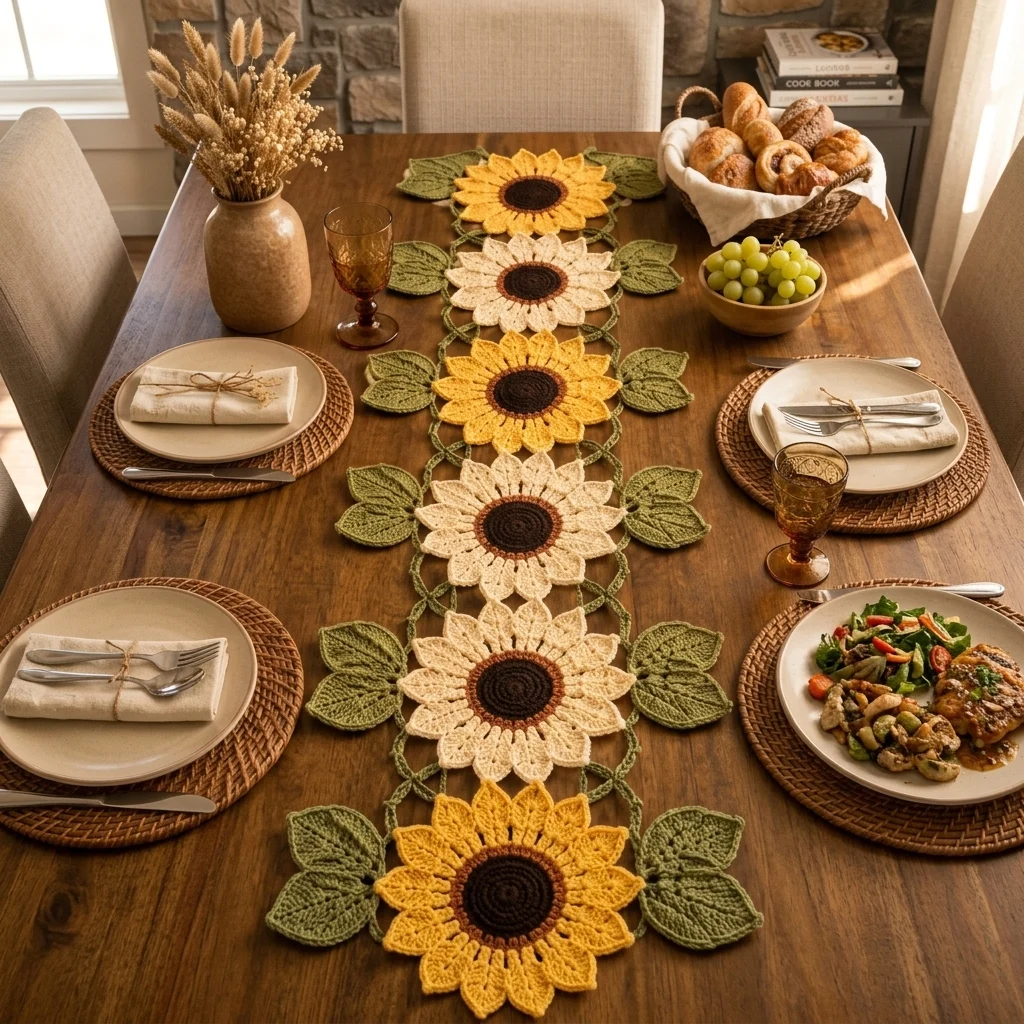
This crochet sunflower table runner pattern joins 6 large sunflowers directly down a single line, alternating warm gold and soft cream petals, each built around a deep brown center ringed in rust. Pairs of pointed leaves flank every flower on both sides, connected to the main line by an open mesh chain rather than sewn on flat, so the whole runner has a light, airy quality despite the bold flowers running down its center.
What makes this design distinctive is the sunflower center: a full, richly textured dark brown disc surrounded by a thin rust ring, worked as two color rounds rather than a single flat circle, giving each flower a realistic sunflower look rather than a generic round center. Connecting the flanking leaf pairs to the main flower line with open mesh chains, instead of joining them directly, is what gives the runner its structured-but-airy character; the leaves read as growing outward from the vine rather than being packed tightly against it. Expect to spend 18-22 hours total across 6 sunflowers and 24 leaves.
This is an advanced pattern, best suited to someone comfortable managing multi-round color changes at each flower center and confident joining motifs through connecting mesh chains, rather than someone wanting a single flat technique throughout.
Materials
- Worsted weight cotton yarn, mustard gold ~60g, 3 sunflowers
- Worsted weight yarn, cream ~60g, 3 sunflowers
- Worsted weight yarn, dark brown ~40g, flower centers
- Worsted weight yarn, rust orange ~15g, center rings
- Worsted weight yarn, sage green ~70g, leaves and connecting mesh
- Crochet hook 4 mm (US G/6)
- Tapestry/yarn needle
- Steam iron and pressing cloth, or blocking mat and pins
- Sharp scissors
Abbreviations
chchainsl stslip stitchscsingle crochethdchalf double crochetdcdouble crochetMRmagic ringincincrease (2 sc in one st)ch-spchain spacest(s)stitch(es)reprepeatFOfasten offSunflower Center (make 6)
- Round 1, with dark brown: 8 sc in MR. (8 sts)
- Round 2: inc in each st around. (16 sts)
- Round 3: *sc 1, inc; rep from * around. (24 sts)
- Round 4, with rust orange: sc around even, working in a slightly raised texture round to form a thin ring separating the dark center from the petals. (24 sts)
- FO leaving a short tail. Repeat for 6 centers total.
Sunflower Petals (make 6: 3 mustard gold, 3 cream)
- With petal color, join in any st of the finished center. Round 1 (inner petals): *ch 3, sl st in 2nd ch from hook, sc in next ch, sl st in same base st; rep from * around all 24 sts. 24 small petals.
- Round 2 (outer petals): join petal color behind Round 1, in the base sts between inner petals. *ch 5, sl st in 2nd ch from hook, sc 2, hdc 1, sl st in same base st; rep from * around. 24 longer petals layered behind the first.
- FO leaving a long tail for joining to the next flower. Fold outer petals slightly back from inner ones for dimension. Repeat for all 6 flowers, alternating gold and cream.
Joining the Sunflowers
- Lay the 6 sunflowers in a single vertical line, alternating gold and cream.
- Using the long tail from each flower’s outer petal round, whipstitch the bottom edge of one flower to the top edge of the next, overlapping the outer petals by 2-3 cm so the seam disappears under the petals.
- Continue until all 6 flowers are joined into one continuous strip.
Leaf Motif (make 24, in sage green)
- Ch 9. Starting in 2nd ch from hook: sl st, sc 2, hdc 2, dc 2, 3 dc in last ch.
- Continue down the other side: dc 2, hdc 2, sc 2, sl st in last ch.
- FO leaving a short tail for attaching. Repeat for 24 leaves total, 4 per sunflower (2 pairs).
Connecting Mesh Chains
- With sage green, at each sunflower’s side, work a short chain of approximately 8-10 sts outward from the joined flower line, then work a leaf onto the end of that chain.
- From the same point, work a second, slightly different-length chain to a second leaf position just below or beside the first, forming an open, criss-crossing mesh connection between the flower line and each leaf pair.
- Repeat this connecting mesh chain on both sides of every sunflower, so each flower has 2 leaves flanking it on the left and 2 on the right, all attached via open chain rather than direct joining.
Finishing
Once every leaf and connecting chain is in place, weave in all yarn tails at the base of each leaf and at the flower joins. Give the whole runner a light steam, keeping the sunflower petals spread and slightly domed rather than pressed flat, and gently opening the connecting mesh chains so they don’t look pulled tight. Let it dry completely flat before moving it to the table.
Tips for Success
- Keep the rust ring round at Round 4 of the center consistent in width across all 6 flowers; an uneven ring is very noticeable once flowers are joined in a line.
- Overlap flower joins generously, 2-3 cm, so the seam disappears fully under the petals rather than leaving a visible gap.
- Vary the connecting mesh chain lengths slightly between the 4 leaves at each flower, rather than making them all identical, for a more natural, less mechanical look.
- Fold outer sunflower petals back deliberately after attaching; this is what gives each flower real depth rather than a flat appearance.
- Block the joined flower strip before adding leaves and connecting chains, so the base line sits flat and even before you build outward from it.
Common Mistakes to Avoid
- Joining flowers with too little overlap leaves a visible bare seam between blooms. Fix: increase the overlap to 2-3 cm and recheck that petals fully hide the join.
- Working all 4 connecting mesh chains at each flower to the exact same length looks stiff and repetitive. Fix: vary chain length slightly leaf to leaf.
- Alternating gold and cream inconsistently breaks the clean color rhythm shown in the photo. Fix: strictly alternate colors flower to flower down the whole line.
- Skipping the rust ring round at the center makes the flower look flatter and less realistic. Fix: work Round 4 in rust orange as a distinct textured round before starting petals.
- Pulling connecting mesh chains too tight during blocking collapses the open, airy look. Fix: gently open and pin the chains rather than steaming them flat.
Ways to Customize This Pattern
- Reduce to 4 sunflowers for a shorter runner suited to a smaller table.
- Use a single petal color throughout instead of alternating gold and cream for a more cohesive, monochrome look.
- Skip the leaf pairs and connecting mesh for a simpler, flower-only strip.
- Swap the sage green leaves for a deeper forest green for a moodier palette.
- Add a small crocheted bud or berry at each connecting chain’s midpoint for extra detail.
Frequently asked questions
This depends on how far you want the leaves to sit from the flower line. Block one flower and one test leaf first, then work a chain to the distance that looks balanced against your own finished pieces rather than a fixed measurement.
Yes, though the runner will look denser and less airy. If you skip the connecting chains, whipstitch each leaf directly to the flower’s outer petal edge instead.
24 gives every sunflower 2 leaves on each side, matching the photo. Reduce to 1 leaf per side if you’d like a lighter, less leaf-heavy look, or add a third for a fuller runner.
This usually means Round 4’s rust ring was worked in the same stitch as the rounds before it. Work this round slightly more textured, such as in back loop only, to create visible separation between the dark center and the ring.
The finished Alternating Sunflower Table Runner Crochet Pattern