Autumn Maple Leaf Table Runner Crochet Pattern
Beginner Friendly
Perfect for those just starting their crochet journey, with clear instructions and simple techniques
Single-Day Project
A satisfying project you can complete in a single afternoon or evening.
Handmade Gift
A beautiful keepsake — free forever. Read online or print at home.
About This Autumn Maple Leaf Table Runner Crochet Pattern
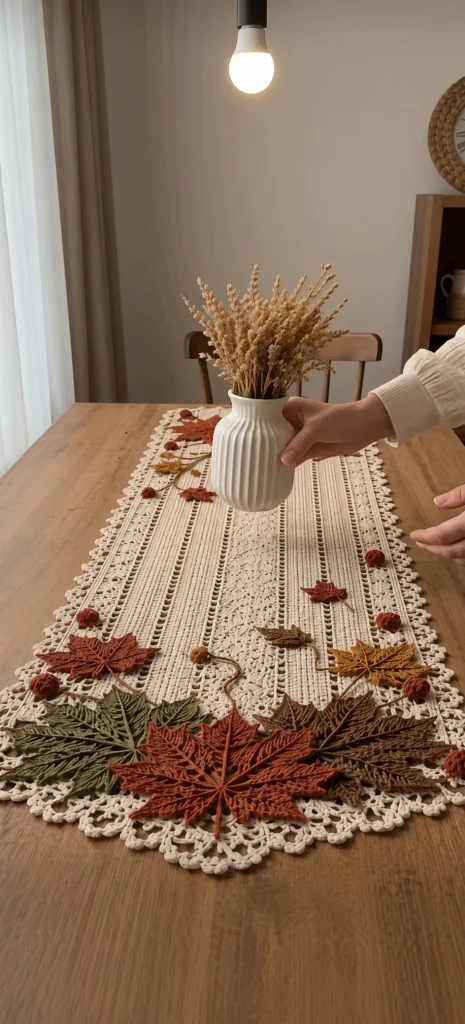
This autumn table runner crochet pattern gives you a cream lace runner with a puffed center panel, a scalloped five-round border, and a scatter of veined maple leaves and knobbly berries in rust, olive, brown and mustard. It is made to sit on the table from the first cool evening through Thanksgiving.
What sets it apart is how the leaves are built. Each maple leaf is worked as separate pointed lobes that overlap at the base, with a slip-stitch vein down every lobe. The tips stay sharp and the leaves sit slightly raised off the lace. The runner itself is worked lengthwise in bands of mesh and solid double crochet around a puff-stitch center, which gives the long slotted lines you can see in the finished piece.
Plan on 20 to 25 hours over a few weekends: about 15 for the runner and border, and 6 to 8 for the leaves and berries. The pattern is written for confident crocheters who are comfortable working to exact stitch counts, decreasing at both ends of a row, and stitching on appliqué. If you have made a lace doily or a leaf motif before, you will be fine.
Materials
- DK weight mercerized cotton, cream (main color) about 500 m / 550 yd
- DK cotton, rust about 45 m / 50 yd
- DK cotton, olive green about 20 m / 22 yd
- DK cotton, chocolate brown about 25 m / 27 yd
- DK cotton, mustard about 25 m / 27 yd
- DK cotton, brick red about 15 m / 16 yd
- 3.0 mm crochet hook
- Polyester fiberfill a small handful, for 8 berries
- Tapestry needle
- Sewing needle and cream sewing thread for tacking the leaves down
- Stitch markers at least 4
- Blocking mat and rustproof pins about 60 pins
- Gauge 18 dc = 10 cm; about 9 rows of dc = 10 cm
Abbreviations
chchainsl stslip stitchst(s)stitch(es)spspacescsingle crochethdchalf double crochetdcdouble crochetinc2 sc in the same stitchsc2togsingle crochet 2 together (decrease)hdc2togyo, insert hook in next st, pull up a loop, insert hook in next st, pull up a loop, yo and pull through all 5 loops (decrease)PFpuff stitch: [yo, insert hook in st, pull up a loop to the height of a dc] 3 times in the same st, yo and pull through all 7 loops, ch 1 to lock. The locking ch is the ch-1 sp after the puff.bobbobble: 4 unfinished dc in the same st, yo and pull through all 5 loops. Counts as 1 st.picotch 3, sl st in the first chMRmagic ringRunner Body
Every row after Row 1 starts with ch 3 (counts as a dc), and you turn at the end of every row. The last dc of each row goes in the top of the previous row’s turning ch. List numbers match row numbers. Every row has 163 stitch positions.
Solid row: ch 3, dc in each st and each ch-1 sp across, dc in top of turning ch (163 dc).
Mesh row: ch 3, (ch 1, skip next st or ch-1 sp, dc in next st) 81 times (82 dc, 81 ch-1 sps).
PF row: ch 3, ch 1, skip 1 st, (PF in next st, skip 1 st) 80 times, dc in top of turning ch (2 dc, 80 PF, 81 ch-1 sps).
All PF rows are odd-numbered, so the puffs all face the same side. That side is the front.
- Ch 165. Dc in 4th ch from hook and in each ch across (163 dc, counting the 3 skipped chs as the first dc). Turn.
- Mesh row (82 dc, 81 ch-1 sps).
- Solid row (163 dc).
- Mesh row.
- Solid row.
- Mesh row.
- Solid row.
- Solid row.
- PF row (80 PF).
- Solid row: dc in each PF and each ch-1 sp (163 dc).
- PF row.
- Solid row.
- PF row.
- Solid row.
- PF row.
- Solid row.
- PF row.
- Solid row.
- PF row.
- Solid row.
- Solid row.
- Mesh row.
- Solid row.
- Mesh row.
- Solid row.
- Mesh row.
- Solid row (163 dc). Fasten off.
Lace Border
Work with the puff side facing you. The four corner sts are the end sts of Row 1 and Row 27. In Round 1, place a marker in the middle sc of each 3-sc corner (the corner peak). In Round 2, move each marker up into the peak sc so you can check every side lands exactly on a marker.
- Join cream with a sl st in a corner st. Ch 1, 3 sc in the same st (the middle sc is the peak). Sc in each of the next 161 sts along the long edge, 3 sc in the corner st. Work 49 sc down the short edge: 2 sc in each row-end of Rows 26 to 2, except work only 1 sc in the row-end of Row 14. 3 sc in the corner st. Sc in each of the next 161 sts, 3 sc in the corner st, then 49 sc along the last short edge as before. Join with a sl st in the first sc (432 sc). On the foundation edge, work each sc at the base of the matching Row 1 st, into the unused loops of the foundation ch.
- Sl st in the next sc (corner peak). Ch 1, sc in the same sc, ch 5, sc in the same sc (corner arch). (Ch 5, skip 3 sc, sc in next sc) 41 times; the last sc lands in the next corner peak. Ch 5, sc in the same peak (corner arch). (Ch 5, skip 3 sc, sc in next sc) 13 times, landing in the next peak. Ch 5, sc in the same peak. (Ch 5, skip 3 sc, sc in next sc) 41 times, landing in the next peak. Ch 5, sc in the same peak. (Ch 5, skip 3 sc, sc in next sc) 12 times, then ch 5, skip 3 sc, sl st in the first sc of the round (112 ch-5 arches).
- Ch 3 (counts as dc), 4 dc in the first ch-5 arch, sc in next sc. (5 dc in next arch, sc in next sc) 111 times. Join with a sl st in the top of the beginning ch 3 (112 shells of 5 dc).
- Sl st in each of the next 2 dc to reach the center (3rd) dc of the first shell. Ch 1, sc in the same st. (Ch 7, sc in the center dc of the next shell) 111 times. Ch 7, sl st in the first sc (112 ch-7 loops).
- Ch 1, then work (sc, hdc, 2 dc, picot, 2 dc, hdc, sc) in the first ch-7 loop and in each ch-7 loop around (112 fans). Join with a sl st in the first sc. Fasten off.
Maple Lobe A (make 3)
Make 1 each in rust, olive and chocolate brown. This is the tall center lobe of each large leaf. Turn each row with ch 2, which does not count as a st. Leave a 20 cm tail at the start for sewing.
- Ch 10. Hdc in 3rd ch from hook and in each ch across (8 hdc). Turn.
- Hdc in each st (8).
- Hdc2tog, hdc in next 4, hdc2tog (6).
- Hdc in each st (6).
- Hdc in each st (6).
- Hdc2tog, hdc in next 2, hdc2tog (4).
- Hdc in each st (4).
- Hdc in each st (4).
- Hdc2tog twice (2).
- Hdc in each st (2).
- Hdc2tog (1). Fasten off and weave in the tip end.
Maple Lobe B (make 8)
Make rust 3, olive 2, chocolate brown 2 and mustard 1. These are the side lobes of the large leaves and the center lobe of each medium leaf. Turn each row with ch 2 (does not count). Leave a 20 cm tail at the start.
- Ch 8. Hdc in 3rd ch from hook and in each ch across (6 hdc). Turn.
- Hdc in each st (6).
- Hdc2tog, hdc in next 2, hdc2tog (4).
- Hdc in each st (4).
- Hdc in each st (4).
- Hdc2tog twice (2).
- Hdc in each st (2).
- Hdc2tog (1). Fasten off and weave in the tip end.
Maple Lobe C (make 16)
Make rust 4, olive 2, chocolate brown 5, mustard 2 and brick red 3. These are the lower lobes of the large leaves, the side lobes of the medium leaves, and all three lobes of each small leaf. Turn each row with ch 2 (does not count). Leave a 15 cm tail at the start.
- Ch 6. Hdc in 3rd ch from hook and in each ch across (4 hdc). Turn.
- Hdc in each st (4).
- Hdc2tog twice (2).
- Hdc in each st (2).
- Hdc2tog (1). Fasten off and weave in the tip end.
Veins and Leaf Assembly
Leaf plan: 3 large leaves (rust, olive, brown), 2 medium leaves (mustard, rust) and 2 small leaves (brick red, brown). Every large leaf uses 1 lobe A, 2 lobes B and 2 lobes C. Every medium leaf uses 1 lobe B and 2 lobes C. Every small leaf uses 3 lobes C.
- Veins: on each lobe, insert the hook between the two center sts of the first row and pull up a loop of the same color. Sl st in the gap between the center sts of each row up the lobe, holding the yarn at the back. Work 9 sl st on lobe A, 6 on lobe B and 3 on lobe C, stopping 2 rows short of the tip. Fasten off and weave in the ends.
- Large leaf: lay lobe A pointing up. Place a lobe B on each side about 45 degrees from A, and a lobe C on each side about 110 degrees from A, all bases meeting at one hub point and overlapping by about 1 cm. Pin.
- Using the starting tails, whip stitch the overlapping bases together. Then whip stitch neighboring lobes together along their edges for the first 3 rows so the middle of the leaf looks webbed. Leave the rest of each edge free so the points stand out.
- Medium leaf: place lobe B pointing up with a lobe C on each side about 70 degrees away. Join as in step 3.
- Small leaf: place one lobe C pointing up with another C on each side about 70 degrees away. Join as in step 3.
- Sew one curly stem (next section) to the hub of each leaf on the wrong side, using the stem tail.
Curly Stems (make 7)
Make one in the color of each leaf.
- Ch 21.
- 2 sc in 2nd ch from hook and 2 sc in each ch across (40 sc). Fasten off, leaving a 15 cm tail. The stem will curl on its own.
Berries (make 8)
Make 6 in rust and 2 in mustard. Work in a spiral without joining, and mark the first st of each round.
- 6 sc in MR (6).
- Inc in each st (12).
- (Sc in next st, inc in next st) 6 times (18).
- Sc in each st (18).
- (Sc in next 2 sts, bob in next st) 6 times (18).
- Sc in each st (18).
- (Sc in next st, sc2tog) 6 times (12). Stuff firmly.
- Sc2tog 6 times (6). Fasten off, leaving a 15 cm tail. Thread the tail through the front loops of the last 6 sts and pull tight to close.
- Berry stem: join the same color at the top of the berry, ch 9, sl st in 2nd ch from hook and in each ch across (8 sl st). Fasten off, leaving a tail for sewing.
Finishing
Weave in all ends. Wet-block the runner: soak it in lukewarm water, press out the water without wringing, and pin it to a blocking mat at about 100 x 40 cm. Pin every arch point and every fan picot along the border so the scallops open evenly, and let it dry completely. Block the leaves too: pin the tips of each lobe out flat, mist or steam lightly, and let dry so the points stay crisp and the hubs stop curling.
Lay the runner flat and arrange the leaves at one end. Center the large rust leaf on the border, put the olive leaf to its left, and tuck the brown leaf slightly under the rust on the right. Place the two medium leaves above the cluster. Scatter the small leaves and berries toward the far end and along the sides, and let the curly stems trail in loose curves. Tack each leaf down at the hub and at two or three tips with tiny stitches in cream sewing thread, catching only the top of the lace so nothing shows underneath. Sew each berry on through its stem base.
Tips for Success
- Put a removable marker at every 20th chain of the foundation, then recount after Rows 1, 2 and 9. A single missed stitch out of 163 skews the mesh in every row that follows.
- On a mesh row you should end with exactly 82 dc. On the solid row above a mesh row, remember every ch-1 sp gets a dc. That is where most miscounts happen.
- Keep the corner markers in place through Rounds 1 and 2. If a side does not land on its marker, you catch the error before it reaches the shells.
- Pin each lobe flat and steam it before joining. Blocked lobes sew together neatly, and the points stay sharp.
Common Mistakes to Avoid
- A tight foundation chain makes the bottom edge pucker and the runner bow. Chain over a 3.5 mm hook, or your loosest tension, and check that Row 1 measures about 90 cm.
- Puffs of uneven height look messy. Pull every loop up to the height of a dc, and keep all PF rows on the odd rows so the puffs face the same way.
- Forgetting the last dc in the turning ch leaves you with 162 sts, and the mesh drifts sideways. Count at the end of every row until the rhythm is automatic.
- A border side that misses its corner marker usually means Round 1 is off. Recount 161 sc per long edge and 49 per short edge (including the single sc at Row 14), and rip back rather than forcing it.
- Sewing the lobes together tightly at the hub makes the leaf cup like a cone. Leave a little slack and lay the leaf flat to check before finishing the seam.
Ways to Customize This Pattern
- Swap the palette: pumpkin, sage and cranberry for Thanksgiving, or ivory and gold leaves on a white runner for winter.
- Make a matching placemat: chain 85 (83 dc) and keep 27 rows. Work 40 PF in the PF rows, 81 sc between corners in Round 1, and 21 arches along each long side in Round 2 (72 arches in all, so Rounds 3 to 5 each repeat 71 times before closing).
- For a lighter, faster runner, replace the puff rows (Rows 9 to 19) with alternating mesh and solid rows. The stitch counts stay the same.
- Sew snap fasteners onto the leaf hubs and tips so the leaves come off for washing.
- Sew a small leaf and two berries onto a crocheted band to make matching napkin rings.
Frequently asked questions
Yes, with precautions. Rust, brick red and brown cotton can bleed onto the cream, so soak a scrap of each color in warm water first. If the water runs, wash and rinse that yarn alone until it is clear before stitching it on. Hand wash the finished runner in cool water, press out the water without wringing, and re-block it flat. If you plan to wash it often, sew the leaves on with snap fasteners so they can be removed.
Change the length in multiples of 4 stitches: the stitch count must stay odd, and the count plus 1 must divide by 4 (167, 171 and so on). Each extra 4 sts means chaining 4 more, working 2 more PF in the puff rows, and adding one arch to each long side in Round 2. Change the width by adding or removing pairs of rows in the center panel (one PF row and one solid row). Each pair adds 4 sc to each short edge in Round 1 and one arch to each short side in Round 2. Adjust the repeat counts in Rounds 3 to 5 to match the new arch total.
Yes. The stitch counts do not change, only the size. With size 10 crochet cotton and a 1.75 mm hook, expect a runner of roughly 60 x 22 cm. Use the length adjustment above if you want it longer.
Working each lobe on its own lets every point decrease down to a single stitch, which keeps the tips sharp, and gives each lobe its own slip-stitch vein. Overlapping the bases at the hub also gives the leaf a slightly raised, natural shape that a flat single-piece leaf does not have.
The finished Autumn Maple Leaf Table Runner Crochet Pattern