Black Floral Square Crochet Blanket Pattern
Beginner Friendly
Perfect for those just starting their crochet journey, with clear instructions and simple techniques
Single-Day Project
A satisfying project you can complete in a single afternoon or evening.
Handmade Gift
A beautiful keepsake — free forever. Read online or print at home.
About This Black Floral Square Crochet Blanket Pattern
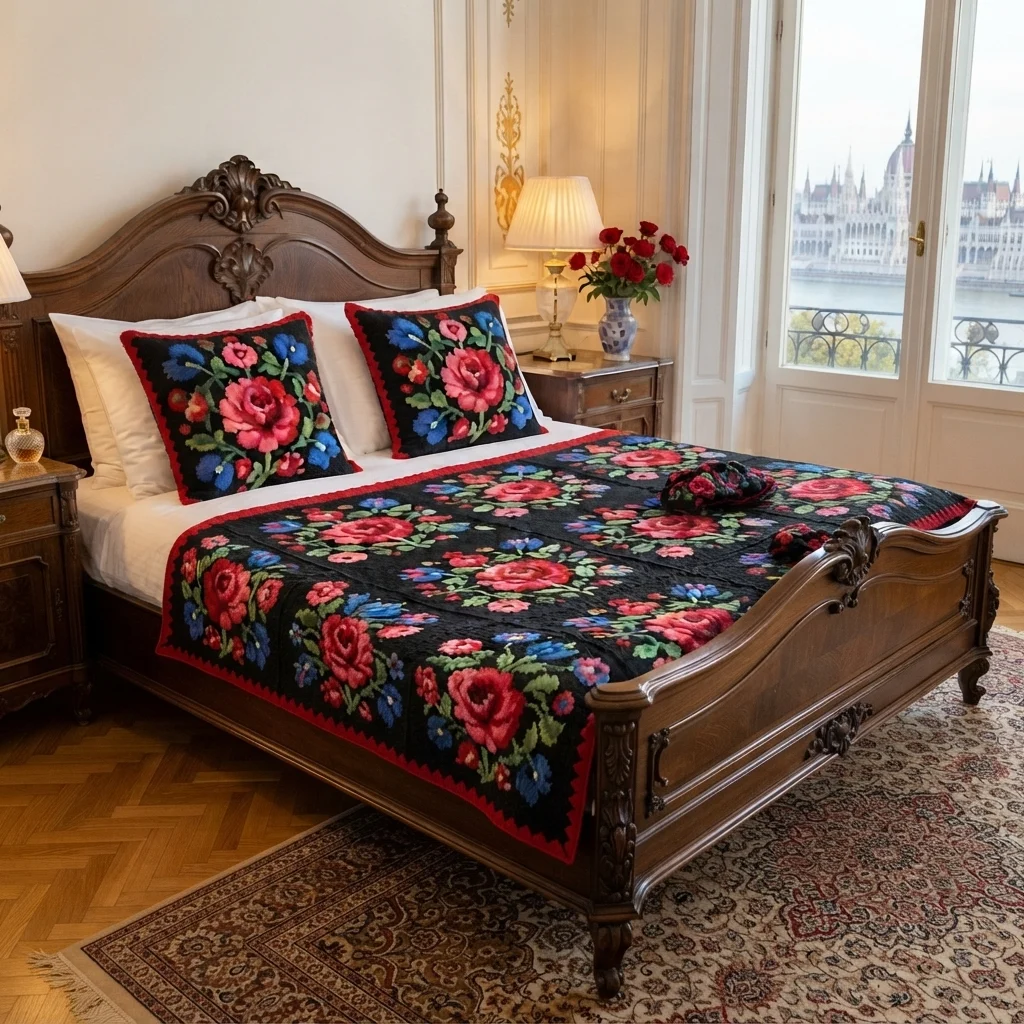
This floral crochet blanket pattern builds a dramatic black throw from 20 plain squares, each carrying a garden of crocheted flowers in red, pink and blue with green leaves. The dark background makes the colors glow, and the result looks like a folk-art floral print, much like the bedspread in the photo.
It is an advanced pattern because of the volume and the finishing. The squares are simple single crochet, but you will make 20 ruffled roses, 20 blue flowers, 20 pink flowers, 20 buds and 80 leaves, then sew every piece on by hand and join the squares with neat seams. Plan on 45 to 55 hours in total, with about 20 of them spent on the flowers.
It suits crocheters who are comfortable with small shaped pieces and careful placement, and who want a rich, romantic throw for a bed with dark wood and white linen. The finished blanket is about 152 x 188 cm, and you can resize it by adding or removing whole squares.
Materials
- Chunky cotton-blend yarn, black (K) about 2.3 kg, estimated
- Chunky cotton-blend yarn, red (R) about 500 g, estimated, roses, buds and edging
- Chunky cotton-blend yarn, pink (P) about 150 g, estimated
- Chunky cotton-blend yarn, blue (U) about 150 g, estimated
- Chunky cotton-blend yarn, green (G) about 200 g, estimated
- Crochet hook 6.0 mm
- Polyester fiberfill a tiny amount for the buds
- Yarn needle
- Stitch markers and pins for placing the flowers and for joining
- Flat surface for blocking and layout
Abbreviations
MRmagic ringchchainscsingle crochetinc2 sc in the same stitchdecsingle crochet 2 stitches togetherhdchalf double crochetdcdouble crochetsl stslip stitchst(s)stitch(es)RSright sideFOfasten offKblack yarnRred yarnPpink yarnUblue yarnGgreen yarn( )xrepeat the stitches in brackets the number of times givenBlack Square (make 20, flat, K)
- Foundation: with K, ch 41. Sc in the 2nd ch from the hook and in each ch across (40). Ch 1 and turn at the end of every row (the ch 1 does not count as a stitch).
- Rows 2-40: sc in each st across (40). You now have 40 rows of 40 stitches. Do not FO.
- Round 1 (border): ch 1, work 3 sc in the corner st. Sc in each of the next 38 sts along the side, then work 3 sc in the next corner. Repeat for the other three sides, working 38 sc between the corner groups on every side (164). Join with a sl st to the first sc.
- Round 2: ch 1, sc in each st around, working 3 sc in the middle st of each 3-sc corner group. Join with a sl st, FO and weave in the ends (172). Each side now has 40 stitches between the corner groups.
- Check your square: it should be about as wide as it is tall. Block each square flat with a damp cloth and pin it to the same size as your test square. Let it dry fully.
Rose (make 20, R)
- Ch 37.
- Row 1: sc in the 2nd ch from the hook and in each ch across (36). Ch 1 and turn.
- Row 2 (petals): (sl st in the next st, 5 dc in the next st, sl st in the next st)x12 (12 petals, 36 sts used). FO leaving a tail of about 40 cm.
- Count your petals. There must be 12, all the same size.
- Roll the strip from the first petal, with the petals on the outside and the bottom edge level. Keep the center tight and let the outer petals open a little. Sew through the base every few stitches as you roll.
- Finish with a few stitches through the whole base and secure the tail on the back. The rose should be about 10 cm across and flat on the bottom.
Blue Flower (make 20, U)
- Round 1: 5 sc in MR (5)
- Round 2: inc x5 (10)
- Round 3 (petals): (sl st in the next st, 4 dc in the next st)x5 (5 petals, 10 sts used). Join with a sl st, FO leaving a long tail.
- With cream or pink yarn, make a French knot in the center and secure it on the back. The flower should be about 6 cm across.
Pink Flower (make 20, P)
- Round 1: 6 sc in MR (6)
- Round 2: inc x6 (12)
- Round 3 (petals): (sl st in the next st, 3 dc in the next st)x6 (6 petals, 12 sts used). Join with a sl st, FO leaving a long tail.
- With red yarn, make a French knot in the center. The flower should be about 5 cm across.
Bud (make 20, R)
- Round 1: 6 sc in MR (6)
- Round 2: inc x6 (12)
- Rounds 3-4: sc in each st around (12) for 2 rounds
- Round 5: dec x6 (6). Stuff with a tiny ball of fiberfill. FO leaving a long tail and close the hole. The bud should be about 3 cm across.
Leaf (make 80, G)
- Ch 8. Starting in the 2nd ch from the hook: sl st, sc, hdc, dc, hdc, sc, sl st (7 sts).
- FO leaving a tail of about 15 cm for sewing. Press each leaf flat with a damp cloth.
Flower Placement
- Lay a blocked square flat with the RS facing you. Number the stitches 1 to 40 from the right edge and the rows 1 to 40 from the bottom. Place every piece by its center.
- Rose: center on stitch 20, row 21.
- Blue flower: center on stitch 8, row 33 (upper left). Pink flower: center on stitch 33, row 8 (lower right). Bud: center on stitch 33, row 33 (upper right).
- Leaves: pin 4 leaves per square, 2 touching the rose (one at stitch 11, row 12 and one at stitch 29, row 29), 1 under the blue flower (stitch 8, row 26) and 1 beside the pink flower (stitch 26, row 8). Angle each tip away from the nearest flower at about 45 degrees.
- Step back and check that the squares on a few blocks look the same before you sew anything.
- Sew the leaves on first, with small stitches along their base and the first 2 cm of each side. Leave the tips loose so they lift slightly.
- Sew the buds, then the blue and pink flowers, then the rose last, with small stitches around the whole base of each piece. Weave all tails along the back of the square for at least 5 cm.
Blanket Layout
- Lay out 4 squares across and 5 squares down (20 squares in all).
- Turn every square the same way, with the rose slightly below the center and the blue flower at the upper left, so the pattern repeats in neat rows.
- Check from a few steps back that the roses line up in straight rows and columns before you start joining.
Joining
- Join the squares into 5 rows of 4. Hold two squares with wrong sides together and sc through the back loops of both, using K. Match the stitches one for one along each side, from the middle stitch of one corner group to the middle stitch of the next (42 stitches including both corners).
- Join the 5 rows to each other in the same way, matching the corners so the seams make a clean cross.
- Work the horizontal seams last so the vertical and horizontal seams meet flat at each corner.
- Weave in all ends.
Blanket Edging (K and R)
- Round 1 (K): join K in any outer corner. Ch 1 and sc evenly around the blanket, working 3 sc in each corner, one sc in each stitch along the edges and one sc in each seam where two squares meet. Join with a sl st and FO K.
- Rounds 2-4 (R): join R in the middle st of any corner group. Ch 1, sc in each st around, working 3 sc in the middle st of each corner group. Join with a sl st at the end of each round. FO after round 4 and weave in the end.
- Check your edging: the corners should lie flat without cupping or ruffling, and the border should be about 6 cm wide.
Finishing
Weave in all ends along the back, following the stitches for at least 8 cm. Block the blanket by laying it flat on towels, pinning the corners and edges to about 152 x 188 cm, and misting it with water. Keep the pins away from the flowers so you do not flatten the petals. Let it dry fully before moving it.
Check each flower for loose stitches and secure any petal that lifts too far. Drape the blanket with the head under the pillows and the foot hanging over the bed, and it will look like the photo.
Tips for Success
- Make one test square with all its flowers before you commit to all 20, and write down your hook size and measurements.
- Count the stitches at the end of every tenth row of each square. There should always be 40, or the seams will not line up.
- Make the flowers in batches of ten, one type at a time, so every piece in a batch comes out the same size.
- Use a thinner thread in the same color to sew on each piece, so the stitches sink in and stay hidden on the black.
- Block the squares before you sew the flowers on, and pin everything in place before you stitch.
Common Mistakes to Avoid
- Counting the ch 1 turning chain as a stitch makes the square 41 or 39 stitches wide. The ch 1 never counts.
- Working the rose petals tightly makes the strip curl and the rose look stiff. Keep each dc loose.
- Sewing the flowers only at the center lets the petals flap. Stitch around the whole base of every piece.
- Placing the pieces by eye makes the squares look uneven across the bed. Use the stitch and row numbers above.
- Joining with a tight seam makes ridges across the flowers. Use a loose stitch and match the seam tension to the squares.
Ways to Customize This Pattern
- Swap black for navy or deep charcoal and keep the same flowers for a softer look.
- Make the roses in cream or blush pink and the small flowers in yellow for a lighter palette.
- Make a baby blanket with 3 squares across and 3 down (9 squares), about 110 x 110 cm with the edging.
- Make matching pillow covers by sewing one finished square to a plain black back, with a red edging and a button closure.
- Make the blanket larger by adding one more column or one more row of squares (about 36 cm each), and edge it with the same 4 rounds.
Frequently asked questions
The amounts above are estimates of about 3.3 kg in all. Weigh your test square with all its flowers and leaves, multiply by 20, and add about 10 percent for the joining and the edging. Black makes up about 70 percent of the total.
Yes. Satin stitch and long and short stitch in the same colors give a flat look much closer to the photo. Use thick tapestry yarn and a blunt needle, and sketch the flowers on the squares with chalk first.
Yes. Each piece is a separate crocheted shape, so it needs stitching to stay in place. Sewing also lets you adjust the position of every flower.
With a washable cotton blend, wash it on a gentle cycle in cool water, press out the water without wringing, and lay it flat to dry. Black and red can bleed onto the lighter colors, so wash it with a color catcher the first time, and check that the flowers are sewn on securely before every wash.
The finished Black Floral Square Crochet Blanket Pattern