Burgundy and Gold Harlequin Crochet Blanket
Beginner Friendly
Perfect for those just starting their crochet journey, with clear instructions and simple techniques
Single-Day Project
A satisfying project you can complete in a single afternoon or evening.
Handmade Gift
A beautiful keepsake — free forever. Read online or print at home.
About This Burgundy and Gold Harlequin Crochet Blanket
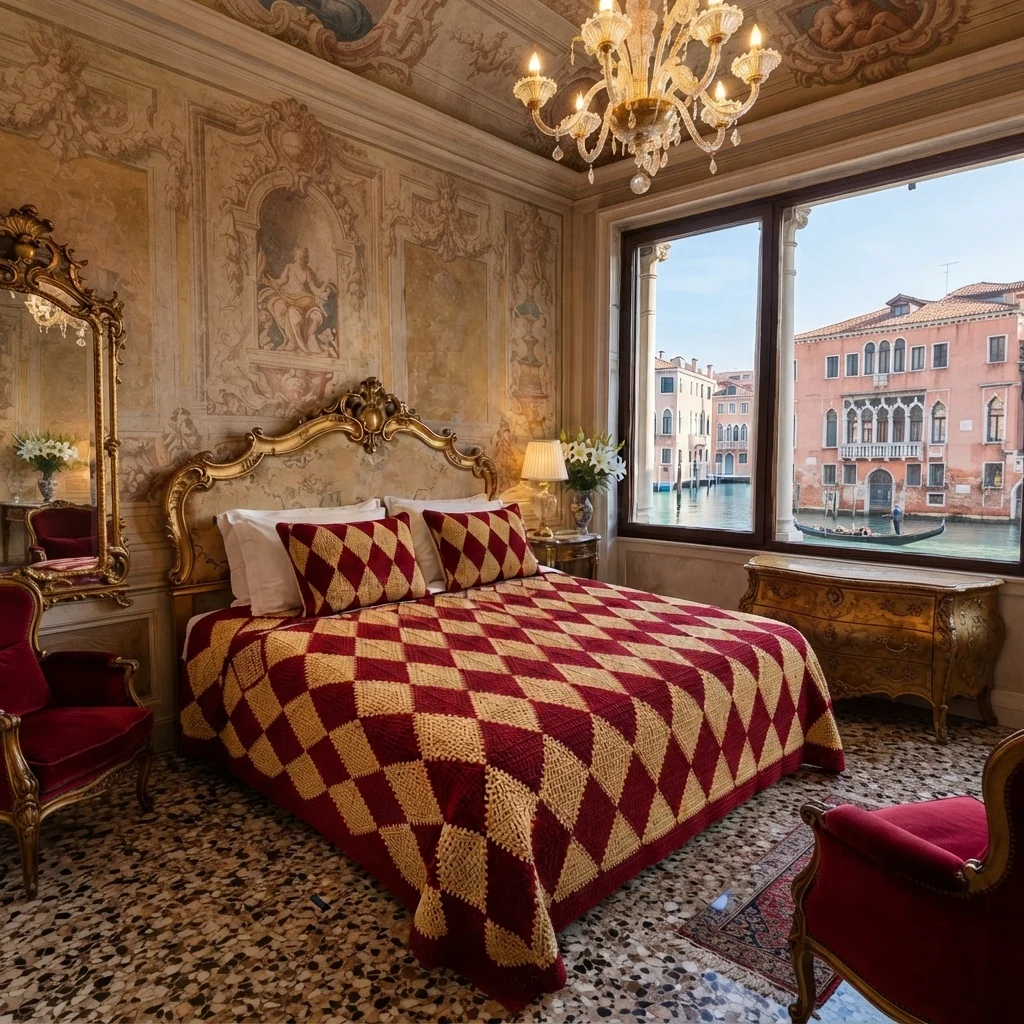
This harlequin crochet blanket pattern builds a rich burgundy and gold throw covered in large diamonds, the way a checkerboard looks when it is turned on its point. Each diamond is a single color, and the diamonds meet tip to tip, so the whole blanket reads as a grand, formal harlequin like the bedspread in the photo.
It is an advanced pattern because every row uses two colors. The blanket is worked in one piece in tapestry single crochet, 202 rows of 160 stitches, and a short run table tells you how many stitches to work in each color so the color changes slide one stitch sideways every two rows. That slide is what draws the diagonal lines. A burgundy border frames the finished blanket. Plan on 70 to 90 hours in total, since there are more than 32,000 stitches.
It suits crocheters who are comfortable carrying a second color and who enjoy a long, rhythmic project with a clear repeat. The finished blanket is about 155 x 178 cm, and you can change the width in steps of one diamond (20 stitches) and the length in steps of 40 rows.
Materials
- Chunky cotton-blend yarn, burgundy (B) about 1.5 kg, estimated
- Chunky cotton-blend yarn, antique gold (G) about 1.2 kg, estimated
- Crochet hook 6.5 mm
- Yarn needle
- Stitch markers one every 40 rows
- Flat surface and pins for blocking
Abbreviations
chchainscsingle crochetsl stslip stitchst(s)stitch(es)RSright sideFOfasten offBburgundy yarnGgold yarnB5, G10the number after the letter is how many sc to work in that color( )xrepeat the runs in brackets the number of times givenHow the Run Table Works
- Every row has 160 stitches. The ch 1 at the start of each row does not count as a stitch. Turn at the end of every row.
- Each row is a list of runs, in order, from one edge to the other. Every row reads the same from either end, so it does not matter whether it is a right-side or a wrong-side row.
- Change color on the last pull-through of the last stitch of a run. Drop the old color, pick the new color up from underneath it (this twists the two yarns and closes the gap), and carry the unused color loosely along the top of the stitches. Crochet over it.
- The runs are named by a number t, from 0 to 10. Each pair of rows uses one value of t. A table below gives the runs for every t.
- As t goes up from 0 to 10, the gold runs shrink and the burgundy runs grow. At t = 10 the whole row is burgundy. As t goes back down, the gold returns. That swelling and shrinking draws the diamonds.
Run Table (160 stitches in every row)
- t = 0: G160 (all gold)
- t = 1: B1, (G18, B2)x7, G18, B1
- t = 2: B2, (G16, B4)x7, G16, B2
- t = 3: B3, (G14, B6)x7, G14, B3
- t = 4: B4, (G12, B8)x7, G12, B4
- t = 5: B5, (G10, B10)x7, G10, B5
- t = 6: B6, (G8, B12)x7, G8, B6
- t = 7: B7, (G6, B14)x7, G6, B7
- t = 8: B8, (G4, B16)x7, G4, B8
- t = 9: B9, (G2, B18)x7, G2, B9
- t = 10: B160 (all burgundy)
- Check the table: every row adds up to 160. For example, t = 4 is 4 + 7 x (12 + 8) + 12 + 4 = 160, and t = 9 is 9 + 7 x (2 + 18) + 2 + 9 = 160.
Foundation and Pair Sequence
- Foundation: with G, ch 161.
- Each repeat of the pattern is 40 rows, which is 20 pairs of rows. Work each pair of rows with the value of t given in this sequence: 0, 1, 2, 3, 4, 5, 6, 7, 8, 9, 10, 9, 8, 7, 6, 5, 4, 3, 2, 1.
- Pair 1 is rows 1-2 (t = 0), pair 2 is rows 3-4 (t = 1), and so on up to pair 11, which is rows 21-22 (t = 10). Pair 12 is rows 23-24 (t = 9), and pair 20 is rows 39-40 (t = 1).
- Then start the next repeat at row 41 with t = 0 again.
Body (rows 1-202)
- Row 1 (t = 0): sc in the 2nd ch from the hook and in each ch across, in G (160). Ch 1 and turn.
- Row 2 (t = 0): sc in each st across, in G (160). Ch 1 and turn.
- Rows 3-4 (t = 1): work the runs for t = 1 in each row (160).
- Rows 5-40: continue through the pair sequence (t = 2 up to 10, then 9 down to 1), two rows for each value (160 in each row). Row 21-22 are all burgundy, and rows 39-40 have t = 1.
- Rows 41-200: repeat the 40-row sequence 4 more times (rows 41-80, 81-120, 121-160 and 161-200).
- Rows 201-202: work t = 0 once more (all gold, 160 in each row). Do not FO after row 202.
- Place a stitch marker in the turning chain of rows 40, 80, 120, 160 and 200 so you can check your length. After 40 rows the blanket should be about 33 cm tall, and the body should measure about 145 x 168 cm.
- Check your work: every row must have exactly 160 stitches. Each gold diamond is 20 stitches wide at its widest row and about 40 rows tall, and the diamonds line up in straight columns.
Burgundy Border
- Round 1: with the RS facing you and row 202 at the top, FO G and join B in the top right corner stitch. Ch 1 and work 3 sc in the corner st. Sc in each of the next 158 sts across the top. Work 3 sc in the last st (the top left corner).
- Work 200 sc evenly down the left side, one in each row end between the corners. Work 3 sc in the first stitch of the foundation chain (bottom left corner), 158 sc along the foundation edge, and 3 sc in the last stitch (bottom right corner). Work 200 sc evenly up the right side. Join with a sl st to the first sc (728).
- Rounds 2-6: ch 1, sc in each st around, working 3 sc in the middle st of each 3-sc corner group. Join with a sl st at the end of each round. Each round adds 8 stitches: round 2 has 736, round 3 has 744, round 4 has 752, round 5 has 760 and round 6 has 768.
- FO and weave in the end.
- Check your border: after round 6, the top and foot have 168 stitches between the corner groups, and each side has 210. The border should be about 5 cm wide, and the corners should lie flat without cupping or ruffling.
Finishing
Weave in all ends along the back of the stitches, following them for at least 8 cm. Because every row has a color change, join new balls of yarn only at the edge, at the end of a row, so the ends stay in the border.
Block the blanket by laying it flat on towels, pinning the corners and the edges to about 155 x 178 cm, and misting it with water. Let it dry fully before moving it. Blocking relaxes the carried yarn and straightens the diamond lines. Drape the blanket with the head under the pillows and the foot hanging over the bed, and it will look like the photo.
Tips for Success
- Write the table on a card and tick off each pair of rows. Keep a second card with the value of t for the next row.
- Count your stitches by runs. Each run is a small, quick count, and the 160 total checks itself.
- Keep the same tension on both colors and carry the unused color loosely. A tight carry puckers the blanket.
- Wind each color into a center-pull ball and keep the two balls on opposite sides of you so they do not tangle.
- Look at the blanket from a few steps back every 20 rows. Crooked diamonds are much easier to spot at a distance than up close.
Common Mistakes to Avoid
- Using the wrong value of t shifts the diagonal by one stitch and breaks the diamond. Tick off each pair, and place a marker every 40 rows.
- Forgetting to twist the two yarns at a color change leaves small holes between the runs. Pick the new color up from underneath every time.
- Pulling the carried yarn tight puckers the blanket and narrows it. Spread the stitches on your hook after every change.
- Counting the ch 1 as a stitch makes the rows 161 wide. The turning chain never counts.
- Working different corner counts in the border makes it ripple. Use exactly 3 sc in each corner stitch on every round.
Ways to Customize This Pattern
- Swap burgundy and gold for navy and cream, forest green and ivory, or charcoal and pale gray, and keep the same table.
- Make a baby blanket: ch 81 (80 stitches, 4 diamonds across) and use the runs B t, (G 20-2t, B 2t)x3, G 20-2t, B t for each t. Work 122 rows (3 repeats plus rows 121-122 at t = 0), about 73 x 100 cm before the border.
- Make a matching pillow cover: ch 41 (40 stitches, 2 diamonds across) with the runs B t, (G 20-2t, B 2t)x1, G 20-2t, B t. Work 42 rows (one repeat plus 2 rows at t = 0), add 3 border rounds, and sew the panel to a plain back.
- Work the border in gold, or work the last round in gold for a thin line, for a lighter frame.
- Add 40 rows to the length, or one more diamond (20 stitches) to the width, to fit a larger bed.
Frequently asked questions
The amounts above are estimates of about 1.5 kg of burgundy and 1.2 kg of gold. Weigh your swatch, scale it up by area, and add about 15 percent because carrying a second color uses extra yarn. The border and the unused carried strand both use more burgundy.
For width, add or remove 20 stitches at a time, which is one diamond, and add 7 repeated runs of (G 20-2t, B 2t) to each row for every extra 20. Keep the stitch count a multiple of 20, and chain the stitch count plus 1. For length, add or remove 40 rows at a time, and finish on a pair of t = 0 rows so the blanket ends with a gold line.
Rows with t = 0 are the widest line of the gold diamonds, where their tips touch, so the whole row is gold. Rows with t = 10 are the widest line of the burgundy diamonds, so the whole row is burgundy. Both rows mark the center line of a diamond.
With a washable cotton blend, wash it on a gentle cycle in cool water, press out the water without wringing, and lay it flat to dry. Dark burgundy can bleed onto the gold, so wash it with a color catcher the first time, and never hang a wet blanket this heavy.
The finished Burgundy and Gold Harlequin Crochet Blanket