Chunky Entrelac Bedspread and Cushions Crochet Pattern
Beginner Friendly
Perfect for those just starting their crochet journey, with clear instructions and simple techniques
Single-Day Project
A satisfying project you can complete in a single afternoon or evening.
Handmade Gift
A beautiful keepsake — free forever. Read online or print at home.
About This Chunky Entrelac Bedspread and Cushions Crochet Pattern
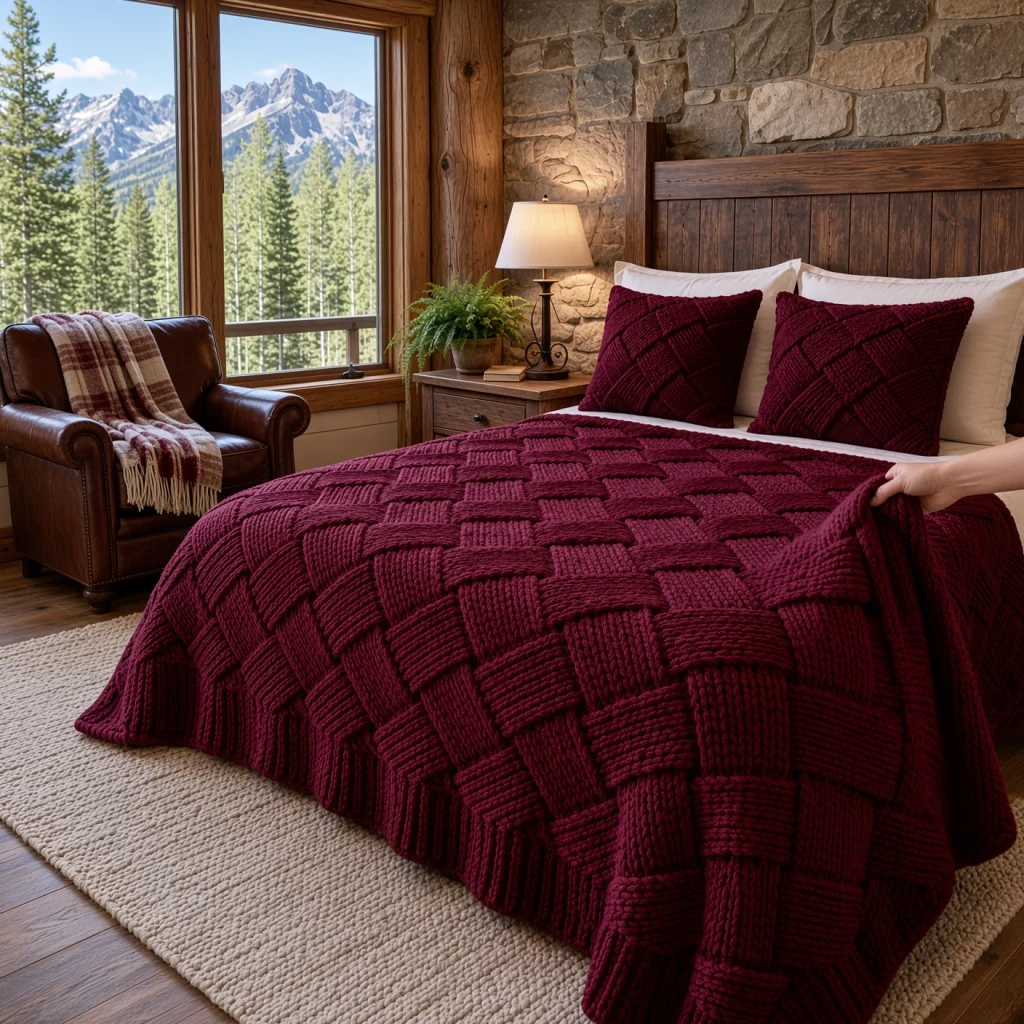
This entrelac crochet bedspread looks like a giant woven basket in chunky burgundy wool. Small blocks of Tunisian knit stitch lie at angles to each other, so the stitch columns change direction from block to block and the whole surface seems to weave over and under itself. Deep ribbed bands finish the foot and sides, and two square cushions repeat the woven pattern.
Instead of working the entrelac in one piece, which is hard to manage with super bulky yarn, the bedspread is built from identical Tunisian knit stitch squares. The squares are set on point and every second one is turned a quarter turn, which recreates the woven entrelac look. Half and quarter triangles fill the edges so the bedspread comes out straight. Tunisian knit stitch looks almost exactly like knitting, which gives the bedspread its knitted, chunky texture.
The bedspread takes about 110 to 130 hours. With super bulky yarn and a big hook, each square works up in around 25 minutes, and most of the remaining time goes into seaming. It suits a crocheter who knows basic Tunisian crochet and is happy to do a lot of careful sewing.
Materials
- Super bulky wool blend, burgundy about 4,000 m (50 skeins of 100 g / 80 m)
- 10 mm Tunisian crochet hook a standard length is fine; the squares are only 12 sts wide
- 10 mm standard crochet hook for the ribbed bands and cushion edges
- Large blunt tapestry needle with an eye big enough for super bulky yarn
- Locking stitch markers about 20
- Two 50 cm square cushion forms
Abbreviations
chchainscsingle crochetsl stslip stitchTKSTunisian knit stitch: insert hook from front to back between the front and back vertical bars of the next st, below the horizontal strands, and pull up a loopTKS2toginsert hook through the next 2 sts at once as for TKS and pull up one loop (decrease)incpull up a loop in the space between two sts (increase)BLOback loop onlyrev screverse single crochet (crab stitch), worked left to rightst(s)stitch(es)rndroundreprepeatRS / WSright side / wrong sideTunisian Knit Stitch Square (make 162)
- With the Tunisian hook, ch 12.
- Row 1: insert hook in 2nd ch from hook and pull up a loop, pull up a loop in each ch across, then work the return pass. (12 sts)
- Rows 2-10: TKS in each st across to the last st, insert hook under both strands of the last vertical bar and pull up a loop, then work the return pass. (12 sts)
- Bind off: sl st in each st across, inserting the hook as for TKS. Fasten off leaving a 50 cm tail for sewing.
- The square measures about 17 x 17 cm, with stitch columns running from the foundation chain to the bind-off edge.
Half Triangles (make 34)
- With the Tunisian hook, ch 3.
- Row 1: pull up a loop in 2nd ch from hook and in next ch, then work the return pass. (3 sts)
- Rows 2-10: TKS in each st across to the last st, inc in the space before the last st, work the last st under both strands, then work the return pass. (Row 2: 4 sts, and 1 more each row to Row 10: 12 sts)
- Bind off as for the square. Fasten off leaving a 40 cm tail.
- The triangle has one straight side (the row ends), one top edge of 12 sts and one slanted side. The slanted side goes along the edge of the bedspread.
Corner Triangles (make 4)
- With the Tunisian hook, ch 12.
- Row 1: work as Row 1 of the square. (12 sts)
- Rows 2-6: TKS2tog in the next 2 sts, TKS in each st to the last 3 sts, TKS2tog, work the last st under both strands, then work the return pass. (Row 2: 10 sts, Row 3: 8, Row 4: 6, Row 5: 4, Row 6: 2)
- Bind off and fasten off leaving a 30 cm tail.
- The foundation edge sews to the side of a square, and the two slanted sides make a bedspread corner.
Layout
- The squares are set on point, like diamonds, in alternating rows. Lay them out on a large floor before sewing anything.
- A rows: 9 squares in a row, points touching, with the stitch columns running up and to the right. There are 10 A rows. (90 squares)
- B rows: 8 squares fitted into the spaces between each pair of A rows, turned a quarter turn so their stitch columns run up and to the left. There are 9 B rows. (72 squares)
- Every square now touches four squares of the other direction, which creates the woven look.
- Foot and head: fill the 8 spaces between the A squares along the foot, and the 8 along the head, with half triangles, slanted side on the outer edge. (16 half triangles)
- Sides: fill the space at each end of every B row with a half triangle, slanted side on the outer edge. (18 half triangles) Turn the triangles so their stitch columns match the B squares.
- Corners: fill each of the four corners with a corner triangle. The finished body is a rectangle of about 216 x 240 cm.
Seaming
- Sew the pieces together in diagonal strips first: each strip is one line of squares running from one edge to the other, with the triangles at its ends.
- Hold two pieces RS together and whipstitch through the outer loops of each edge with the matching tail, keeping the stitches loose enough that the seam lies flat when opened.
- Then sew the strips to each other, matching the corners where four squares meet carefully.
- Press each seam open with your fingers as you go. On the RS the seams sink into the texture and the blocks look woven together.
Ribbed Bands
- Side bands (make 2): with the standard 10 mm hook, ch 12. Row 1: sc in 2nd ch from hook and in each ch across. (11 sc) Rows 2-252: ch 1, turn, sc in BLO of each st across. Fasten off. (11 sc in every row, about 12 x 252 cm)
- Foot band: ch 12. Row 1: sc in 2nd ch from hook and in each ch across. (11 sc) Rows 2-216: ch 1, turn, sc in BLO of each st across. Fasten off. (about 12 x 216 cm)
- The ridges of each row run across the band, so on the bed they form vertical ribs down the drop.
- Sew one long edge of the foot band to the foot edge of the bedspread.
- Sew one long edge of each side band to a side of the bedspread, starting at the head. The last 12 cm of each side band covers the end of the foot band; sew them together to close the corner.
Cushion Fronts (make 2)
- Each front uses 5 squares, 4 half triangles and 4 corner triangles.
- Lay out 2 rows of 2 A squares on point, with 1 B square in the middle where they meet.
- Fill the space in the middle of each outer edge with a half triangle, and each corner with a corner triangle.
- Sew together as for the bedspread. Each front measures about 48 cm square.
Cushion Backs (make 2)
- With the Tunisian hook, ch 34.
- Row 1: pull up a loop in 2nd ch from hook and in each ch across, then work the return pass. (34 sts)
- Rows 2-29: TKS in each st across to the last st, work the last st under both strands, then work the return pass. (34 sts)
- Bind off as for the square. The back measures about 48 cm square.
Cushion Assembly
- Hold a front and a back WS together, with the front facing you.
- Rnd 1: with the standard 10 mm hook, join in a corner through both layers. Working through both layers, 3 sc in each corner and 34 sc evenly along each side. Insert the cushion form before closing the last side. Join. (148 sts)
- Rnd 2: ch 1, rev sc in each st around. Join and fasten off. (148 sts)
- Rep with the second cushion.
Finishing
Weave in all ends on the WS, running them along the seams where the thick yarn hides them best. Split the plies of the wool as you weave so the ends don’t work loose.
Lay the bedspread flat and steam it lightly, without pressing, to settle the Tunisian stitches and relax the seams. Smooth each block with your hands so the columns run straight. Let it cool and dry flat before putting it on the bed.
Tips for Success
- Keep the forward pass loops loose and even. TKS is dense, and tight loops make the fabric stiff and curl badly.
- Always work the last st of each row under both strands of the edge bar. It keeps the side edges firm, which makes seaming much neater.
- Lay out the whole bedspread on the floor before sewing anything, and take a photo. It is the easiest way to keep track of which way each square should be turned.
- Mark the top edge of each square with a locking marker while laying out. It’s easy to rotate a square by mistake when picking it up to sew.
- Choose a wool blend rather than acrylic. Wool blocks beautifully and makes the woven texture look much crisper.
Common Mistakes to Avoid
- Squares that come out taller than wide. TKS rows are short and can stretch tall if your return pass is loose. Keep the return pass firm, or work one row fewer.
- Two squares with the same direction side by side. This breaks the woven look. Every square must touch only squares turned the other way.
- Triangles turned the wrong way. The slanted side must always face out, along the edge of the bedspread.
- Tight seams. A tight whipstitch puckers the chunky fabric. Leave the stitches relaxed so the seam opens flat.
- Ribbed bands that ruffle. If a band is longer than its edge, the ribs fold. Count the rows and check the band against the edge before sewing.
Ways to Customize This Pattern
- Use two colors: one for the A squares and one for the B squares, for a bold woven checkerboard.
- Change the size: each additional square in an A row adds about 24 cm in width, and each additional A row adds about 24 cm in length.
- Make a throw of 4 A squares across and 5 A rows long, about 96 x 120 cm, with a ribbed band all around.
- Use Tunisian simple stitch instead of TKS for a woven look with a flatter, smoother texture.
- Make the ribbed bands in a contrasting color, such as cream, for a modern frame.
Frequently asked questions
It recreates the entrelac look with separate squares instead of working tiers of blocks in one piece. The finished surface looks the same, but separate squares are much easier to make in super bulky yarn and to carry around.
TKS is worked through the fabric between the vertical bars, which creates V-shaped stitches just like knit stockinette. That’s what gives this bedspread its hand-knitted appearance.
In super bulky wool, expect around 5 kg. If that’s too heavy, use a bulky weight yarn with an 8 mm Tunisian hook and make the squares 14 sts by 12 rows to keep the same size.
If you used wool, hand wash in cool water or have it dry cleaned. Never machine wash or tumble dry a large wool bedspread, because it will felt and shrink. Dry it flat, supported along its whole length.
The finished Chunky Entrelac Bedspread and Cushions Crochet Pattern