Emerald Fish Scale Crochet Blanket Pattern
Beginner Friendly
Perfect for those just starting their crochet journey, with clear instructions and simple techniques
Single-Day Project
A satisfying project you can complete in a single afternoon or evening.
Handmade Gift
A beautiful keepsake — free forever. Read online or print at home.
About This Emerald Fish Scale Crochet Blanket Pattern
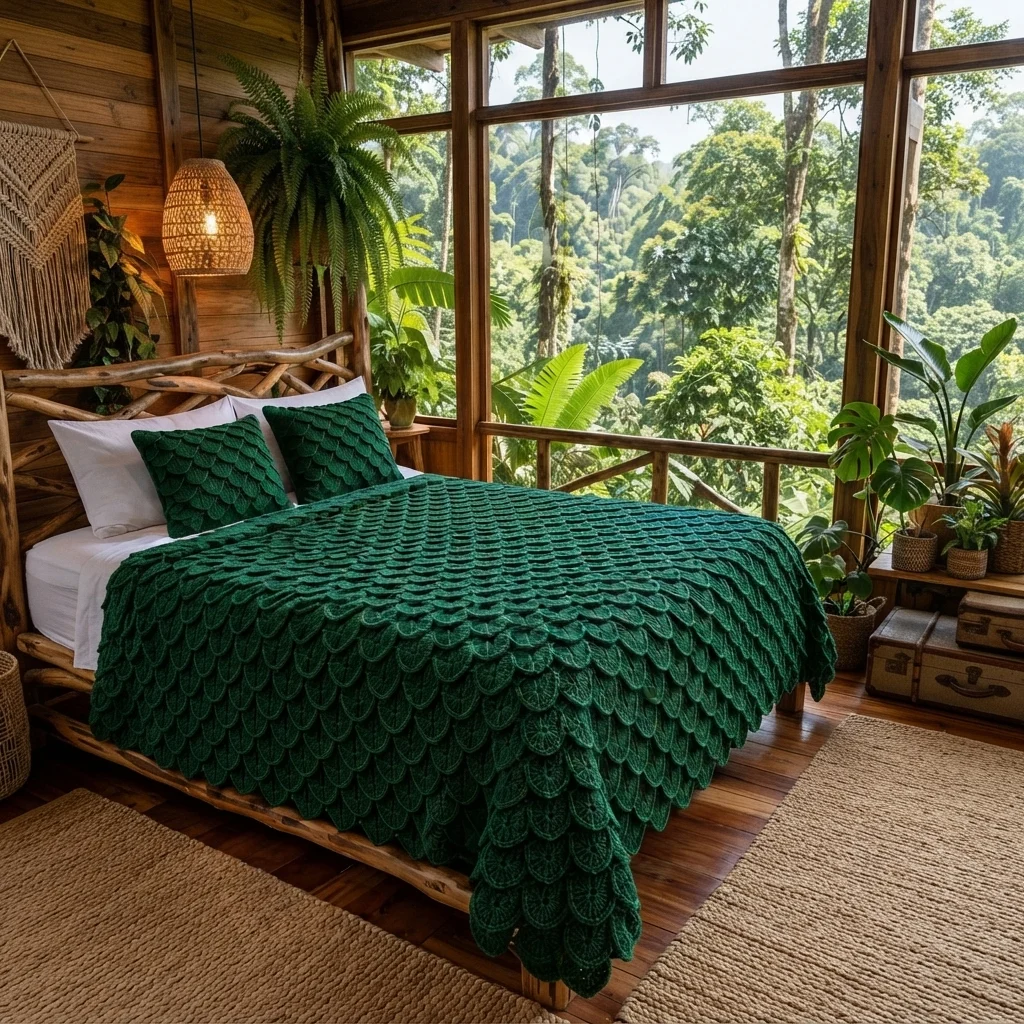
This fish scale crochet blanket pattern builds a deep emerald throw covered in rounded scales that overlap like roof tiles, with a scalloped edge hanging over the foot of the bed. The scales are fans of double crochet, and every second tier is shifted by half a scale, so the whole surface looks like the blanket in the photo.
It is an advanced pattern because of the length and the loop work. The blanket is worked in one piece from the head down, in 182 rows of 161 stitches, with fans worked into the front loops only and a separate ledge row between every tier. You have to keep the stitch count exact on every row, because a single skipped stitch moves the fans out of line. Plan on 55 to 65 hours in total.
It suits crocheters who are comfortable with double crochet, front loop only work and long projects, and who want a heavy, sculptural throw in one rich color. The finished blanket is about 146 x 190 cm, and you can change the width in steps of 8 stitches.
Materials
- Chunky cotton-blend yarn, emerald green about 4.5 kg, estimated
- Crochet hook 6.5 mm
- Yarn needle
- Stitch markers one every 10 tiers
- Flat surface and pins for blocking
Abbreviations
chchainscsingle crochetdcdouble crochetsl stslip stitchst(s)stitch(es)FLOfront loop only (the loop nearest to you)fan9 dc worked in the same stitchRSright sideWSwrong sideFOfasten off( )xrepeat the stitches in brackets the number of times givenHow the Scales Work
- Row 1 is the head of the bed, and the scales point toward the foot. Every row has 161 stitches.
- The blanket is made of tiers. Each tier is two rows: a fan row worked from the RS, and a ledge row worked from the WS.
- Fan rows are worked in the FLO of the row below. Work every stitch, including the skipped ones, into the same row, so the count stays at 161.
- Ledge rows are worked in dc into the loop of each stitch that the fans did not use. It is the loop nearest to you when the wrong side faces you.
- The fans fold down over the ledge row and hide it, which is what makes the scales overlap.
- Fan row A has 20 full fans. Fan row B is shifted by half a fan, so it has 19 full fans and a half fan (5 dc) at each edge. A and B alternate on every tier.
- The ch 2 at the end of a fan row is a turning chain and does not count as a stitch.
Foundation and Row 1
- Ch 162.
- Row 1 (WS): sc in the 2nd ch from the hook and in each ch across (161). Ch 1 and turn.
Scale Rows (4-row repeat)
- Row 2 (RS, fan row A): sl st in the FLO of the first st, (skip 3 sts, fan in the FLO of the next st, skip 3 sts, sl st in the FLO of the next st)x20 (20 fans, 161 sts used). Ch 2 and turn.
- Row 3 (WS, ledge row): dc in the unused loop of each st of the row below (161). Turn.
- Row 4 (RS, fan row B): 5 dc in the FLO of the first st, skip 3 sts, sl st in the FLO of the next st, (skip 3 sts, fan in the FLO of the next st, skip 3 sts, sl st in the FLO of the next st)x19, skip 3 sts, 5 dc in the FLO of the last st (19 full fans and 2 half fans, 161 sts used). Ch 2 and turn.
- Row 5 (WS, ledge row): dc in the unused loop of each st of the row below (161). Turn.
- Repeat rows 2-5 a total of 45 times (rows 2-181, which is 90 tiers).
- Row 182 (RS, final fan row): work row 2 once more. FO and weave in the end.
- Place a stitch marker in the first stitch of row 3 of every 10th tier (row 21, row 41 and so on) so you can check your length. After 10 tiers the blanket should be about 21 cm long.
- Check your work: every fan row uses exactly 161 stitches, every ledge row has exactly 161 dc, and the half fans in rows B sit at the very edges of the blanket.
Finishing
Weave in all ends along the back of the ledge rows, following the stitches for at least 8 cm. Join new balls of yarn at the end of a ledge row, so the ends sit at the edge and not under a fan.
Block the blanket gently. Lay it flat on towels, pin only the head edge and the sides, and steam it a few centimeters above the fabric without pressing, so the fans keep their shape. Let it dry fully. Drape the blanket with row 1 at the head and the scalloped last row hanging over the foot, and it will look like the photo.
Tips for Success
- Count the stitches at the end of every ledge row. There should always be 161, or the fans will drift out of line.
- Pull each dc of a fan up to the same height, so the fans are round and not lopsided.
- Work the ledge rows with a relaxed tension. A tight ledge pulls the fans up and shows the row behind them.
- Mark the RS with a stitch marker on row 2, since both sides of the ledge rows look similar.
- Wind the yarn into center-pull balls before you start. Chunky yarn tangles easily on a project this big.
Common Mistakes to Avoid
- Working a fan row in both loops locks the ledge loops and the scales stop overlapping. Always work fan rows in the FLO only.
- Working a ledge row in the same loops as the fans pulls the fans flat. Use the unused loop each time.
- Skipping 2 or 4 stitches instead of 3 between fans shifts every fan to the right or left. Count the skips on the first fan of each row.
- Repeating fan row A on every tier stacks the scales in straight columns. Alternate A and B.
- Forgetting the half fans at the edges of row B leaves a gap along the sides. Work 5 dc in the first and last stitch.
Ways to Customize This Pattern
- Swap emerald for navy, burgundy or charcoal, and use the same pattern for a different room.
- Make a baby blanket: ch 82 (81 sts, 10 fans in row A and 9 full fans in row B) and work 45 tiers, about 74 x 95 cm.
- Make a matching pillow cover: ch 50 (49 sts, 6 fans in row A and 5 full fans in row B), work 22 tiers and sew the panel to a plain back with a button closure.
- Change the yarn color every 5 tiers for an ombre version, from deep green to sage.
- Work each fan row in a contrasting color, such as cream, for a two-tone scale effect.
Frequently asked questions
The amount above is an estimate of about 4.5 kg, based on roughly 45 meters of chunky yarn per tier. Weigh your swatch, scale it up by the number of tiers, and add about 10 percent. Scale blankets use much more yarn than a flat dc blanket.
Add or remove 8 stitches at a time, which gives one more or one fewer fan in each row. The stitch count must always be a multiple of 8 plus 1, and the foundation chain is the stitch count plus 1. Row B always has one fewer full fan than row A.
Working in the front loop leaves the back loop free, and the next ledge row is built on those free loops. This is what lifts the fans away from the fabric and lets them fold down over the row below.
With a washable cotton blend, wash it on a gentle cycle in cool water, press out the water without wringing, and lay it flat to dry. A wet blanket this heavy stretches if you hang it, and it can take several days to dry fully.
The finished Emerald Fish Scale Crochet Blanket Pattern