Four Seasons Floral Crochet Table Runner
Beginner Friendly
Perfect for those just starting their crochet journey, with clear instructions and simple techniques
Single-Day Project
A satisfying project you can complete in a single afternoon or evening.
Handmade Gift
A beautiful keepsake — free forever. Read online or print at home.
About This Four Seasons Floral Crochet Table Runner
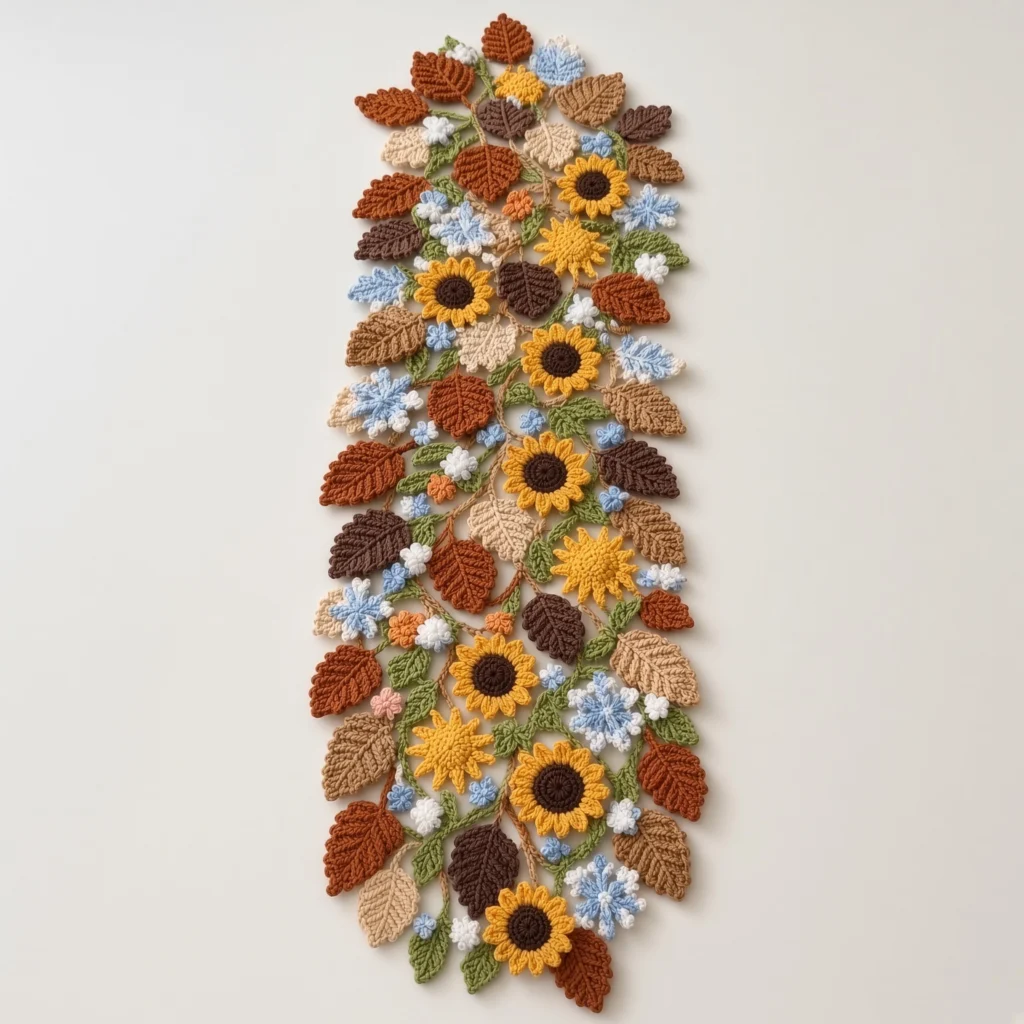
This four seasons crochet table runner pattern puts all four seasons on one table at once: summer sunflowers down the middle, autumn oak and beech leaves fanning out to the sides, pale blue snowflake blooms scattered between them, and tiny cream, orange and pink spring buds filling the gaps. Nothing is worked as a single fabric. Every element is a separate motif, and the whole runner is held together by a chain vine that runs down the center like a real stem, with green side branches feeding off it.
That construction is what makes it worth the effort. Because the motifs are individual, you can lay the whole thing out on your table before you sew a single stitch and shuffle the pieces around until the color balance looks right. It also means the runner has an irregular, organic outline instead of a rectangle, with leaf tips and flower rays breaking past the edge. There are eight different motifs here and around ninety pieces in total, so budget roughly 20 to 26 hours spread over a couple of weeks. The individual motifs are small and portable, which makes this an easy project to pick at.
This is not a first project. You will be working around both sides of a foundation chain, making picot rays and chained leaf tips, changing color mid-motif, and doing a fair amount of careful hand sewing at the end. If you have made granny squares and a few flower appliqués before and you are comfortable counting your own stitches, you can absolutely handle it. If you have never worked around a chain, make one small autumn leaf as a practice piece first and the rest will follow.
Materials
- Worsted weight cotton, golden yellow 100 g — sunflower petals and rays
- Worsted weight cotton, deep mustard 50 g — inner petal rounds
- Worsted weight cotton, chocolate brown 50 g — sunflower centers
- Worsted weight cotton, rust / terracotta 75 g — autumn leaves
- Worsted weight cotton, dark walnut brown 75 g — autumn leaves
- Worsted weight cotton, camel 50 g — autumn leaves
- Worsted weight cotton, cream 75 g — pale leaves and small flowers
- Worsted weight cotton, sage green 50 g — vine leaves
- Worsted weight cotton, olive green 50 g — sepals and branch vines
- Worsted weight cotton, pale blue 75 g — snowflake blooms
- Worsted weight cotton, white 25 g — snowflake tips
- Worsted weight cotton, soft orange 25 g — tiny cluster flowers
- Worsted weight cotton, dusty pink 25 g — tiny cluster flowers
- Worsted weight cotton, linen / natural beige 50 g — main chain vine
- 3.5 mm crochet hook
- Tapestry needle blunt tip, for sewing and weaving in
- Stitch markers at least 6
- Blocking mat and rustproof pins a foam play mat works fine
- Spray starch or a stiffening solution optional but strongly recommended
- Linen or cotton backing fabric optional, ~120 x 42 cm if you want a lined runner
Abbreviations
MRmagic ring
chchain
sl stslip stitch
scsingle crochet
hdchalf double crochet
dcdouble crochet
incincrease (2 sc in the same stitch)
BLOback loops only
skskip
st(s)stitch(es)
rndround
reprepeat
FOfasten off
( ) x6work the sequence in brackets 6 times
Before you start: Leave a 30 cm tail when you fasten off every single motif. Those tails are what you sew the runner together with, and cutting them short means threading fresh yarn ninety times at the assembly stage. All stitch counts are in US terms.
Gauge and Motif Count
- Gauge: a finished large sunflower measures about 10 cm across, and a finished large autumn leaf measures about 9.5 cm from base to tip. If yours come out much bigger, drop to a 3.25 mm hook.
- Make 6 large sunflowers.
- Make 3 sunburst sunflowers.
- Make 14 large autumn leaves: 4 rust, 4 dark walnut, 3 camel, 3 cream.
- Make 10 small autumn leaves: 3 rust, 3 dark walnut, 2 camel, 2 cream.
- Make 18 green vine leaves in sage green.
- Make 14 blue snowflake blooms.
- Make 16 tiny cluster flowers: 8 cream, 4 soft orange, 4 dusty pink.
- Make 1 main chain vine and 12 green branch vines.
Large Sunflower (make 6)
- Rnd 1: with chocolate brown, 6 sc in MR. (6 sts)
- Rnd 2: 2 sc in each st around. (12 sts)
- Rnd 3: (sc in next st, inc) x6. (18 sts)
- Rnd 4: (sc in next 2 sts, inc) x6. (24 sts) Sl st to the next st and FO brown, leaving a short tail to weave in.
- Rnd 5: join deep mustard in any st, ch 1, sc in each st around, sl st to first sc. (24 sts)
- Rnd 6: ch 1, (sc in next 3 sts, inc) x6, sl st to first sc. (30 sts) FO mustard.
- Rnd 7 (petal bases): join golden yellow in any st, ch 1, *sc in next st, ch 4, sk next st; rep from * around, sl st to first sc. (15 sc and 15 ch-4 loops; 15 sts of Rnd 6 are left unworked and you will use them in Rnd 9)
- Rnd 8 (petals): sl st into the first ch-4 loop, ch 1, *(sc, hdc, 3 dc, hdc, sc) in the ch-4 loop; rep from * in each loop around, sl st to first sc. (15 petals) FO golden yellow.
- Rnd 9 (sepals): turn the flower face down. Join olive green in any unworked st of Rnd 6, ch 1, sc in the same st, *ch 6, sl st in 2nd ch from hook, sc in next ch, hdc in next 2 ch, sl st in last ch, sk the next 2 unworked sts, sc in the following unworked st; rep from * 4 more times, sl st to first sc. (5 green sepals sitting behind the petals) FO, leaving a 30 cm tail.
- Weave the brown and mustard tails in on the back. Do not trim the golden or green tails.
Sunburst Sunflower (make 3)
- Rnd 1: with chocolate brown, 6 sc in MR. (6 sts)
- Rnd 2: 2 sc in each st around. (12 sts)
- Rnd 3: (sc in next st, inc) x6. (18 sts) Sl st to the next st and FO brown.
- Rnd 4: join golden yellow in any st, ch 1, sc in each st around, sl st to first sc. (18 sts)
- Rnd 5: ch 1, (sc in next 2 sts, inc) x6, sl st to first sc. (24 sts)
- Rnd 6 (rays): ch 1, *ch 8, then working back along that chain: sl st in 2nd ch from hook, sc in next ch, hdc in next 2 ch, dc in next 2 ch, sc in last ch, then sl st in the next 2 sts of Rnd 5; rep from * 11 more times, sl st to the base of the first ray. (12 pointed rays, 2 sts of Rnd 5 used per ray) FO, leaving a 30 cm tail.
- Pinch each ray flat between your fingers as you finish it so it lies straight rather than curling; a light steam at blocking will set it.
Large Autumn Leaf (make 14)
- Rnd 1: with your chosen leaf color, ch 13. Sl st in 2nd ch from hook, sc in next ch, hdc in next 2 ch, dc in next 4 ch, hdc in next 2 ch, sc in next ch, 3 sc in the last ch (this is the leaf point). Now working along the opposite side of the same foundation chain: sc in next ch, hdc in next 2 ch, dc in next 4 ch, hdc in next 2 ch, sc in next ch, sl st in the last ch. Sl st to the first sl st to join. (25 sts)
- Rnd 2 (this is the round that creates the raised central vein): ch 1, working in BLO, sc in each st around, placing 3 sc in the center st of the 3-sc point. Sl st to first sc. (27 sts)
- Rnd 3: ch 1, working in both loops, sc in each st around, placing 3 sc in the center st of the point. Sl st to first sc. (29 sts)
- Rnd 4 (stem): ch 7, sl st in 2nd ch from hook and in each ch back to the leaf base, sl st into the base st. FO, leaving a 30 cm tail.
- Repeat 14 times: 4 in rust, 4 in dark walnut, 3 in camel, 3 in cream.
Small Autumn Leaf (make 10)
- Rnd 1: with your chosen leaf color, ch 9. Sl st in 2nd ch from hook, sc in next ch, hdc in next 2 ch, dc in next 2 ch, sc in next ch, 3 sc in the last ch. Working along the opposite side of the chain: sc in next ch, dc in next 2 ch, hdc in next 2 ch, sc in next ch, sl st in the last ch. Sl st to the first sl st to join. (17 sts)
- Rnd 2: ch 1, working in BLO, sc in each st around, placing 3 sc in the center st of the point. Sl st to first sc. (19 sts)
- Rnd 3 (stem): ch 5, sl st in 2nd ch from hook and in each ch back to the leaf base, sl st into the base st. FO, leaving a 25 cm tail.
- Repeat 10 times: 3 in rust, 3 in dark walnut, 2 in camel, 2 in cream.
Green Vine Leaf (make 18)
- Rnd 1: with sage green, ch 8. Sl st in 2nd ch from hook, sc in next ch, hdc in next 2 ch, sc in next 2 ch, (sc, ch 2, sc) in the last ch. Working along the opposite side of the chain: sc in next 2 ch, hdc in next 2 ch, sc in next ch, sl st in the last ch. (15 sts plus the ch-2 tip)
- Rnd 2 (stem): ch 4, sl st in 2nd ch from hook and in each ch back to the leaf base, sl st into the base st. FO, leaving a 20 cm tail.
- These are single-layer leaves on purpose. They should sit flatter and thinner than the autumn leaves so the vine reads as foliage rather than another feature motif.
Blue Snowflake Bloom (make 14)
- Rnd 1: with pale blue, 6 sc in MR. (6 sts)
- Rnd 2: ch 1, 2 sc in each st around, sl st to first sc. (12 sts)
- Rnd 3 (points): ch 1, *ch 6, then working back along that chain: sl st in 2nd ch from hook, sc in next 2 ch, hdc in next 2 ch, then sk 1 st of Rnd 2 and sl st in the next st; rep from * 5 more times, sl st to the base of the first point. (6 points, 2 sts of Rnd 2 used per point) FO pale blue, leaving a 25 cm tail.
- Rnd 4 (white tips): join white with a sl st in the tip st of any point. Work (ch 3, sl st in 2nd ch from hook, sl st in last ch) twice into that same tip st, then sl st once more into the tip to lock it. FO and knot the two white ends together on the back. Repeat on all 6 points of every bloom.
- The two little white prongs on each point are what turn a plain six-petal flower into a snowflake shape, so do not skip them or work them all in blue.
Tiny Cluster Flowers (make 16)
- Rnd 1: with cream, soft orange or dusty pink, 10 sc in MR, sl st to first sc. (10 sts)
- Rnd 2: ch 1, *(sc, hdc, dc, hdc, sc) in next st, sl st in next st; rep from * 4 more times, sl st to first sc. (5 petals, all 10 sts of Rnd 1 used) FO, leaving a 20 cm tail.
- Pull the magic ring tight so the center closes completely. These flowers are only about 3 cm across and a loose center will show as a hole on a pale table.
- Repeat 16 times: 8 cream, 4 soft orange, 4 dusty pink.
Chain Vines
- Main vine: with linen beige, ch 260. Sl st in 2nd ch from hook and in each ch back to the start. FO, leaving a 40 cm tail at each end. This gives a firm two-sided cord roughly 115 cm long that will not stretch out of shape once the motifs are sewn on.
- Branch vines: with olive green, ch 34. Sl st in 2nd ch from hook and in each ch back to the start. FO, leaving a 25 cm tail at each end.
- Repeat the branch vine 11 more times, for 12 branches total. Vary the chain count between 26 and 42 if you want branches of different lengths, which looks more natural than twelve identical ones.
- Do not block the vines flat. They should keep a slight curve so they meander through the motifs.
Finishing
Block every motif before you assemble anything. Pin the leaves flat with the point stretched out and the two halves symmetrical, pin the sunflower petals so they radiate evenly, and pin each snowflake point straight. Spray with water or spray starch, and let everything dry completely. This step is not optional on a runner made of separate pieces, because unblocked motifs cup and the finished runner will never sit flat on a table.
Lay the main vine down the center of your table or a large sheet, letting it wander slightly from side to side rather than running dead straight. Arrange the six large sunflowers along it at roughly even intervals, then place the three sunburst sunflowers in the gaps between them. Work outward from there: large autumn leaves along both outer edges with their points facing out, small leaves filling the middle band, snowflake blooms scattered so no two of the same size sit next to each other, and tiny cluster flowers dropped into whatever gaps remain. Step back and check that the four color families are spread across the whole length instead of pooling at one end. Move things around until you are happy, then photograph the layout so you can rebuild it if the pieces shift.
Sew from the center out. Attach the branch vines to the main vine first, angling them out to left and right, then sew each sunflower over the point where a branch meets the spine so the join is hidden underneath. Use the motif’s own long tail and a small whip stitch through the back loops only, catching the vine or the neighboring motif rather than sewing through to the front. Every motif should touch at least two others or a vine, otherwise the runner will sag between pieces. Attach the leaves next, tacking each one at the stem and again near the tip so it cannot flip over, then the snowflakes, then the tiny flowers last, sewn through the center only so their petals stay free and lift slightly off the surface.
Weave in all remaining ends on the back, then give the whole runner a final light steam and a night under a flat weight. If you want a more durable, non-slip finish, cut a piece of linen or cotton to the rough outline of the runner, leave a 1 cm allowance, turn the edge under, and slip stitch it to the back by hand. Leave the outermost leaf tips and flower rays free of the backing so the edge keeps its irregular silhouette.
Tips for Success
- Make all fourteen large autumn leaves in one sitting rather than one at a time between other motifs. The BLO round in the middle is easy to forget once you have set the pattern down, and a leaf missing its vein is obvious next to the others.
- Put a stitch marker in the center stitch of the 3-sc point on every leaf as you finish Rnd 1. On the next round you have to place 3 sc into that exact stitch, and it is very hard to identify once the fabric closes up.
- Keep your chain tension a little loose on the sunburst rays and the snowflake points. Those chains carry stitches worked back along them, and a tight foundation makes the ray curl into a hook shape no amount of blocking will fix.
- Build the runner on the actual table it is for, not on the floor. The layout that looks balanced on a large surface often turns out too wide or too long once it is on a 90 cm table.
- Weigh your yarn as you go if you are working from stash. The rust and walnut browns run out fastest, and a leaf finished in a slightly different dye lot stands out badly against the cream ones.
Common Mistakes to Avoid
- Working Rnd 7 of the large sunflower into every stitch instead of skipping every other one. If you use all 30 stitches you will get 30 petal loops, the flower will ruffle into a bowl, and there will be no free stitches left for the green sepals in Rnd 9. Count that you finish with 15 sc and 15 loops before moving on.
- Sewing motifs down through all layers so the stitching shows on the front. Catch back loops only, and where two motifs overlap, sew the top one to the one underneath rather than passing the needle right through to the table side.
- Skipping the blocking step because the motifs look fine in your hand. Individually they do; laid side by side, unblocked leaves cup and the runner develops waves along its whole length. Block before assembly, not after, because once everything is sewn you cannot pin a single leaf flat on its own.
- Attaching flowers by only one stitch in the center. They will spin face down within a week of use. Anchor each tiny flower with three or four stitches around the magic ring, and tack the large sunflowers at four points around the brown center.
- Running the main vine dead straight down the middle. It reads as a seam rather than a stem, and it makes the motif placement look like a grid. Let it curve gently, and sew the motifs so they cross it in places.
Ways to Customize This Pattern
- Make a single-season version. Use only the sunflowers, green vine leaves and cream cluster flowers for a summer runner, or only the rust, walnut, camel and cream leaves with the sunburst flowers for a pure autumn one. The construction is identical, you just make fewer motif types in higher numbers.
- Shorten it into a centerpiece mat. Chain 90 instead of 260 for the main vine, use 4 branch vines, and make 2 large sunflowers, 1 sunburst, 6 large leaves, 4 small leaves, 6 vine leaves, 5 snowflakes and 6 tiny flowers. That gives you a roughly 40 cm oval for the middle of a round table.
- Turn the motifs into a garland. Skip the main vine, chain 300 in linen beige, and sew the motifs directly along it with 8 to 10 cm of bare chain between them. Add a loop at each end and hang it along a mantelpiece.
- Swap the palette to spring. Work the leaves in three shades of fresh green instead of browns, change the sunflowers to pale pink and white daisies by using cream for the center and blush for the petals, and keep the blue snowflakes as forget-me-nots.
- Add a scalloped edge. Once the runner is assembled, join sage green at one corner and work a round of (sc, sk 1, 5 dc in next st, sk 1) along the outer leaf tips, connecting them into a continuous border. This makes the outline more formal and holds the edge motifs firmly in place.
Frequently asked questions
Do I really need to make all 81 motifs, or can I use fewer?
You can use fewer, but reduce every motif type proportionally rather than dropping one type entirely. The runner reads as four seasons because all four color families appear along its whole length, so cutting the fourteen snowflake blooms down to four would leave winter looking like an afterthought at one end. If you want a lighter project, shorten the main vine instead and scale the counts as described in the centerpiece variation.
Can I use acrylic yarn instead of cotton?
You can, but the result is noticeably different. Acrylic has more stretch and less body, so the leaf points go soft and the sunburst rays droop rather than standing out crisply. Acrylic also resists blocking, since it does not hold a pinned shape the way cotton does unless you steam it carefully, and too much heat will flatten the texture permanently. If acrylic is what you have, go down to a 3.25 mm hook to tighten the fabric and plan on a fabric backing to give the runner structure.
How do I stop the finished runner from shifting around on the table?
The weight of the cotton holds it reasonably well on a wooden table, but on a polished or glass surface it will slide. The simplest fix is the linen backing described in the Finishing section. If you would rather not line it, sew a few small circles of non-slip rug tape to the back under the sunflowers, where the fabric is thickest and the tape will not show through.
Is this runner washable?
Hand wash only, in cool water with a gentle detergent, and never in a machine. The motifs are joined by sewn seams rather than a continuous fabric, and machine agitation will strain those joins. Squeeze the water out without wringing, lay the runner flat on a towel, reshape the leaf points and flower rays with your fingers, and let it dry completely flat. If you starched it originally, you will need to re-starch after washing.
What is the best order to make the motifs in?
Make the nine sunflowers first, because they set the scale for everything else and let you check your gauge before you commit to the rest of the yarn. Then do all the large leaves, then all the small leaves, then the vine leaves, snowflakes and tiny flowers. Make the vines last, once you know roughly how much length the assembled motifs actually need.
This four seasons crochet table runner pattern puts all four seasons on one table at once: summer sunflowers down the middle, autumn oak and beech leaves fanning out to the sides, pale blue snowflake blooms scattered between them, and tiny cream, orange and pink spring buds filling the gaps. Nothing is worked as a single fabric. Every element is a separate motif, and the whole runner is held together by a chain vine that runs down the center like a real stem, with green side branches feeding off it.
That construction is what makes it worth the effort. Because the motifs are individual, you can lay the whole thing out on your table before you sew a single stitch and shuffle the pieces around until the color balance looks right. It also means the runner has an irregular, organic outline instead of a rectangle, with leaf tips and flower rays breaking past the edge. There are eight different motifs here and around ninety pieces in total, so budget roughly 20 to 26 hours spread over a couple of weeks. The individual motifs are small and portable, which makes this an easy project to pick at.
This is not a first project. You will be working around both sides of a foundation chain, making picot rays and chained leaf tips, changing color mid-motif, and doing a fair amount of careful hand sewing at the end. If you have made granny squares and a few flower appliqués before and you are comfortable counting your own stitches, you can absolutely handle it. If you have never worked around a chain, make one small autumn leaf as a practice piece first and the rest will follow.
Materials
- Worsted weight cotton, golden yellow 100 g — sunflower petals and rays
- Worsted weight cotton, deep mustard 50 g — inner petal rounds
- Worsted weight cotton, chocolate brown 50 g — sunflower centers
- Worsted weight cotton, rust / terracotta 75 g — autumn leaves
- Worsted weight cotton, dark walnut brown 75 g — autumn leaves
- Worsted weight cotton, camel 50 g — autumn leaves
- Worsted weight cotton, cream 75 g — pale leaves and small flowers
- Worsted weight cotton, sage green 50 g — vine leaves
- Worsted weight cotton, olive green 50 g — sepals and branch vines
- Worsted weight cotton, pale blue 75 g — snowflake blooms
- Worsted weight cotton, white 25 g — snowflake tips
- Worsted weight cotton, soft orange 25 g — tiny cluster flowers
- Worsted weight cotton, dusty pink 25 g — tiny cluster flowers
- Worsted weight cotton, linen / natural beige 50 g — main chain vine
- 3.5 mm crochet hook
- Tapestry needle blunt tip, for sewing and weaving in
- Stitch markers at least 6
- Blocking mat and rustproof pins a foam play mat works fine
- Spray starch or a stiffening solution optional but strongly recommended
- Linen or cotton backing fabric optional, ~120 x 42 cm if you want a lined runner
Abbreviations
MRmagic ringchchainsl stslip stitchscsingle crochethdchalf double crochetdcdouble crochetincincrease (2 sc in the same stitch)BLOback loops onlyskskipst(s)stitch(es)rndroundreprepeatFOfasten off( ) x6work the sequence in brackets 6 timesGauge and Motif Count
- Gauge: a finished large sunflower measures about 10 cm across, and a finished large autumn leaf measures about 9.5 cm from base to tip. If yours come out much bigger, drop to a 3.25 mm hook.
- Make 6 large sunflowers.
- Make 3 sunburst sunflowers.
- Make 14 large autumn leaves: 4 rust, 4 dark walnut, 3 camel, 3 cream.
- Make 10 small autumn leaves: 3 rust, 3 dark walnut, 2 camel, 2 cream.
- Make 18 green vine leaves in sage green.
- Make 14 blue snowflake blooms.
- Make 16 tiny cluster flowers: 8 cream, 4 soft orange, 4 dusty pink.
- Make 1 main chain vine and 12 green branch vines.
Large Sunflower (make 6)
- Rnd 1: with chocolate brown, 6 sc in MR. (6 sts)
- Rnd 2: 2 sc in each st around. (12 sts)
- Rnd 3: (sc in next st, inc) x6. (18 sts)
- Rnd 4: (sc in next 2 sts, inc) x6. (24 sts) Sl st to the next st and FO brown, leaving a short tail to weave in.
- Rnd 5: join deep mustard in any st, ch 1, sc in each st around, sl st to first sc. (24 sts)
- Rnd 6: ch 1, (sc in next 3 sts, inc) x6, sl st to first sc. (30 sts) FO mustard.
- Rnd 7 (petal bases): join golden yellow in any st, ch 1, *sc in next st, ch 4, sk next st; rep from * around, sl st to first sc. (15 sc and 15 ch-4 loops; 15 sts of Rnd 6 are left unworked and you will use them in Rnd 9)
- Rnd 8 (petals): sl st into the first ch-4 loop, ch 1, *(sc, hdc, 3 dc, hdc, sc) in the ch-4 loop; rep from * in each loop around, sl st to first sc. (15 petals) FO golden yellow.
- Rnd 9 (sepals): turn the flower face down. Join olive green in any unworked st of Rnd 6, ch 1, sc in the same st, *ch 6, sl st in 2nd ch from hook, sc in next ch, hdc in next 2 ch, sl st in last ch, sk the next 2 unworked sts, sc in the following unworked st; rep from * 4 more times, sl st to first sc. (5 green sepals sitting behind the petals) FO, leaving a 30 cm tail.
- Weave the brown and mustard tails in on the back. Do not trim the golden or green tails.
Sunburst Sunflower (make 3)
- Rnd 1: with chocolate brown, 6 sc in MR. (6 sts)
- Rnd 2: 2 sc in each st around. (12 sts)
- Rnd 3: (sc in next st, inc) x6. (18 sts) Sl st to the next st and FO brown.
- Rnd 4: join golden yellow in any st, ch 1, sc in each st around, sl st to first sc. (18 sts)
- Rnd 5: ch 1, (sc in next 2 sts, inc) x6, sl st to first sc. (24 sts)
- Rnd 6 (rays): ch 1, *ch 8, then working back along that chain: sl st in 2nd ch from hook, sc in next ch, hdc in next 2 ch, dc in next 2 ch, sc in last ch, then sl st in the next 2 sts of Rnd 5; rep from * 11 more times, sl st to the base of the first ray. (12 pointed rays, 2 sts of Rnd 5 used per ray) FO, leaving a 30 cm tail.
- Pinch each ray flat between your fingers as you finish it so it lies straight rather than curling; a light steam at blocking will set it.
Large Autumn Leaf (make 14)
- Rnd 1: with your chosen leaf color, ch 13. Sl st in 2nd ch from hook, sc in next ch, hdc in next 2 ch, dc in next 4 ch, hdc in next 2 ch, sc in next ch, 3 sc in the last ch (this is the leaf point). Now working along the opposite side of the same foundation chain: sc in next ch, hdc in next 2 ch, dc in next 4 ch, hdc in next 2 ch, sc in next ch, sl st in the last ch. Sl st to the first sl st to join. (25 sts)
- Rnd 2 (this is the round that creates the raised central vein): ch 1, working in BLO, sc in each st around, placing 3 sc in the center st of the 3-sc point. Sl st to first sc. (27 sts)
- Rnd 3: ch 1, working in both loops, sc in each st around, placing 3 sc in the center st of the point. Sl st to first sc. (29 sts)
- Rnd 4 (stem): ch 7, sl st in 2nd ch from hook and in each ch back to the leaf base, sl st into the base st. FO, leaving a 30 cm tail.
- Repeat 14 times: 4 in rust, 4 in dark walnut, 3 in camel, 3 in cream.
Small Autumn Leaf (make 10)
- Rnd 1: with your chosen leaf color, ch 9. Sl st in 2nd ch from hook, sc in next ch, hdc in next 2 ch, dc in next 2 ch, sc in next ch, 3 sc in the last ch. Working along the opposite side of the chain: sc in next ch, dc in next 2 ch, hdc in next 2 ch, sc in next ch, sl st in the last ch. Sl st to the first sl st to join. (17 sts)
- Rnd 2: ch 1, working in BLO, sc in each st around, placing 3 sc in the center st of the point. Sl st to first sc. (19 sts)
- Rnd 3 (stem): ch 5, sl st in 2nd ch from hook and in each ch back to the leaf base, sl st into the base st. FO, leaving a 25 cm tail.
- Repeat 10 times: 3 in rust, 3 in dark walnut, 2 in camel, 2 in cream.
Green Vine Leaf (make 18)
- Rnd 1: with sage green, ch 8. Sl st in 2nd ch from hook, sc in next ch, hdc in next 2 ch, sc in next 2 ch, (sc, ch 2, sc) in the last ch. Working along the opposite side of the chain: sc in next 2 ch, hdc in next 2 ch, sc in next ch, sl st in the last ch. (15 sts plus the ch-2 tip)
- Rnd 2 (stem): ch 4, sl st in 2nd ch from hook and in each ch back to the leaf base, sl st into the base st. FO, leaving a 20 cm tail.
- These are single-layer leaves on purpose. They should sit flatter and thinner than the autumn leaves so the vine reads as foliage rather than another feature motif.
Blue Snowflake Bloom (make 14)
- Rnd 1: with pale blue, 6 sc in MR. (6 sts)
- Rnd 2: ch 1, 2 sc in each st around, sl st to first sc. (12 sts)
- Rnd 3 (points): ch 1, *ch 6, then working back along that chain: sl st in 2nd ch from hook, sc in next 2 ch, hdc in next 2 ch, then sk 1 st of Rnd 2 and sl st in the next st; rep from * 5 more times, sl st to the base of the first point. (6 points, 2 sts of Rnd 2 used per point) FO pale blue, leaving a 25 cm tail.
- Rnd 4 (white tips): join white with a sl st in the tip st of any point. Work (ch 3, sl st in 2nd ch from hook, sl st in last ch) twice into that same tip st, then sl st once more into the tip to lock it. FO and knot the two white ends together on the back. Repeat on all 6 points of every bloom.
- The two little white prongs on each point are what turn a plain six-petal flower into a snowflake shape, so do not skip them or work them all in blue.
Tiny Cluster Flowers (make 16)
- Rnd 1: with cream, soft orange or dusty pink, 10 sc in MR, sl st to first sc. (10 sts)
- Rnd 2: ch 1, *(sc, hdc, dc, hdc, sc) in next st, sl st in next st; rep from * 4 more times, sl st to first sc. (5 petals, all 10 sts of Rnd 1 used) FO, leaving a 20 cm tail.
- Pull the magic ring tight so the center closes completely. These flowers are only about 3 cm across and a loose center will show as a hole on a pale table.
- Repeat 16 times: 8 cream, 4 soft orange, 4 dusty pink.
Chain Vines
- Main vine: with linen beige, ch 260. Sl st in 2nd ch from hook and in each ch back to the start. FO, leaving a 40 cm tail at each end. This gives a firm two-sided cord roughly 115 cm long that will not stretch out of shape once the motifs are sewn on.
- Branch vines: with olive green, ch 34. Sl st in 2nd ch from hook and in each ch back to the start. FO, leaving a 25 cm tail at each end.
- Repeat the branch vine 11 more times, for 12 branches total. Vary the chain count between 26 and 42 if you want branches of different lengths, which looks more natural than twelve identical ones.
- Do not block the vines flat. They should keep a slight curve so they meander through the motifs.
Finishing
Block every motif before you assemble anything. Pin the leaves flat with the point stretched out and the two halves symmetrical, pin the sunflower petals so they radiate evenly, and pin each snowflake point straight. Spray with water or spray starch, and let everything dry completely. This step is not optional on a runner made of separate pieces, because unblocked motifs cup and the finished runner will never sit flat on a table.
Lay the main vine down the center of your table or a large sheet, letting it wander slightly from side to side rather than running dead straight. Arrange the six large sunflowers along it at roughly even intervals, then place the three sunburst sunflowers in the gaps between them. Work outward from there: large autumn leaves along both outer edges with their points facing out, small leaves filling the middle band, snowflake blooms scattered so no two of the same size sit next to each other, and tiny cluster flowers dropped into whatever gaps remain. Step back and check that the four color families are spread across the whole length instead of pooling at one end. Move things around until you are happy, then photograph the layout so you can rebuild it if the pieces shift.
Sew from the center out. Attach the branch vines to the main vine first, angling them out to left and right, then sew each sunflower over the point where a branch meets the spine so the join is hidden underneath. Use the motif’s own long tail and a small whip stitch through the back loops only, catching the vine or the neighboring motif rather than sewing through to the front. Every motif should touch at least two others or a vine, otherwise the runner will sag between pieces. Attach the leaves next, tacking each one at the stem and again near the tip so it cannot flip over, then the snowflakes, then the tiny flowers last, sewn through the center only so their petals stay free and lift slightly off the surface.
Weave in all remaining ends on the back, then give the whole runner a final light steam and a night under a flat weight. If you want a more durable, non-slip finish, cut a piece of linen or cotton to the rough outline of the runner, leave a 1 cm allowance, turn the edge under, and slip stitch it to the back by hand. Leave the outermost leaf tips and flower rays free of the backing so the edge keeps its irregular silhouette.
Tips for Success
- Make all fourteen large autumn leaves in one sitting rather than one at a time between other motifs. The BLO round in the middle is easy to forget once you have set the pattern down, and a leaf missing its vein is obvious next to the others.
- Put a stitch marker in the center stitch of the 3-sc point on every leaf as you finish Rnd 1. On the next round you have to place 3 sc into that exact stitch, and it is very hard to identify once the fabric closes up.
- Keep your chain tension a little loose on the sunburst rays and the snowflake points. Those chains carry stitches worked back along them, and a tight foundation makes the ray curl into a hook shape no amount of blocking will fix.
- Build the runner on the actual table it is for, not on the floor. The layout that looks balanced on a large surface often turns out too wide or too long once it is on a 90 cm table.
- Weigh your yarn as you go if you are working from stash. The rust and walnut browns run out fastest, and a leaf finished in a slightly different dye lot stands out badly against the cream ones.
Common Mistakes to Avoid
- Working Rnd 7 of the large sunflower into every stitch instead of skipping every other one. If you use all 30 stitches you will get 30 petal loops, the flower will ruffle into a bowl, and there will be no free stitches left for the green sepals in Rnd 9. Count that you finish with 15 sc and 15 loops before moving on.
- Sewing motifs down through all layers so the stitching shows on the front. Catch back loops only, and where two motifs overlap, sew the top one to the one underneath rather than passing the needle right through to the table side.
- Skipping the blocking step because the motifs look fine in your hand. Individually they do; laid side by side, unblocked leaves cup and the runner develops waves along its whole length. Block before assembly, not after, because once everything is sewn you cannot pin a single leaf flat on its own.
- Attaching flowers by only one stitch in the center. They will spin face down within a week of use. Anchor each tiny flower with three or four stitches around the magic ring, and tack the large sunflowers at four points around the brown center.
- Running the main vine dead straight down the middle. It reads as a seam rather than a stem, and it makes the motif placement look like a grid. Let it curve gently, and sew the motifs so they cross it in places.
Ways to Customize This Pattern
- Make a single-season version. Use only the sunflowers, green vine leaves and cream cluster flowers for a summer runner, or only the rust, walnut, camel and cream leaves with the sunburst flowers for a pure autumn one. The construction is identical, you just make fewer motif types in higher numbers.
- Shorten it into a centerpiece mat. Chain 90 instead of 260 for the main vine, use 4 branch vines, and make 2 large sunflowers, 1 sunburst, 6 large leaves, 4 small leaves, 6 vine leaves, 5 snowflakes and 6 tiny flowers. That gives you a roughly 40 cm oval for the middle of a round table.
- Turn the motifs into a garland. Skip the main vine, chain 300 in linen beige, and sew the motifs directly along it with 8 to 10 cm of bare chain between them. Add a loop at each end and hang it along a mantelpiece.
- Swap the palette to spring. Work the leaves in three shades of fresh green instead of browns, change the sunflowers to pale pink and white daisies by using cream for the center and blush for the petals, and keep the blue snowflakes as forget-me-nots.
- Add a scalloped edge. Once the runner is assembled, join sage green at one corner and work a round of (sc, sk 1, 5 dc in next st, sk 1) along the outer leaf tips, connecting them into a continuous border. This makes the outline more formal and holds the edge motifs firmly in place.
Frequently asked questions
You can use fewer, but reduce every motif type proportionally rather than dropping one type entirely. The runner reads as four seasons because all four color families appear along its whole length, so cutting the fourteen snowflake blooms down to four would leave winter looking like an afterthought at one end. If you want a lighter project, shorten the main vine instead and scale the counts as described in the centerpiece variation.
You can, but the result is noticeably different. Acrylic has more stretch and less body, so the leaf points go soft and the sunburst rays droop rather than standing out crisply. Acrylic also resists blocking, since it does not hold a pinned shape the way cotton does unless you steam it carefully, and too much heat will flatten the texture permanently. If acrylic is what you have, go down to a 3.25 mm hook to tighten the fabric and plan on a fabric backing to give the runner structure.
The weight of the cotton holds it reasonably well on a wooden table, but on a polished or glass surface it will slide. The simplest fix is the linen backing described in the Finishing section. If you would rather not line it, sew a few small circles of non-slip rug tape to the back under the sunflowers, where the fabric is thickest and the tape will not show through.
Hand wash only, in cool water with a gentle detergent, and never in a machine. The motifs are joined by sewn seams rather than a continuous fabric, and machine agitation will strain those joins. Squeeze the water out without wringing, lay the runner flat on a towel, reshape the leaf points and flower rays with your fingers, and let it dry completely flat. If you starched it originally, you will need to re-starch after washing.
Make the nine sunflowers first, because they set the scale for everything else and let you check your gauge before you commit to the rest of the yarn. Then do all the large leaves, then all the small leaves, then the vine leaves, snowflakes and tiny flowers. Make the vines last, once you know roughly how much length the assembled motifs actually need.
The finished Four Seasons Floral Crochet Table Runner