Harvest Mandala Autumn Crochet Table Runner
Beginner Friendly
Perfect for those just starting their crochet journey, with clear instructions and simple techniques
Single-Day Project
A satisfying project you can complete in a single afternoon or evening.
Handmade Gift
A beautiful keepsake — free forever. Read online or print at home.
About This Harvest Mandala Autumn Crochet Table Runner
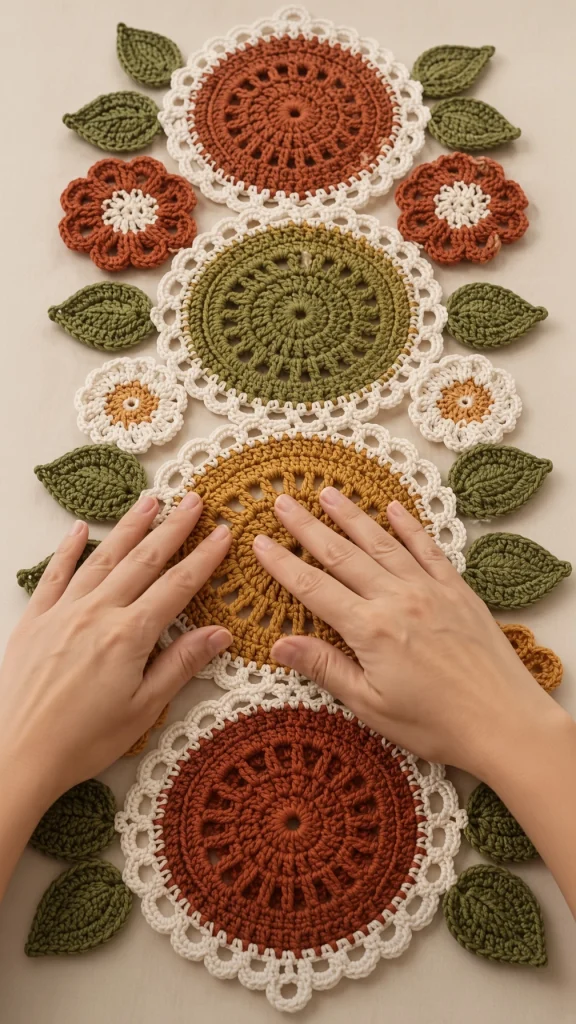
This autumn crochet table runner pattern is built from four large mandala medallions in rust, olive, and gold, each finished with a cream picot lace border. Two rounds of open spoke stitches give every medallion its wheel-like center, and the cream edging pulls the whole line of colors together.
Between the medallions sit small eight-petal flowers, and sage green leaves with a surface-crocheted vein fill the spaces along both long edges. Everything is made separately and sewn, which means you can lay the pieces out on your own table and shift them until the spacing suits the width you have.
Plan on twelve to sixteen hours in total. The medallions are the longest part; the flowers and leaves are quick and good for evenings in front of the television. It is a project for crocheters who are comfortable working in joined rounds and counting stitch repeats, and it suits a harvest table, a sideboard, or a long console.
Materials
- Worsted weight cotton in cream about 150 g (all four borders and two flowers)
- Worsted weight cotton in rust about 90 g (two medallions and four flowers)
- Worsted weight cotton in olive green about 45 g (one medallion)
- Worsted weight cotton in golden mustard about 55 g (one medallion and two flower centers)
- Worsted weight cotton in sage green about 70 g (16 leaves)
- 4.0 mm crochet hook
- Tapestry needle
- Stitch markers at least 4
- Rustproof blocking pins and a foam mat or towel
- Spray bottle of water
- Scissors
Abbreviations
MRmagic ringchchainsl stslip stitchscsingle crochethdchalf double crochetdcdouble crochetspspacest(s)stitch(es)Medallion Center (Make 2 in Rust, 1 in Olive, 1 in Gold)
- Work in joined rounds throughout. Begin each round with ch 3 (counts as dc) and end with a sl st in the top of the ch-3.
- Round 1: Ch 3, 15 dc in MR, pull ring closed and join. (16)
- Round 2: Ch 3, dc in the same st, 2 dc in each st around, join. (32)
- Round 3: Ch 3, 2 dc in next st, (dc in next st, 2 dc in next st) 15 times, join. (48)
- Round 4: Ch 3, dc in next st, 2 dc in next st, (dc in next 2 sts, 2 dc in next st) 15 times, join. (64)
- Round 5 (open spokes): Ch 4 (counts as dc and ch 1), skip next st, *dc in next st, ch 1, skip next st* 31 times, join in the 3rd ch of the ch-4. (32 dc and 32 ch-1 sps)
- Round 6: Ch 3, dc in each dc and in each ch-1 sp around, join. (64)
- Round 7 (open spokes): Ch 4, skip next st, *dc in next st, ch 1, skip next st* 31 times, join in the 3rd ch of the ch-4. (32 dc and 32 ch-1 sps)
- Round 8: Ch 3, dc in next dc, dc in next ch-1 sp, 2 dc in next dc, then *dc in next ch-1 sp, dc in next dc, dc in next ch-1 sp, 2 dc in next dc* 15 times, join. (80)
- Round 9: Ch 3, dc in each st around, join. (80) Fasten off the color and weave in the ends.
Cream Lace Border (Work on All 4 Medallions)
- Round 10: Join cream with a sl st in any st of Round 9. Ch 1, sc in the same st and in each st around, sl st to the first sc to join. (80)
- Round 11: Ch 1, sc in the first st, *ch 5, skip next 3 sts, sc in next st* 19 times, ch 5, sl st to the first sc to join. (20 sc and 20 ch-5 loops)
- Round 12: Sl st into the first ch-5 sp. In each ch-5 sp around work (sc, 2 hdc, ch 3, sl st in the last hdc made, 2 hdc, sc). Sl st to the first sc to join. (20 picot scallops)
- Fasten off, leaving a 30 cm tail for joining. Each finished medallion should measure about 23 cm across.
Rust Flowers (Make 4)
- Round 1: With cream, ch 1, 8 sc in MR, pull ring closed, sl st to the first sc to join. (8)
- Round 2: Ch 1, 2 sc in each st around, join. (16) Fasten off cream.
- Round 3: Join rust in any st. Ch 1, sc in the same st, *ch 3, skip next st, sc in next st* 7 times, ch 3, sl st to the first sc to join. (8 sc and 8 ch-3 sps)
- Round 4: Sl st into the first ch-3 sp. In each ch-3 sp around work (sc, hdc, 3 dc, hdc, sc). Sl st to the first sc to join. (8 petals of 7 sts)
- Fasten off, leaving a 25 cm tail. The flower should measure about 9 cm across.
Cream Flowers (Make 2)
- Round 1: With gold, ch 1, 8 sc in MR, pull ring closed, sl st to the first sc to join. (8)
- Round 2: Ch 1, 2 sc in each st around, join. (16) Fasten off gold.
- Round 3: Join cream in any st. Ch 1, sc in the same st, *ch 3, skip next st, sc in next st* 7 times, ch 3, sl st to the first sc to join. (8 sc and 8 ch-3 sps)
- Round 4: Sl st into the first ch-3 sp. In each ch-3 sp around work (sc, hdc, 2 dc, hdc, sc). Sl st to the first sc to join. (8 petals of 6 sts)
- Fasten off, leaving a 25 cm tail. These sit slightly smaller than the rust flowers.
Leaves (Sage Green, Make 16)
- Ch 12.
- Round 1: Starting in the 2nd ch from hook, work sc, hdc, dc, dc, dc, hdc, hdc, hdc, sc, sc across the next 10 chs, then 3 sc in the last ch. Rotate to work along the opposite side of the foundation chain: sc, sc, hdc, hdc, hdc, dc, dc, dc, hdc, sc in the next 10 chs. Sl st in the first sc. (23 sts)
- Round 2: Ch 1, sc in each st around, working 2 sc in the center st of the 3-sc group at the wide end. Sl st in the first sc. (24 sts)
- Ch 2 and sl st back into the same st at the narrow end to form the point. Fasten off, leaving a 20 cm tail.
- Vein: cut a 30 cm length of sage green. Working on the right side, surface slip stitch a straight line from the point of the leaf to the center of the wide end, picking up one strand of the fabric for each slip stitch. Pull both ends to the back, knot, and trim.
Finishing
Block every piece before assembly. Spray each medallion damp, pin it into a true circle with one pin in each picot scallop, and let it dry fully. Pin the flowers with the petals opened evenly and the leaves flat with the point pulled straight. Blocking is what makes the cream lace borders sit crisp against each other instead of curling.
Lay the medallions in a line in this order: rust, olive, gold, rust. Slide them together until the picot scallops of neighboring borders just touch, then check the total length against your table. Using the cream tails and a tapestry needle, sew each pair of medallions together where two scallops meet, taking three or four small stitches through both scallops. Then join the two scallops on each side of that point as well, so each pair of medallions is held at three places and cannot twist.
Place a flower over each notch where two medallions meet, one on the left edge and one on the right, so the petals cover the small V-shaped gap: rust flowers at the first and third joins, cream flowers at the second. Sew each flower down through its center round and the tips of two or three petals. Finally, arrange the leaves along both long edges, two beside each medallion and two at each end of the runner, with the points facing outward and the wide ends tucked under the cream lace. Sew each leaf through its wide end and one side. Weave in all remaining ends on the back and give the finished runner one last light blocking.
Tips for Success
- Mark the first stitch of every medallion round with a stitch marker. The open spoke rounds are easy to lose your place in, and a miscount there throws off the Round 8 increases.
- Work all four medallion centers before starting any borders. Comparing them side by side shows up a tension drift right away, while it is still easy to redo one.
- Keep the ch-3 picots on Round 12 small and firm. Loose picots flop and blur the scalloped outline that defines the runner.
- Pin the whole layout on a bed or floor before sewing anything. Once the flowers and leaves are stitched, moving them means unpicking.
- Sew with the same cream cotton rather than a sewing thread. It disappears into the lace and holds up to washing better.
Common Mistakes to Avoid
- Joining Round 5 or Round 7 into the top of a ch-3 instead of the 3rd chain of the ch-4. That shifts the spoke pattern by one stitch and leaves a visible seam line down the medallion.
- Skipping the wrong stitch in Round 11. If the ch-5 loops do not come out at exactly 20, the picot scallops will not sit evenly and neighboring medallions will not meet cleanly. Count the loops before moving on.
- Sewing the medallions edge to edge at only one point. They pivot and the runner ends up crooked on the table. Always join at three scallops per pair.
- Working the leaf vein too tightly. It puckers the leaf into a curl. Keep the surface slip stitches loose enough that the leaf still lies flat.
- Leaving the pieces unblocked. Unblocked medallions cup slightly, and four cupped circles in a row make the runner ripple instead of lying smooth.
Ways to Customize This Pattern
- Make five or six medallions for a long dining table, repeating the rust, olive, gold sequence, and add two more flowers and four more leaves per extra medallion.
- Make a single medallion with its border as a round doily or centerpiece mat, or three of them as large placemats.
- Swap the palette for winter: cranberry, forest green, and gold medallions with cream lace and white flowers.
- Leave off the leaves and flowers for a simpler modern runner where the mandalas and cream lace do all the work.
- Add a hanging loop to the top medallion and use the runner as a vertical wall banner for an autumn doorway.
Frequently asked questions
Each medallion adds about 21 cm to the length once joined. Add or remove whole medallions for big changes, and shift the joins slightly closer or further apart for small ones. Aim to leave 15 to 20 cm of bare table at each end.
Yes. On Round 12 of the second and later medallions, replace the ch-3 picot with ch 1, sl st into the matching picot of the finished medallion, ch 1, at the three scallops where they meet. The result is flatter, but you lose the freedom to adjust the spacing later.
Small differences disappear once blocked, since you can pin the smaller ones out a little further. For a difference of more than about 1 cm, redo the smaller medallion with a hook a half size larger.
Hand wash in cool water with mild detergent, press out the water in a towel, then pin it flat to dry the way you blocked it. Machine washing is possible in a mesh bag on a gentle cycle, but the picots and leaves will need reblocking afterward.
The finished Harvest Mandala Autumn Crochet Table Runner