Irish Lace Sunflower Vine Table Runner Crochet Pattern
Beginner Friendly
Perfect for those just starting their crochet journey, with clear instructions and simple techniques
Single-Day Project
A satisfying project you can complete in a single afternoon or evening.
Handmade Gift
A beautiful keepsake — free forever. Read online or print at home.
About This Irish Lace Sunflower Vine Table Runner Crochet Pattern
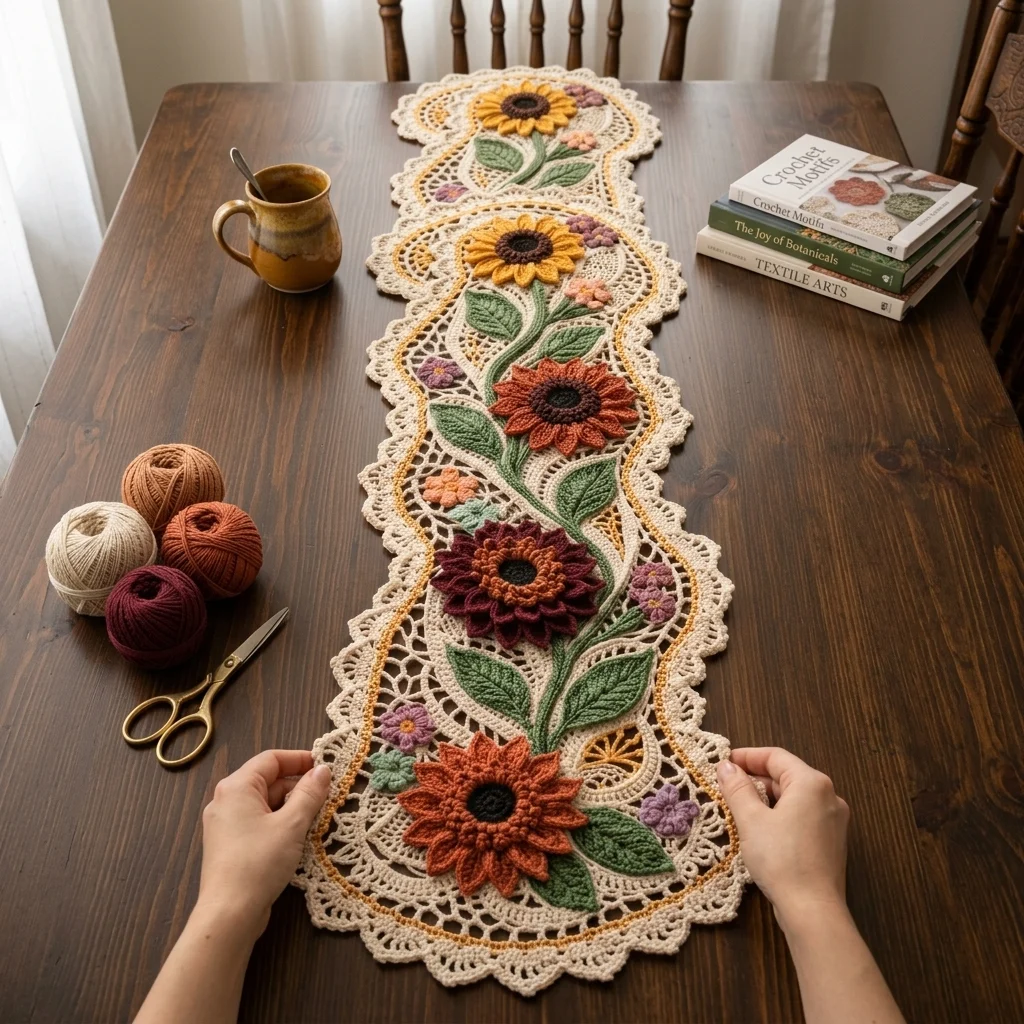
This crochet sunflower lace table runner pattern builds an Irish-crochet style piece: a background of open picot mesh worked around a raised centerpiece vine, with 3 large 3D sunflower-style motifs, one dahlia, a run of crocheted leaves, and a scattering of tiny accent flowers in lavender, peach, and sage, all finished with a scalloped lace edge and a wavy gold trim line winding through the background.
What makes this design distinctive is the layered construction order: unlike a flat filet or granny-square runner, every motif here, sunflowers, dahlia, leaves, and small flowers, is made completely separately first, then arranged onto a plain net-mesh background and tacked in place, so the whole surface builds up in visible relief rather than lying in one flat plane. The gold trim line worked separately and couched across the mesh is what gives the background its extra hand-finished, heirloom look. Expect to spend 30-36 hours total; this is a genuinely long project best worked over several weeks.
This is an advanced pattern, best suited to someone experienced with Irish lace or freeform motif assembly and comfortable improvising slightly around a background mesh, rather than someone wanting a strictly row-counted project.
Materials
- Fingering weight cotton yarn, cream ~150g, mesh background and edging
- Fingering weight yarn, mustard gold ~20g, one sunflower
- Fingering weight yarn, rust/terracotta ~30g, two sunflowers
- Fingering weight yarn, dark brown ~15g, sunflower and dahlia centers
- Fingering weight yarn, burgundy wine ~15g, dahlia petals
- Fingering weight yarn, sage green ~40g, leaves and vine
- Small amounts of lavender, peach, and dusty blue yarn accent flowers
- Fingering weight yarn, gold/mustard ~10g, couched trim line
- Crochet hook, small 2.75 mm (US C/2), for mesh and edging
- Crochet hook, larger 3.5 mm (US E/4), for motifs
- Tapestry/yarn needle
- Steam iron and pressing cloth, or blocking mat and pins
- Straight pins, for positioning motifs before sewing
- Sharp scissors
Abbreviations
chchainsl stslip stitchscsingle crochethdchalf double crochetdcdouble crochettrtreble/triple crochetMRmagic ringch-spchain spacepicotch 3, sl st in first ch of the 3incincrease (2 sc in one st)st(s)stitch(es)reprepeatFOfasten offSunflower Motif (make 2: 1 mustard gold, 1 rust/terracotta)
- With dark brown, 8 sc in MR. Round 2: inc in each st around (16 sts). Sl st to join, FO leaving a short tail. This is the flat textured center.
- With petal color, join in any st of the brown center. Round 1 (inner petals): *ch 2, dc 3 in next st, ch 2, sl st in same st; rep from * around all 16 sts. 16 petals.
- Round 2 (outer petals): join petal color in a base st between two inner petals. *ch 3, dc 4 in next base st, ch 3, sl st in same st; rep from * around. 16 larger petals layered behind the first set.
- FO leaving a long tail for attaching. Fold outer petals slightly back so the two rounds separate visually.
Dahlia Motif (make 1, burgundy wine petals, dark brown and mustard center)
- With dark brown, 6 sc in MR, inc around (12 sts), sl st to join, FO leaving a short tail.
- With mustard gold, join and work *ch 2, sl st in same st, sl st in next st; rep from * around all 12 sts for a ruffled ring around the brown center. FO leaving a short tail.
- With burgundy, join behind the ruffle. Round 1 (inner petals): *ch 3, sl st in 2nd ch from hook, sc in next ch, sl st in same base st; rep from * around 12 sts.
- Round 2 (outer petals): join burgundy behind Round 1. *ch 5, sl st in 2nd ch from hook, sc 2, hdc 1, sl st in same base st; rep from * around.
- FO leaving a long tail for attaching. Fold outer petals back from inner ones for dimension.
Vine and Leaves
- With sage green, ch a length matching your planned motif line, approximately 70 cm, to form the vine’s main spine.
- Sl st back down the entire chain for body and a smooth edge. FO leaving tails at both ends.
- Leaf motif (make 10): ch 9. Starting in 2nd ch from hook: sl st, sc 2, hdc 2, dc 2, 3 dc in last ch, then work back down the other side: dc 2, hdc 2, sc 2, sl st. FO leaving a short tail for attaching.
- Repeat for 10 leaves total, to be tacked along the vine between and around the sunflowers and dahlia.
Small Accent Flowers (make approximately 10: mix of lavender, peach, and dusty blue)
- Ch 2. Round 1: 6 sc in 2nd ch from hook, do not join, work in a continuous spiral.
- Round 2: *ch 2, sl st in same st, sl st in next st; rep from * around all 6 sts to form 6 small petals.
- FO leaving a short tail for attaching. Repeat for approximately 10 flowers total in mixed colors.
Background Net Mesh
- With cream and the smaller hook, ch 61. Row 1: dc in 6th ch from hook, *ch 3, skip 2 ch, dc in next ch; rep from * across. 18 open ch-3 spaces.
- Row 2: ch 6, turn, dc in first dc, *ch 3, dc in next dc; rep from * across, ending dc in top of turning ch.
- Rep Row 2 until the panel measures approximately 90 cm long, keeping the open net consistent throughout.
- FO after the final row, leaving a long tail for the edging join.
Scalloped Edging
- With cream, join at one corner of the net panel. Round 1: sc evenly around the entire panel, working extra sc sts at each short end to round the corners into gentle curves rather than sharp points.
- Round 2 (scallop round): *sk 2 sts, 5 dc in next st, sk 2 sts, sl st in next st; rep from * evenly around the entire panel, adjusting slightly at the rounded ends so scallops stay even in size.
- Join with sl st to first st and FO. Weave in all ends.
Gold Trim Line
- With gold/mustard yarn, chain a long, single continuous strand, roughly 200 cm, to be couched onto the mesh background in a loose, winding S-curve from end to end.
- Lay the chain in position on the blocked mesh, curving it loosely around the central vine and motifs rather than in a straight line, and pin in place.
- Using a matching thread and needle, tack the chain down at intervals of about 3-4 cm, catching just the mesh background underneath so the gold line sits visibly on top.
Assembly
- Pin the vine down the center of the blocked mesh panel, curving it gently side to side rather than in a straight line.
- Position the mustard sunflower near the top, the rust sunflower in the upper-middle, and the dahlia in the lower half of the vine, roughly evenly spaced, and pin.
- Tack the vine to the mesh at intervals, then sew each sunflower and the dahlia down firmly through their centers into the vine and mesh below.
- Tuck and tack the 10 leaves along the vine, 2-3 per flower, angling them outward from the stem.
- Scatter the small accent flowers around the open mesh areas to either side of the central vine, spacing them irregularly rather than in a grid, and tack each one down through its center.
Finishing
Once every motif and the gold trim line are attached, steam-block the entire runner face-down on a towel, gently opening the net mesh so the ch-3 spaces sit even, and reshaping the scalloped edge by hand while it’s still slightly damp. Let it dry completely flat. Because this piece combines so many separately made elements, do a final check over the whole surface for any motif tacked at only one point and reinforce it before considering the runner finished.
Tips for Success
- Make every motif before starting the mesh; Irish lace assembly works far better when you can audition placement with finished pieces in hand rather than planning from a sketch.
- Curve the vine and gold trim line loosely rather than pinning them straight; the organic winding is a key part of this style’s look.
- Fold outer petal rounds back on both the sunflowers and dahlia after attaching; this is what gives each flower real dimension rather than a flat appearance.
- Scatter small accent flowers irregularly, closer together in some spots and further apart in others, rather than evenly spacing them in a grid.
- Block the plain mesh and edging on their own first, before attaching any motifs, so the open net sits flat and even underneath everything else.
Common Mistakes to Avoid
- Attaching motifs before blocking the mesh causes the background to distort once steamed later. Fix: block the plain mesh and edging first, then applique everything else.
- Pinning the vine and gold trim in perfectly straight lines looks stiff and graphic rather than lace-like. Fix: curve both loosely from side to side as you pin.
- Spacing the small accent flowers in a visible grid pattern breaks the organic, scattered look. Fix: step back and check the overall spread from a distance before tacking anything down.
- Sewing sunflowers and the dahlia down around their outer edges flattens the petal layers. Fix: stitch through the center only so petal layers stay raised and separated.
- Skipping the couching step and just laying the gold chain loose leaves it prone to snagging. Fix: tack the chain down at regular intervals as instructed.
Ways to Customize This Pattern
- Reduce to a single sunflower and skip the dahlia for a simpler, faster version of the same background technique.
- Swap the gold trim line for a second vine in a different green for a fuller, greener background instead of a metallic accent.
- Use only cream and one accent color throughout for a more restrained, monochrome lace look.
- Shrink the whole piece to a round doily with a single centered sunflower for a smaller matching accessory.
- Swap the accent flower colors for blues and whites for a cooler, spring-toned version.
Frequently asked questions
Some familiarity helps, particularly with sewing separately made motifs onto a background mesh by eye rather than following a strict row-by-row layout. If you’re new to this style, practice arranging and tacking motifs on a small mesh swatch first.
Yes, the runner holds together and looks complete without it. The trim is a decorative accent rather than a structural element, so leaving it out only changes the finished look slightly.
Not very exact at all. This style is meant to look organic and hand-arranged, so use the photo as a general guide for balance, top to bottom and side to side, rather than measuring precise placement.
Uneven ch-3 spacing during the mesh rows is the most common cause. Recount your chain spaces every few rows as you work, and block firmly with steam and pins to even out any minor inconsistencies afterward.
The finished Irish Lace Sunflower Vine Table Runner Crochet Pattern