Lavender Garden Crochet Floral Wreath Pattern
Advanced
For experienced crocheters who enjoy complex shaping, fine detail, and ambitious construction
Single-Day Project
A satisfying project you can complete in a single afternoon or evening.
Handmade Gift
A beautiful keepsake — free forever. Read online or print at home.
About This Lavender Garden Crochet Floral Wreath Pattern
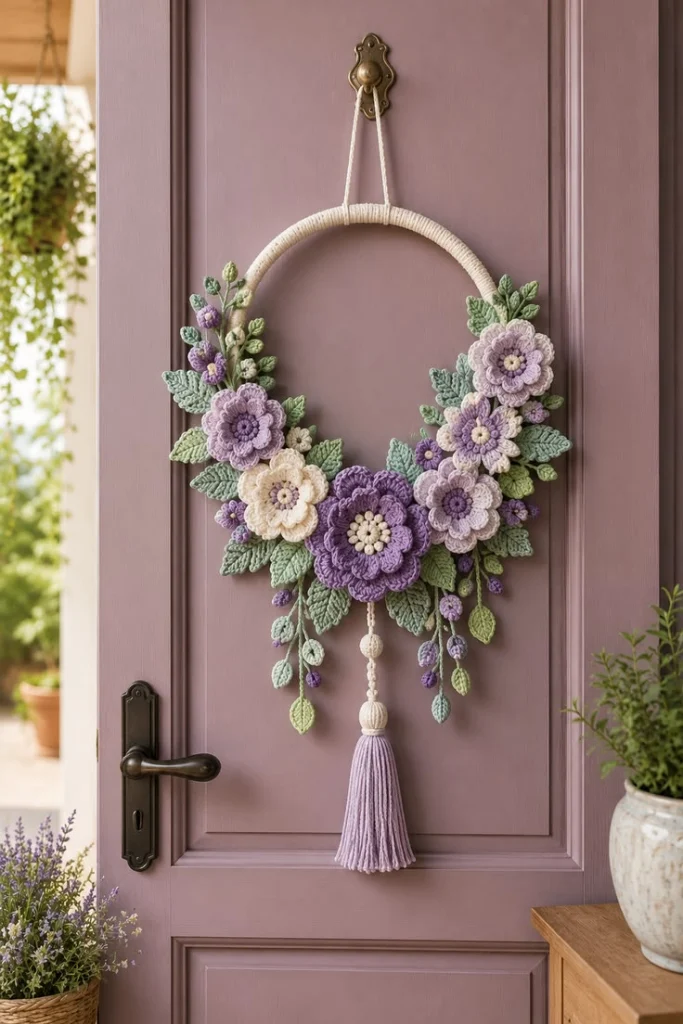
This crochet floral wreath pattern frames an open hoop with layered lavender, plum, and cream flowers, softly pointed green leaves, and trailing bud stems. An ivory-wrapped ring keeps the upper half light and open, while a long lavender tassel balances the dense arrangement below.
The design takes approximately 22–30 hours and suits experienced crocheters who enjoy detailed botanical work. You will make flowers with overlapping petal layers, embroidered centers, shaped leaves, tiny stuffed buds, and decorative covered beads before stitching everything onto a reinforced backing. The finished piece measures approximately 38 cm wide and 72 cm from the top of the hoop to the tassel ends, excluding its hanging loop.
Materials
- Sport-weight cotton yarn, approximately 125 m per 50 g Ivory 100 g; dusty lavender 100 g; pale lilac 50 g; deep plum 50 g; sage 100 g; olive 50 g. Quantities include a working allowance.
- 2.5 mm crochet hook Adjust if necessary to meet gauge.
- Rigid metal or wooden hoop 30 cm outside diameter; approximately 5 mm thick.
- Firm wool-blend felt in sage Two pieces, each 35 × 20 cm, for the concealed backing.
- Polyester stuffing A small handful for buds and covered beads.
- Tapestry needle, sharp sewing needle, and matching sewing thread For embroidery, backing, and secure assembly.
- Stitch markers, rustproof pins, scissors, and ruler For counting and blocking.
- Cardboard rectangle 22 cm long for the tassel.
- Cotton cord 80 cm of 2 mm cord for the hanging loop and central ornament.
Abbreviations
MRmagic ringchchainsl stslip stitchscsingle crochethdchalf double crochetdcdouble crochettrtreble crochetinc2 sc in one stitchdecsingle crochet 2 stitches togetherFLOfront loop onlyBLOback loop onlyst / stsstitch / stitchesGauge and Construction Notes
- Use US crochet terminology. For a gauge swatch, ch 23. Row 1: sc in the second ch from the hook and each remaining ch; turn. (22 sc)
- Rows 2–25: ch 1, sc in each st; turn. (22 sc per row) Block without stretching. Target gauge is 22 sc and 24 rows per 10 cm.
- Flower rounds are joined with a sl st to the first sc unless stated otherwise. Joining sl sts and turning chains do not count as stitches. Buds and beads use continuous rounds; mark the first stitch.
- Petal rounds use only the front loops of their supporting sc round. The unused back loops form a separate foundation for the next flower layer. Fold completed petals toward the center while working into those loops.
- Leave 25 cm sewing tails on flowers and leaves. Flowers and leaves remain unstuffed. Only buds and decorative beads receive stuffing. This botanical wreath has no eyes or facial details.
Ivory Hoop Cover
- With ivory, place a slip knot on the hook. Hold the working yarn behind the hoop. Insert the hook through the hoop opening, draw up a loop around the hoop, yarn over, and pull through both loops to make the first enclosing sc.
- Continue working sc around the hoop itself, sliding the stitches together as you go. Work 300 sc in total, including the first sc. Join to the first sc and fasten off.
- Distribute the 300 stitches evenly around the circumference. The covering should conceal the hoop without overlapping. Because hoop thickness and yarn compression vary, add or remove stitches if needed for complete coverage; record the final count.
- Position the join at 6 o’clock, where the flowers will hide it. Weave the ends through the backs of at least 15 covering stitches.
Large Three-Layer Plum Flower — Make 1
- Round 1: with deep plum, work 6 sc in MR. Join. (6)
- Round 2: inc in each st. Join. (12)
- Round 3: inc in each st. Join. (24)
- Round 4, inner petals: working FLO into Round 3, repeat the following 8 times: sl st in the next st, ch 2, work 2 dc in that same st; work 3 tr in the next st; work 2 dc in the next st, ch 2, sl st in that same st. Each petal uses 3 foundation stitches. Fasten off. (8 petals over 24 sts)
- Round 5, second foundation: attach deep plum to an unused back loop of Round 3. Working into those 24 back loops, repeat (sc in the next 3 loops, inc in the next loop) 6 times. Join. (30)
- Round 6, middle petals: working FLO into Round 5, repeat the following 10 times: sl st in the next st, ch 3, work 2 tr in that same st; work 3 tr in the next st; work 2 tr in the next st, ch 3, sl st in that same st. Fasten off. (10 petals over 30 sts)
- Round 7, outer foundation: attach deep plum to an unused back loop of Round 5. Repeat (sc in the next 4 back loops, inc in the next back loop) 6 times. Join. (36)
- Round 8, outer petals: working FLO into Round 7, repeat the Round 6 petal sequence 12 times. Fasten off, leaving a sewing tail. (12 petals over 36 sts)
- Block to approximately 11–12 cm across, cupping the petals slightly. With ivory, embroider 15 small French knots over the central disk, wrapping the needle twice for each knot. Keep all knots within the central 2.5 cm.
Medium Two-Layer Flowers — Make 4
- Make one flower in each combination: deep plum center with dusty lavender petals; dusty lavender center with ivory petals; deep plum center with pale lilac petals; dusty lavender center with pale lilac petals.
- Round 1: with the center color, work 6 sc in MR. Join. (6)
- Round 2: inc in each st. Join. (12)
- Round 3: inc in each st. Change to the petal color on the joining sl st. (24)
- Round 4: working FLO into Round 3, repeat the following 8 times: sl st in the next st, ch 2, work 2 dc in that same st; work 3 tr in the next st; work 2 dc in the next st, ch 2, sl st in that same st. Fasten off. (8 petals over 24 sts)
- Round 5: attach the petal color to an unused back loop of Round 3. Repeat (sc in the next 3 back loops, inc in the next back loop) 6 times. Join. (30)
- Round 6: working FLO into Round 5, repeat the following 10 times: sl st in the next st, ch 3, work 2 tr in that same st; work 3 tr in the next st; work 2 tr in the next st, ch 3, sl st in that same st. Fasten off. (10 petals over 30 sts)
- Block each flower to approximately 8–9 cm across. Embroider 7 ivory French knots in the center of the ivory flower and the lavender-centered pale lilac flower. On the other two flowers, add 9 short radial straight stitches in their center color to emphasize the central disk.
Small Layered Cream and Lavender Flower — Make 1
- Round 1: with dusty lavender, work 6 sc in MR. Join. (6)
- Round 2: inc in each st. Join. (12)
- Round 3: working FLO, repeat the following 6 times: sl st in the next st, ch 2, work 3 dc in that same st, ch 2, sl st in the next st. Fasten off. (6 petals over 12 sts)
- Round 4: attach ivory to an unused back loop of Round 2. Repeat (sc in the next back loop, inc in the next back loop) 6 times. Join. (18)
- Round 5: working FLO, repeat the following 6 times: sl st in the next st, ch 2, work 2 dc in that same st; work 3 tr in the next st; work 2 dc in the next st, ch 2, sl st in that same st. Fasten off. (6 petals over 18 sts)
- Block to approximately 6–7 cm across. Embroider 5 ivory French knots in the center.
Tiny Accent Blossoms — Make 8
- Make 5 in dusty lavender, 2 in deep plum, and 1 in ivory.
- Round 1: work 5 sc in MR. Join. (5)
- Round 2: in each of the 5 stitches work (sl st, ch 2, 2 dc, ch 2, sl st). Fasten off. (5 petals)
- Embroider one ivory French knot in each center; use dusty lavender for the ivory blossom. Finished diameter is approximately 2.5 cm.
Veined Leaves — Make 34
- Make 18 large leaves: 12 sage and 6 olive. With the chosen color, ch 9.
- Large leaf, Round 1: beginning in the second ch from the hook, work sc, hdc, dc in each of the next 3 chains, hdc, sc; work 3 sc in the last chain. Rotate to work along the unused underside loops: sc, hdc, dc in each of the next 3 loops, hdc, sc. Join to the first sc. (17 sts: 7 on each side and 3 at the tip)
- Large leaf, Round 2: sl st in each of the first 8 sts, (sl st, ch 2, sl st) in the next st, then sl st in each of the last 8 sts. Join and fasten off. (18 sl sts and one ch-2 point)
- Make 16 small leaves: 10 sage and 6 olive. With the chosen color, ch 7.
- Small leaf, Round 1: beginning in the second ch from the hook, work sc, hdc, dc, hdc, sc; work 3 sc in the last chain. Along the underside, work sc, hdc, dc, hdc, sc. Join. (13 sts: 5 on each side and 3 at the tip)
- Small leaf, Round 2: sl st in each of the first 6 sts, (sl st, ch 2, sl st) in the next st, then sl st in each of the last 6 sts. Join and fasten off. (14 sl sts and one ch-2 point)
- Embroider a central vein with a line of backstitches along the foundation chain. Add 3 diagonal branch veins on each side of large leaves and 2 on each side of small leaves. Use olive on sage leaves and sage on olive leaves.
- Block large leaves to approximately 5 × 2.5 cm and small leaves to 3.5 × 2 cm. Pin the tips sharply and leave the bases slightly cupped.
Shaped Buds — Make 16
- Make 8 deep plum buds, 4 dusty lavender buds, and 4 olive buds. Work in continuous rounds.
- Round 1: work 6 sc in MR. (6)
- Round 2: repeat (sc, inc) 3 times. (9)
- Round 3: sc in each st. (9)
- Round 4: repeat (sc, dec) 3 times. (6) Add a small pinch of stuffing.
- Round 5: dec 3 times. (3) Fasten off and draw the tail through the remaining 3 stitches to close.
- With sage, make 3 long straight stitches from the closed base to halfway up the bud, spaced evenly around it. These form the narrow calyx. Leave the colored tip visible.
- Each bud measures approximately 1.5–2 cm long. Keep the stuffing light so the shape remains oval.
Upper Botanical Sprays — Make 2
- Main stem: with sage, ch 31. Sl st in the second ch from the hook and each remaining ch. Fasten off. (30 sl sts; approximately 13 cm long)
- Branch 1: attach sage at the 6th main-stem stitch counted from the lower end; ch 7, sl st in the second ch from the hook and the next 5 chains, then sl st back into the attachment stitch. Fasten off. (6 branch sl sts plus one anchoring sl st)
- Branch 2: repeat at the 13th main-stem stitch on the opposite side. Branch 3: repeat at the 20th main-stem stitch, alternating sides.
- For each spray, sew one bud to the tip of each branch and one bud to the main-stem tip. Use 2 plum, 1 lavender, and 1 olive bud per spray. (4 buds per spray)
- Sew 3 small leaves to each spray: one at each branch junction. Angle each leaf away from the stem, alternating sides. Reserve the lower 3 cm of each stem for concealment behind the flowers.
Trailing Vines — Make 4
- Make 2 long sage vines: ch 43, then sl st in the second ch from the hook and each remaining ch. Fasten off. (42 sl sts; approximately 19 cm)
- Make 2 shorter olive vines: ch 33, then sl st in the second ch from the hook and each remaining ch. Fasten off. (32 sl sts; approximately 14 cm)
- On each vine, attach a side branch at the 10th stitch from its upper end: ch 6, sl st in the second ch from the hook and the next 4 chains, then sl st into the attachment stitch. Repeat at the 20th stitch, facing the opposite side. (Each branch has 5 sl sts plus one anchoring sl st.)
- Sew one bud to each branch tip. Across all 4 vines, use the remaining 4 plum, 2 lavender, and 2 olive buds. (8 buds total)
- Sew one small leaf to the end of each vine and one small leaf to the upper branch junction. This uses 8 small leaves. Add one large leaf near the upper end of each long vine. Reserve the remaining leaves for the main floral cluster.
- Steam lightly from a distance, following the yarn manufacturer’s care instructions. Let the vines cool while hanging so they fall naturally.
Covered Beads and Tassel
- Small ivory bead, Round 1: work 6 sc in MR. (6)
- Round 2: inc in each st. (12)
- Rounds 3–4: sc in each st. (12 per round)
- Round 5: dec 6 times. (6) Stuff lightly, fasten off, and draw the opening closed. Finished diameter is approximately 1.5 cm.
- Large ivory bead, Round 1: work 6 sc in MR. (6)
- Round 2: inc in each st. (12)
- Round 3: repeat (sc, inc) 6 times. (18)
- Rounds 4–6: sc in each st. (18 per round)
- Round 7: repeat (sc, dec) 6 times. (12) Stuff firmly enough to hold an oval shape.
- Round 8: dec 6 times. (6) Close and fasten off. Finished length is approximately 2.5 cm. Embroider 8 evenly spaced ivory straight stitches lengthwise around the bead to create shallow ribs.
- Wrap dusty lavender yarn 70 times around the 22 cm length of the cardboard. Pass a separate 30 cm lavender tie under all wraps at one end and knot tightly. Cut all wraps at the opposite end. Fold the strands together beneath the tie.
- Wrap ivory yarn firmly around the bundle 1.5 cm below its folded top, making 12 wraps. Knot securely and bury the ends inside the tassel. Trim the tassel to 21 cm from folded top to ends.
- Cut 25 cm from the cotton cord. Thread on the small bead, then tie 3 overhand knots below it, spaced about 1 cm apart. Thread on the large bead and knot immediately below it. Use a tapestry needle to guide the cord through the stuffed beads.
- Tie the tassel’s top tie securely around the cord below the large bead. Sew through the tie and cord several times, then conceal the ends inside the tassel. Leave approximately 8 cm from the hoop attachment point to the top of the large bead; the bead-and-tassel ornament should hang approximately 32 cm below the hoop.
Backing and Exact Placement
- Place the covered hoop on paper and trace its inner and outer edges. Draw a crescent following the lower arc from 8:30 clockwise through 6 o’clock to 3:30. Extend its lower edge 5 cm below the hoop and its upper edge 2 cm above the lower hoop arc. Round both ends so the backing stays hidden behind the flowers.
- Use the paper template to cut 2 matching felt crescents. Place one behind the lower hoop. With doubled sage yarn, couch it to the hoop at 12 evenly spaced positions, making 3 snug stitches around the hoop at each position.
- Lay the wreath flat with 12 o’clock at the top. Pin the large plum flower centered at 6 o’clock, with its center approximately 1 cm below the hoop’s lower edge.
- Pin the dusty lavender medium flower at 8 o’clock and the ivory medium flower at 7 o’clock. Pin the plum-centered pale lilac medium flower at 4:30 and the lavender-centered pale lilac medium flower at 3 o’clock. Pin the small cream-and-lavender flower at 3:45, between the two right-hand medium flowers.
- Overlap neighboring flowers by approximately 1–2 cm. Their exact positions may shift slightly with blocked motif size; preserve the open center and keep the large plum flower lowest.
- Position the upper sprays behind the flowers at 8:30 and 2:30, with tips reaching approximately 9:30 and 1:30. Sew the concealed lower 3 cm of each stem to the felt and hoop covering.
- Attach the 4 trailing vines behind the lower flowers: long vines at 6:45 and 5:15, shorter vines at 7:15 and 4:45. Anchor the upper 3 cm of each vine with 4 separate stitches.
- Arrange the remaining 16 large leaves and 2 small leaves around the outside and inner lower edge of the flower cluster. Place large leaves in pairs or trios, with tips radiating outward. Keep the small leaves beside the upper medium flowers.
- Place the 8 accent blossoms in visible gaps: 2 beside the left upper flower, 2 beside the ivory flower, 2 along the lower right edge, and 2 near the right upper spray. Check that the felt is concealed before sewing.
Finishing
Sew leaves and stems first, catching their bases and one point along each central vein. Sew the flowers through their foundation disks with at least six attachment stitches per flower. Catch the felt and, where reachable, the hoop covering. Leave petal edges free so the layers keep their depth. Stitch each accent blossom through its center and beneath two petals.
Tie the central ornament cord around the hoop at 6 o’clock, behind the plum flower. Add several sewing stitches through the knot and adjacent hoop covering. Position the small bead just below the petals and let the larger bead sit directly above the tassel. Sew the second felt crescent over the back using small whipstitches approximately 5 mm apart, enclosing attachment tails and knots.
Use the remaining 55 cm of cotton cord for the hanger. Pass it around the hoop at 11:30 and 12:30 and tie the ends together above the hoop, forming a hanging loop with an approximately 15 cm drop. Adjust the knot until the wreath hangs level, then secure it with sewing thread. Hang the wreath overnight, check that the flowers remain supported, and give the tassel a final even trim.
Tips for Success
- Mark one unused back loop before starting each petal round. It makes the next foundation easier to find beneath the overlapping petals.
- Block the flower layers with your fingers and pin only their foundations. Flattening the whole flower removes the soft cupping visible in the reference.
- Photograph the pinned arrangement before sewing. Use that placement guide while lifting flowers to secure the leaves underneath.
- Attach heavy flowers through their central disks and the felt backing. The petals alone cannot support their weight.
- Comb the tassel gently with your fingers and trim it while the wreath hangs. A flat-table trim can look uneven once the strands settle.
Common Mistakes to Avoid
- Working through both loops during a petal round removes the foundation for the next layer. Undo that round and use FLO throughout.
- Accidentally counting petal chains as foundation stitches changes the petal spacing. Each large petal consumes exactly 3 supporting sc stitches; mark every third supporting stitch if needed.
- Pulling leaf edging too tightly makes the leaves roll into tubes. Loosen the slip stitches or use a hook 0.25 mm larger for the edging only.
- Overstuffing buds makes them round and bulky. Remove filling until each bud holds a narrow oval shape.
- Adding flowers before supporting the lower hoop lets the arrangement twist forward. Install the felt backing first and anchor each flower at several points.
Ways to Customize This Pattern
- Use three closely related lavender shades for softer shading while retaining ivory centers and the sage foliage.
- Give the ivory medium flower a pale lilac outer layer by changing colors when attaching Round 5.
- Shorten the tassel to 15 cm for a wreath displayed above a narrow console; leave the covered beads and cord spacing unchanged.
- For a fuller lower cluster, add 4 large sage leaves using the existing instructions and tuck them behind the central plum flower.
Frequently asked questions
A 35 cm hoop will create a more open arrangement. Keep the flowers grouped along the lower arc, lengthen the upper sprays by 5 chains each, and cut the felt backing from a new tracing. For the dense proportions shown here, use the specified 30 cm hoop.
The supporting rounds expand from 24 to 30 to 36 stitches. Working one petal over every 3 stitches produces 8, 10, and 12 petals, giving the outer layers enough width to surround the inner layer.
Secure the felt crescent firmly to the hoop before adding flowers. Sew through each flower’s foundation disk at several widely spaced points, and include the hoop covering in at least two attachment stitches wherever the disk overlaps the hoop.
It is best suited to an indoor door or a sheltered, dry entryway. Cotton flowers and the tassel absorb moisture, and prolonged sunlight can fade the lavender shades. Dust gently and spot-clean the motifs rather than soaking the assembled wreath.
The finished Lavender Garden Crochet Floral Wreath Pattern