Mandala Flower Vine Table Runner Crochet Pattern
Beginner Friendly
Perfect for those just starting their crochet journey, with clear instructions and simple techniques
Single-Day Project
A satisfying project you can complete in a single afternoon or evening.
Handmade Gift
A beautiful keepsake — free forever. Read online or print at home.
About This Mandala Flower Vine Table Runner Crochet Pattern
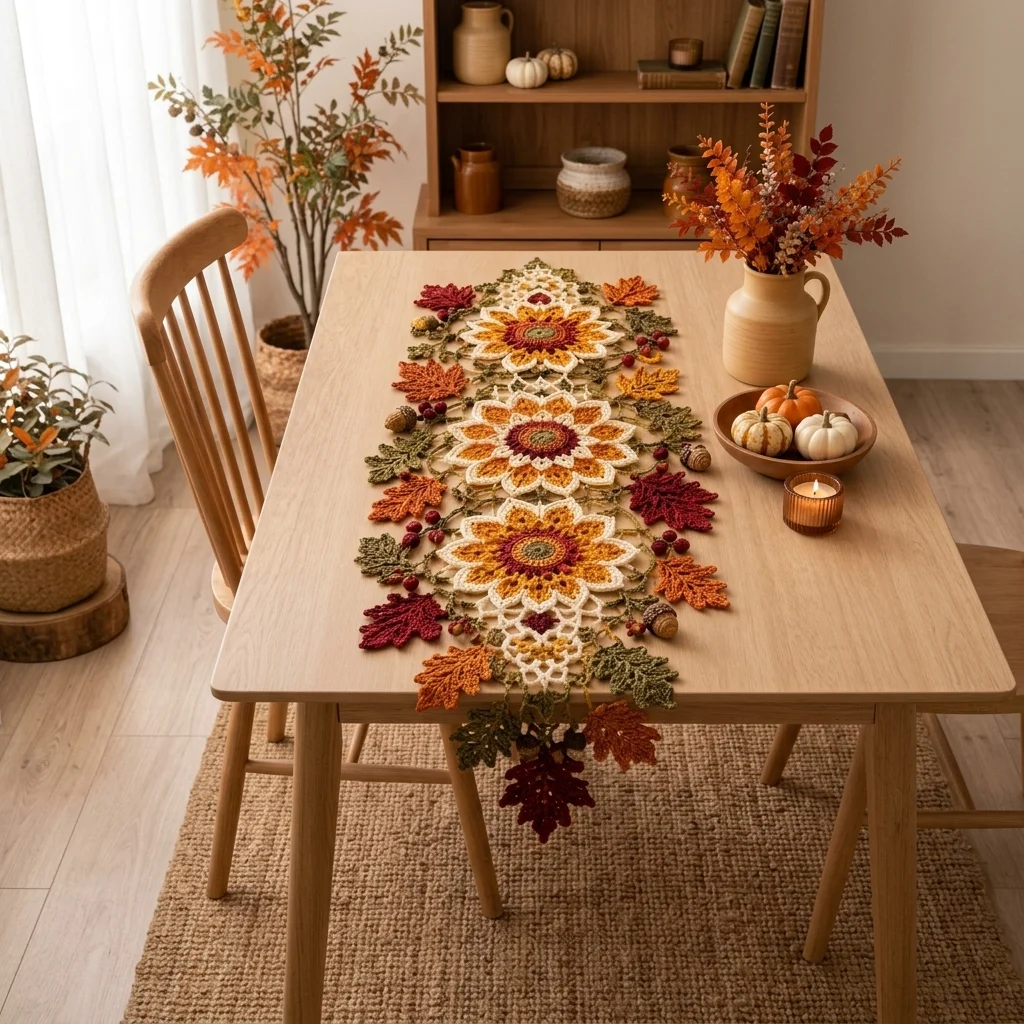
This crochet mandala flower table runner pattern links three large, richly layered mandala flowers, each built from a green center ring, a burgundy round, a mustard gold round, and a scalloped white outer round, down a connecting mesh vine. The vine is bordered on both sides by large maple leaves in rust, gold, and burgundy, with small crocheted acorns and berry clusters tucked in between.
What makes this design distinctive is the mandala construction itself: four full color rounds build outward from a small center in concentric rings, each round using a different stitch pattern, solid rounds near the center, sharp petals further out, so the flower reads as a detailed, doily-like medallion rather than a simple layered bloom. Connecting the mandalas with an open mesh vine, rather than joining them directly, lets the runner drape slightly and keeps the design from feeling too solid or heavy. Expect to spend 24-30 hours total across 3 mandalas, the connecting mesh, and all the leaf, acorn, and berry accents.
This is an advanced pattern, best suited to someone experienced with multi-round mandala or doily construction and comfortable managing several color changes per motif, rather than someone attempting their first round medallion.
Materials
- DK weight cotton yarn, sage green ~30g, mandala centers
- DK weight yarn, burgundy wine ~50g, mandala round 2
- DK weight yarn, mustard gold ~60g, mandala round 3
- DK weight yarn, cream/white ~60g, mandala outer round and mesh vine
- DK weight yarn, rust orange ~50g, leaves
- DK weight yarn, amber gold ~40g, leaves
- DK weight yarn, deep burgundy ~40g, leaves
- DK weight yarn, olive green ~20g, vine connectors
- Small amount of brown yarn acorn caps
- Small amount of tan yarn acorn bodies
- Small amount of dark red yarn berry clusters
- Crochet hook, small 3 mm (US C/2), for mandalas and mesh
- Crochet hook, larger 3.5 mm (US E/4), for leaves
- Tapestry/yarn needle
- Steam iron and pressing cloth, or blocking mat and pins
- Straight pins, for positioning accents before sewing
- Sharp scissors
Abbreviations
chchainsl stslip stitchscsingle crochethdchalf double crochetdcdouble crochettrtreble/triple crochetMRmagic ringch-spchain spaceincincrease (2 sc in one st)st(s)stitch(es)reprepeatFOfasten offMandala Flower (make 3)
- Round 1 (sage green): 8 sc in MR. Sl st to join. (8 sts)
- Round 2 (sage green): inc in each st around. Sl st to join, FO. (16 sts)
- Round 3 (burgundy wine): join in any st. *dc 2, ch 1, sl st in same st; rep from * around all 16 sts to form a ring of small V-shaped clusters. Sl st to join, FO. (16 clusters)
- Round 4 (mustard gold): join in a ch-1 sp between clusters. *sc in sp, ch 3, hdc 3 in same sp, ch 3, sl st in same sp; rep from * around all 16 sps to form a ring of larger petals. Sl st to join, FO. (16 petals)
- Round 5 (cream/white): join behind Round 4, working into the base sts between petals. *ch 4, dc 5 in next base st, ch 4, sl st in same st; rep from * around to form 16 large outer petals with a scalloped edge. Sl st to join, FO leaving a long tail.
- Repeat this entire sequence to make 3 mandalas total.
Connecting Mesh Vine
- With cream, ch 25. Row 1: dc in 6th ch from hook, *ch 1, skip 1 ch, dc in next ch; rep from * across. This forms a short mesh strip.
- Rows 2-4: ch 4, turn, dc in next dc, *ch 1, dc in next dc; rep from * across, ending dc in top of turning ch, maintaining the mesh pattern.
- FO leaving long tails at both ends. Make 2 mesh strips total, one to connect Mandala 1 to Mandala 2, one to connect Mandala 2 to Mandala 3.
Maple Leaf Motif (make approximately 12: mix of rust, amber gold, and deep burgundy)
- Ch 4, sl st in first ch to form a small foundation ring.
- Lobe 1, top center: ch 12. Starting in 2nd ch from hook: sl st, sc 2, hdc 3, dc 3, tr 2 (10 sts). Sl st into ring.
- Lobe 2, upper right: ch 9. Starting in 2nd ch from hook: sl st, sc 2, hdc 3, dc 2 (8 sts). Sl st into ring.
- Lobe 3, lower right: ch 6. Starting in 2nd ch from hook: sl st, sc 3, hdc 1 (5 sts). Sl st into ring.
- Lobe 4, lower left: repeat Lobe 3 exactly. Sl st into ring.
- Lobe 5, upper left: repeat Lobe 2 exactly. Sl st into ring.
- Sl st into base of Lobe 1 to close. FO leaving a 15-20 cm tail for joining and veining. Repeat for approximately 12 leaves total, 4 per mandala.
Acorns (make approximately 6)
- Body, with tan: 6 sc in MR, inc around (12 sts), sc around even 2 rounds, then dec around back to 6 sts, stuffing very lightly with a few scraps or leaving unstuffed for a flatter accent. FO leaving a short tail.
- Cap, with brown: 6 sc in MR, inc around once (12 sts), sc around even 1 round. FO leaving a short tail.
- Sew the cap over the top of the body to form a complete acorn. Repeat for 6 total, 2 per mandala cluster.
Berry Clusters (make approximately 12)
- With dark red, 5 sc in MR. Do not join.
- Pull the MR tail tight to close, then sl st into the first sc to close the round into a small tight bobble.
- FO leaving a short tail for attaching. Repeat for approximately 12 total, grouped in small clusters of 2-3 near each mandala.
Assembly
- Lay the 3 mandalas in a line with a mesh vine strip between each pair, and sew the mesh strips securely to the outer petal round of the mandalas on each end.
- Arrange 4 leaves around each mandala, angled outward at the top and bottom, and pin before sewing.
- Tack an acorn pair and a berry cluster near the base of the leaves on at least one side of each mandala, mixing placement slightly so it doesn’t repeat identically at each flower.
- Sew leaves down through their base only, at 2-3 points, so their tips stay slightly raised off the surface, then secure the acorns and berries alongside them.
Finishing
Once every mandala, leaf, acorn, and berry cluster is attached, steam-block the whole runner flat, being careful to keep the mandala’s scalloped outer petals spread evenly and not pressed flat. Check the connecting mesh vine sections especially, gently opening the ch-1 spaces so they don’t look pulled tight after handling. Let the piece dry completely flat before moving it to the table.
Tips for Success
- Keep each mandala’s 4 color rounds consistent in tension; a tight inner round with loose outer petals will make the flower sit unevenly once blocked.
- Make and block one full mandala before starting the mesh vine, so your vine length matches the actual gap needed between finished flowers.
- Angle leaves outward and slightly upward from each mandala rather than flat against the table, to keep some of the dimensional look shown in the photo.
- Group acorns and berries asymmetrically around the mandalas rather than placing them identically at each flower, for a more natural look.
- Block the mesh vine sections gently open; over-steaming can flatten the ch-1 spaces until the vine looks solid rather than airy.
Common Mistakes to Avoid
- Working all 4 mandala rounds in the same stitch pattern loses the layered, doily-like detail. Fix: follow the distinct stitch pattern given for each round, cluster, petal, and scallop.
- Sewing the mesh vine to the mandala’s inner rounds instead of the outer petal round leaves an awkward, bunched-up connection. Fix: always attach the vine to the outermost cream petal round.
- Overstuffing the acorn bodies makes them look like separate beads rather than blending into the leaf clusters. Fix: leave acorns lightly stuffed or unstuffed for a flatter, more accent-like shape.
- Placing leaves at identical angles around every mandala looks repetitive across the runner’s length. Fix: vary leaf angle and spacing slightly at each of the 3 flower positions.
- Skipping blocking on the mesh vine sections leaves them looking tighter and stiffer than the flowers on either side. Fix: block the entire runner as one piece so tension reads consistently throughout.
Ways to Customize This Pattern
- Reduce to 2 mandalas with one mesh vine section for a shorter table centerpiece instead of a full runner.
- Swap the burgundy and mustard color rounds for blues and creams for a different seasonal palette.
- Skip the acorns and use only leaves and berries for a simpler accent set around each mandala.
- Widen the mesh vine sections for more visible drape between mandalas on a longer table.
- Scale each mandala down with a finer thread and smaller hook for a set of matching coasters using the same 4-round construction.
Frequently asked questions
This depends on your finished mandala size and how much spacing you want. Block one mandala first, measure the gap you’d like between flowers, and work the mesh strip to that length rather than a fixed measurement.
Yes, though the runner will sit stiffer and won’t drape as naturally. If you skip the vine, overlap the outer petal rounds of adjacent mandalas slightly and whipstitch them together instead.
No. These are small accent pieces meant to sit flat alongside the leaves, so light stuffing or none at all keeps them proportional and easy to sew flush against the runner’s surface.
This is usually a tension issue in Round 5. Work the ch-4 and dc-5 petal clusters a little looser than your instinct, and block firmly afterward to open up the scalloped edge fully.
The finished Mandala Flower Vine Table Runner Crochet Pattern