Navy Speckle Linen Stitch Crochet Blanket Pattern
Beginner Friendly
Perfect for those just starting their crochet journey, with clear instructions and simple techniques
Single-Day Project
A satisfying project you can complete in a single afternoon or evening.
Handmade Gift
A beautiful keepsake — free forever. Read online or print at home.
About This Navy Speckle Linen Stitch Crochet Blanket Pattern
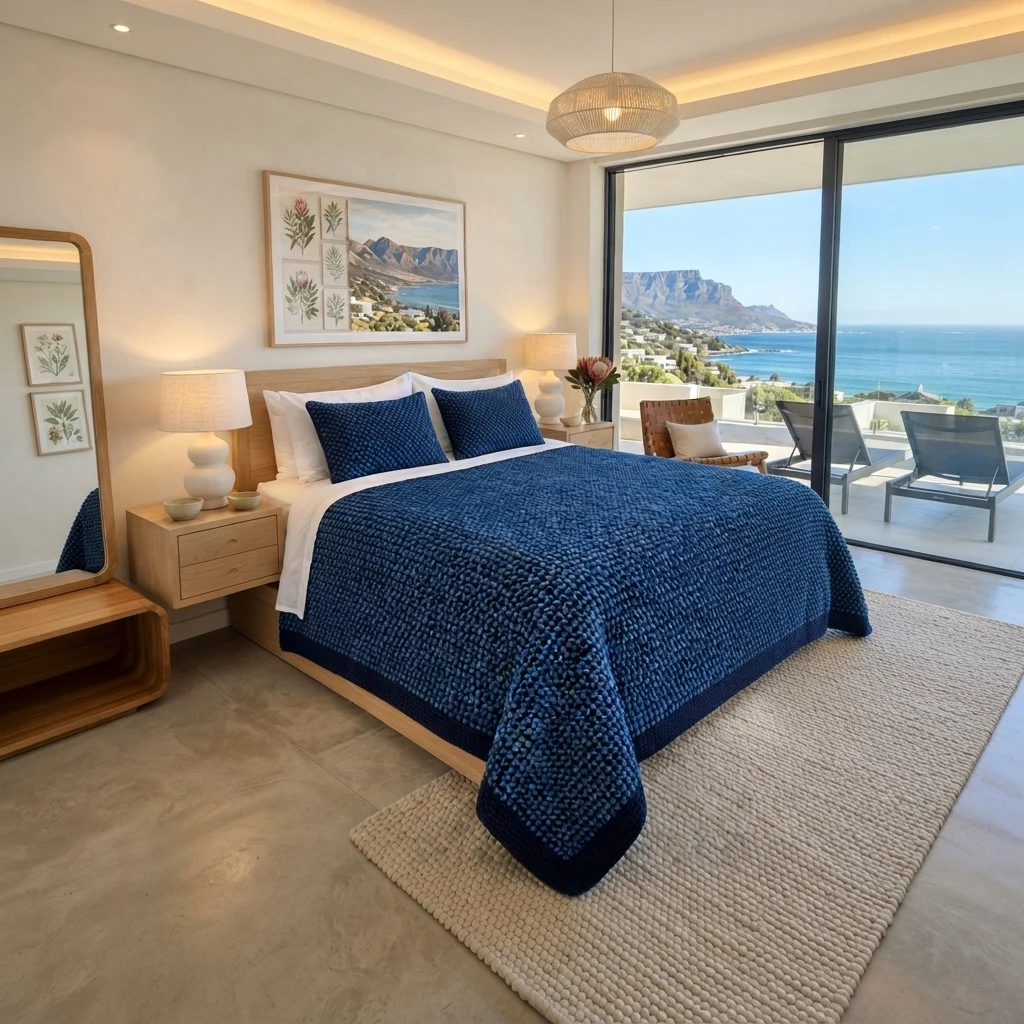
This linen stitch crochet blanket pattern makes a dense, speckled throw in navy and mid blue, finished with a wide solid navy border. The two colors alternate every row, and the offset stitches of linen stitch scatter them into a fine, even speckle, the same look as the blanket in the photo.
It is an advanced project because of its size and the discipline it needs. The stitch is a simple two-row repeat, but you will work nearly 200 rows of 141 stitches, change color at the end of every row, and keep your tension and stitch count steady across the whole piece. The border adds twelve more rounds of more than 700 stitches. Plan on 40 to 50 hours in total.
It suits crocheters who are comfortable with chunky yarn and long projects and want a heavy, tailored throw for a bed or sofa. The finished blanket is about 150 x 200 cm, and it is easy to resize because the width changes in steps of 2 chains.
Materials
- Chunky cotton-blend yarn, navy (N) about 2.6 kg, estimated
- Chunky cotton-blend yarn, mid blue (B) about 1.4 kg, estimated
- Crochet hook 6.5 mm
- Yarn needle
- Stitch markers one for every 20 rows
- Flat surface and pins for blocking
Abbreviations
chchainscsingle crochetsl stslip stitchspspace (the gap made by a ch 1)st(s)stitch(es). Each sc and each ch-1 sp counts as one stitch.RSright sideFOfasten offNnavy yarnBmid blue yarn*...*repeat the stitches between the asterisks the number of times givenStitch Guide: Two-Color Linen Stitch
- Every row has 141 stitches: sc and ch-1 spaces together. The pattern is a two-row repeat, with a different color on every row.
- Odd rows are worked in N and even rows in B.
- Change color on the last pull-through of the last stitch of each row, so the new color is ready for the next row. Drop the old color, leave it hanging at the edge and pick it up again two rows later.
- Carry the unused color loosely up the side edge. Do not pull it tight, and do not cut it. The border will cover it.
- Always work each sc into the ch-1 space of the row below, never into the sc, except at the very first and last stitch of a row.
- The ch 1 at the start of each row is a turning chain and does not count as a stitch.
Body
- Foundation: with N, ch 142.
- Row 1 (RS, N): sc in the 2nd ch from the hook, *ch 1, skip the next ch, sc in the next ch*, repeat from * to * 70 times in total (71 sc and 70 ch-1 sps, 141 sts). Change to B on the last pull-through of the last sc. Turn.
- Row 2 (B): ch 1, sc in the first sc, sc in the next ch-1 sp, *ch 1, skip the next sc, sc in the next ch-1 sp*, repeat from * to * 69 times in total, sc in the last sc (72 sc and 69 ch-1 sps, 141 sts). Change to N on the last pull-through. Turn.
- Row 3 (N): ch 1, sc in the first sc, *ch 1, skip the next sc, sc in the next ch-1 sp*, repeat from * to * 69 times in total, ch 1, skip the next sc, sc in the last sc (71 sc and 70 ch-1 sps, 141 sts). Change to B on the last pull-through. Turn.
- Rows 4-192: repeat rows 2 and 3 (even rows in B as row 2, odd rows in N as row 3) until you have 192 rows in all. Row 192 is a row 2 type row, in B.
- Place a stitch marker in the turning chain every 20 rows so you can check your length at a glance. The body should measure about 127 cm wide and 173 cm long.
- After row 192, FO B. Do not turn. Join N for the border.
- Check your body: every row must have exactly 141 stitches. Count the ch-1 sps on a few rows. There should be 70 on odd rows and 69 on even rows.
Solid Navy Border (N)
- Round 1: with the RS facing you, join N in the top right corner stitch. Ch 1 and work 3 sc in the corner st. Sc in each of the next 139 sts and sps along the top. Work 3 sc in the next corner st.
- Work 192 sc evenly down the left side, one in each row end. Work 3 sc in the bottom corner st, 139 sc along the foundation edge, 3 sc in the next corner st, and 192 sc up the right side. Join with a sl st to the first sc (674 sts).
- Rounds 2-12: ch 1, sc in each st around, working 3 sc in the middle st of each 3-sc corner group. Join with a sl st at the end of each round. Each round adds 8 stitches (round 2 has 682, round 12 has 762).
- After round 12, FO and weave in the end.
- Check your border: it should be about 12 cm wide, and the corners should lie flat without cupping or ruffling.
Finishing
Weave in all ends along the back, following the stitches for at least 8 cm. Block the blanket by laying it flat on towels, pinning the corners and edges to about 150 x 200 cm, and misting it with water. Let it dry fully before moving it. Blocking evens the speckle and flattens the border.
Drape the blanket over the foot of the bed with the navy border hanging down, and it will look like the photo.
Tips for Success
- Count your stitches at the end of every tenth row. There should always be 141, and the count is the easiest way to catch a skipped space early.
- Pull the new color through on the last stitch of the previous row, not at the start of the next one, so the edge stays neat and the color never changes mid-row.
- Wind your yarn into center-pull balls before you start, and keep the navy and blue balls on opposite sides of you so they do not tangle.
- Work the ch 1 loosely. A tight chain pulls the stitches together and makes the speckle look cramped.
- Mark the right side with a stitch marker on row 1, since the front and back look almost the same.
Common Mistakes to Avoid
- Working a sc into the sc below instead of the ch-1 space stacks the stitches and destroys the speckle. Always look for the gap before you insert the hook.
- Skipping the wrong stitch after a ch 1 shifts the pattern by one. If a row has 140 or 142 stitches, rip back to the last correct row.
- Pulling the carried yarn too tight puckers the side edge. Let it hang loose and check the edge every 10 rows.
- Working a different number of stitches at the corners makes the border ruffle or cup. Use exactly 3 sc in every corner on every round.
- Cutting the yarn at each color change leaves hundreds of ends. Carry the yarn up the side, as the pattern says.
Ways to Customize This Pattern
- Swap the colors for charcoal and gray, forest green and sage, or burgundy and rose, and keep the same pattern.
- Make the border in the lighter blue, or work the last 3 rounds in B for a thin contrast line.
- Make a baby blanket by chaining 82 and working 112 rows (about 73 x 100 cm), with 4 border rounds.
- Make matching pillow covers by chaining 54 and working 52 rows for each of two panels, then sewing them together on three sides with a button closure.
- Use a thicker yarn and an 8 mm hook for a faster, looser blanket, and recalculate the chain from your swatch.
Frequently asked questions
The amounts above are estimates of about 2.6 kg of navy and 1.4 kg of blue. Linen stitch uses less yarn than solid single crochet, but the border uses a lot of navy. Weigh your swatch, scale it up by area, and add about 10 percent.
Chain 2n + 2, where n is the number of repeats in row 1. In this pattern n is 70. Work row 1 with n repeats, and rows 2 and 3 with n – 1 repeats. Every extra 2 chains adds about 2 cm. For the border, the stitches between the top corners are 2n – 1.
It keeps the edge straight. The double sc at the start of every even row stops the side from curving in, and it gives the blanket a firm edge that the border can sit on.
With a washable cotton blend, wash it on a gentle cycle in cool water, press out the water without wringing, and lay it flat to dry. Hanging a wet blanket this heavy stretches it out of shape.
The finished Navy Speckle Linen Stitch Crochet Blanket Pattern