Pink Four-Petal Flower Filet Bedspread and Shams Crochet Pattern
Beginner Friendly
Perfect for those just starting their crochet journey, with clear instructions and simple techniques
Single-Day Project
A satisfying project you can complete in a single afternoon or evening.
Handmade Gift
A beautiful keepsake — free forever. Read online or print at home.
About This Pink Four-Petal Flower Filet Bedspread and Shams Crochet Pattern
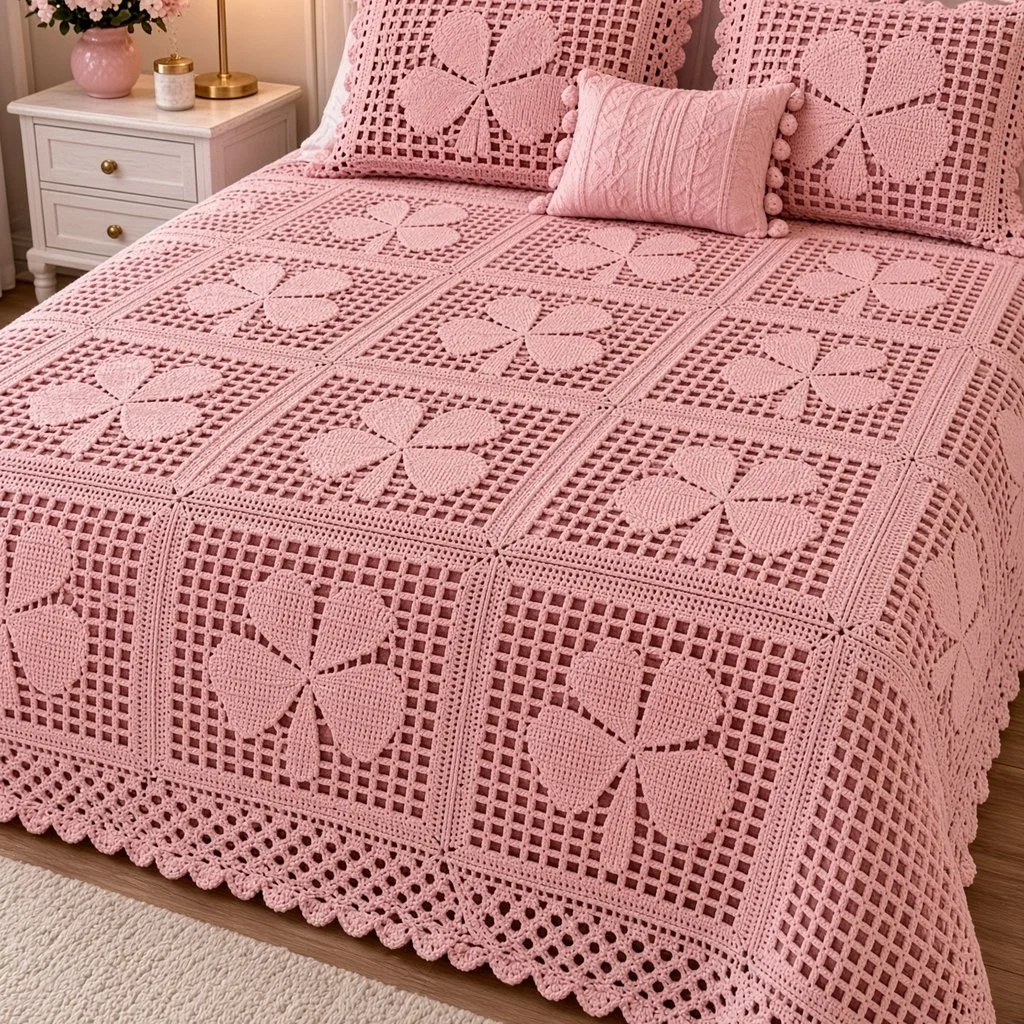
This filet crochet flower bedspread is worked in a soft blush pink, with a large four-petal flower charted into the open mesh of every square. The rounded petals are filled blocks, separated by a fine open cross, with a single block at the center. A solid frame around each square gives it a clean edge, and when the 42 squares are joined with raised seams, the flowers sit in neat rows across the bed. A scalloped border, two Euro shams and a ribbed lumbar pillow complete the set.
Filet crochet uses only double crochet and chains: a block is three double crochets and a space is two chains and one double crochet. The flower appears simply from where the blocks are placed, following a chart, so the work is easy to memorize once you’ve done a square. In one solid color, the contrast between the filled petals and the open mesh does all the work.
The set takes about 120 to 140 hours, with each square taking around two hours. It suits a crocheter who knows basic filet crochet and is comfortable following a chart row by row.
Materials
- Worsted weight cotton blend, blush pink about 5,400 m (27 skeins of 100 g / 200 m)
- 5 mm crochet hook
- Pompom maker about 3 cm, for the lumbar pillow
- A printed copy of the chart and a pencil, for crossing off rows
- Tapestry needle, stitch markers and scissors
- Two 70 cm square Euro pillows and one 30 x 50 cm cushion form
Abbreviations
chchainscsingle crochethdchalf double crochetdcdouble crochetsl stslip stitchrev screverse single crochet (crab stitch), worked left to rightblocka filled filet squarespacean open filet squareBLOback loop onlyskskipspspacest(s)stitch(es)rndroundreprepeatRS / WSright side / wrong sideFilet Basics
- Every row has 25 filet squares, worked over 76 sts. Each square is the dc at its left edge plus 2 sts.
- Every row starts with ch 3, which counts as the first dc.
- Block over a block: dc in next 3 dc.
- Block over a space: 2 dc in the ch-2 sp, dc in next dc.
- Space over a block: ch 2, sk next 2 dc, dc in next dc.
- Space over a space: ch 2, dc in next dc.
- The first and last squares of every row are blocks, forming the solid frame.
Flower Chart (25 x 25)
- Key:
Bblock,ospace. The chart is symmetrical, so it reads the same in either direction. - Row 1:
BBBBBBBBBBBBBBBBBBBBBBBBB - Rows 2-3:
BoooooooooooooooooooooooB - Row 4:
BooooBBBoooooooooBBBooooB - Row 5:
BoooBBBBBoooooooBBBBBoooB - Rows 6-7:
BooBBBBBBBoooooBBBBBBBooB - Row 8:
BooBBBBBBBBoooBBBBBBBBooB - Row 9:
BoooBBBBBBBoooBBBBBBBoooB - Row 10:
BooooBBBBBBoooBBBBBBooooB - Row 11:
BooooooBBBBBoBBBBBooooooB - Row 12:
BoooooooooBBoBBoooooooooB - Row 13:
BoooooooooooBoooooooooooB - Rows 14-25: work Rows 12 back to 1 in reverse order (Row 14 = Row 12, Row 15 = Row 11, and so on, ending with Row 25 = Row 1).
- Each square has 297 blocks and 328 spaces. The four rounded petals point in toward the center, separated by an open cross, with one block at the very center.
Working the Square (make 50)
- Foundation: ch 78.
- Row 1: dc in 4th ch from hook (the skipped ch count as the first dc) and in each ch across. (76 sts = 25 blocks)
- Rows 2-25: ch 3, turn, and work the 25 squares of the matching chart row, using the filet basics above. (76 sts = 25 squares in every row)
- Cross off each row on your printed chart as you finish it.
- You need 42 squares for the bedspread and 8 for the shams.
Edging Round (all squares)
- Rnd 1: don’t turn. Ch 1, work around the square: (sc, ch 2, sc) in each corner, 74 sc across the top and bottom edges (1 sc in each st, skipping the corner sts), and 76 sc along each side edge (3 sc in each row end, plus 1 extra in the middle row end). Join. Fasten off. (78 sc per side between corner ch-2 sps, 312 sc)
- Block each square to about 34 cm.
Joining the Squares
- Lay out 42 squares, 6 across and 7 long, all with the same side up.
- Join method: hold two squares WS together with the edges matched. Sl st through both loops of both squares in each matching st, starting and ending in the corner ch-2 sps. (80 sl st per side, including both corners) This leaves a raised ridge on the RS.
- Join the squares into rows of 6, then join the rows along their long edges.
- Where four corners meet, work through all four corner sps so no gap is left.
- The joined bedspread measures about 204 x 238 cm.
Scalloped Border
- Rnd 1: RS facing, join in a corner sp. Work 1 sc in each bedspread corner sp, sc in each st along the edge of every square, and 1 sc in each point where two squares meet. Join. (552 sc along each long side, 473 along each short side and 4 at the corners: 2,054 sts)
- Rnd 2: ch 1, *sc in next st, ch 3, sk next st; rep from * around, join. (1,027 ch-3 loops)
- Rnd 3: sl st in first ch-3 loop, *(sc, hdc, dc, hdc, sc) in loop; rep from * around, join. Fasten off. (1,027 small scallops)
- The border is about 4 cm deep, with a soft, lacy scallop edge.
Euro Shams (make 2)
- Front: join 4 squares in 2 rows of 2, as for the bedspread. (about 68 cm square)
- Back pieces (make 2 per sham): ch 97. Row 1: hdc in 3rd ch from hook and in each ch across. (95 hdc) Rows 2-34: ch 2 (does not count as a st), turn, hdc in BLO of each st across. Fasten off. (about 68 x 38 cm, ribbed)
- Lay one back piece over the other, both RS up, so they overlap by about 8 cm and the rectangle measures 68 cm square. Pin the overlap.
- Edging rnd: join in a corner. Working through both layers where they overlap, 3 sc in corner st, sc in next 93 sts, 3 sc in corner st, 95 sc evenly along the side, 3 sc in corner st, sc in next 93 sts, 3 sc in corner st, 95 sc evenly along the other side. Join. Fasten off. (388 sts)
Sham Assembly
- Hold a front and a back WS together, with the front facing you and the corners matched.
- Whipstitch the outer edge of the front to the edging rnd of the back all the way around, easing the two edges together evenly.
- Rep with the second sham, and slip the Euro pillows in through the back opening.
Ribbed Lumbar Pillow
- Front and back (make 2): ch 44. Row 1: hdc in 3rd ch from hook and in each ch across. (42 hdc) Rows 2-45: ch 2, turn, hdc in BLO of each st across. Fasten off. (about 30 x 50 cm)
- Hold the front and back WS together. Rnd 1: join in a corner through both layers, 3 sc in each corner, sc in each st along the short sides and 70 sc evenly along each long side. Insert the cushion form before closing the last side. Join. (236 sts)
- Rnd 2: ch 1, rev sc in each st around. Join and fasten off. (236 sts)
- Make 8 pompoms about 3 cm across and sew 4 evenly along each short end.
Finishing
Weave in all ends along the solid blocks of the petals or the frame, where they hide completely. Avoid weaving through the open mesh, where they would show.
Wet block the bedspread on a large flat surface. Pin the squares straight and the raised seams in neat lines, open up the mesh around each flower and pin out the scallops of the border. Let it dry completely. A white or pale sheet underneath shows the mesh best.
Tips for Success
- Count the squares at the end of every row. Every row must have 25, and one extra or missing square shifts the whole flower.
- Keep the chains in each space as long as the dc are tall, so the spaces stay square.
- Work the top half of the chart (Rows 1-13) with your finger on each square the first time. The bottom half is just the same rows in reverse.
- Choose a smooth, firm cotton blend so the blocks look solid and the spaces crisp.
- Block every square to the same size before joining, so the frames line up across the seams.
Common Mistakes to Avoid
- Forgetting that the ch 3 counts as a dc. If you work a dc into the first st as well, the row gains a stitch and the flower shifts.
- Blocks over spaces with too few sts. A block over a space needs 2 dc in the ch-2 sp plus 1 dc in the next dc, or the row shrinks.
- Lopsided petals. If one petal is bigger than the others, a row was misread. Check each row against the chart before moving on.
- Squares that come out taller than wide. Tall dc make tall spaces. Go down a hook size if your squares are rectangular.
- A wavy border. Work exactly 1 sc at each corner and each joining point in Rnd 1, or the loop count won’t come out even.
Ways to Customize This Pattern
- Work it in white or ecru for a classic heirloom filet bedspread.
- Cross-stitch the petals in a deeper pink for a two-tone flower on the mesh.
- Change the size: each square adds about 34 cm. A throw of 4 by 4 squares is about 140 cm square.
- Make a tablecloth of 3 by 3 squares, or a table runner of 1 by 4 squares.
- Use the chart on its own in fine cotton with a smaller hook for a doily or cushion top.
Frequently asked questions
The stitches are just dc and chains. The challenge is reading the chart and keeping count. Once you know how to work blocks and spaces over each other, it becomes a steady rhythm.
The easiest way is to cross-stitch over the petal blocks in a second color after the square is finished. Changing colors within filet rows is possible but fiddly.
Yes, by repeating the chart across and down the whole width, but the rows would be very long and heavy. Separate squares are easier to carry, count and block.
Wash it on a gentle cold cycle inside a large laundry bag, or by hand, and dry it flat. Re-block while damp to square up the mesh and straighten the seams.
The finished Pink Four-Petal Flower Filet Bedspread and Shams Crochet Pattern