Advanced
For experienced crocheters who enjoy complex shaping, fine detail, and ambitious construction
Single-Day Project
A satisfying project you can complete in a single afternoon or evening.
Handmade Gift
A beautiful keepsake — free forever. Read online or print at home.
About This Red Pineapple Lace Doily
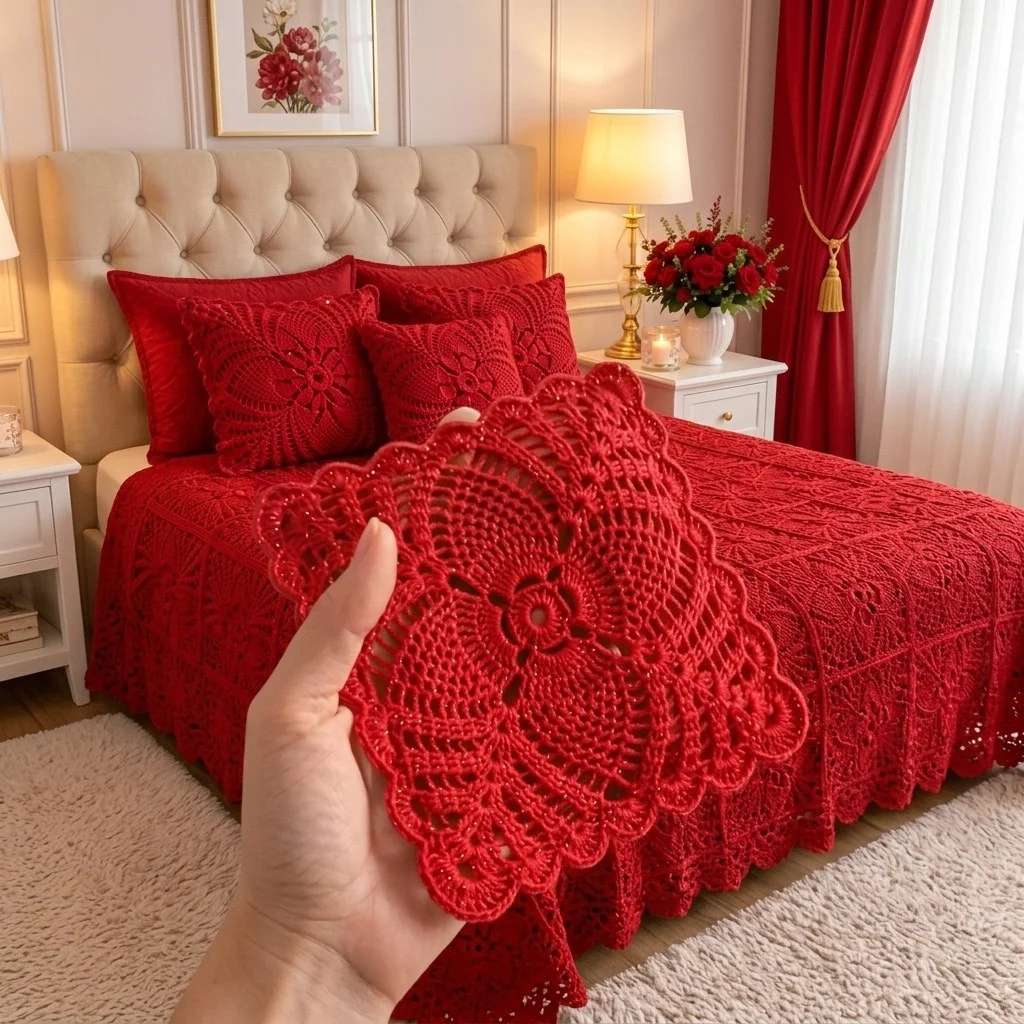
This red pineapple lace doily crochet pattern gives you a full-size round centerpiece worked in one continuous spiral of rounds, finished with a separate five-petal rose that sits raised in the middle. The doily is built in three clear stages: a dense medallion center, a first tier of eight pineapples separated by growing shells, and a second, taller tier of pineapples that pushes the diameter out to about 38 cm. Every pineapple closes to a point, and the shells between them open into the next tier, so the whole piece grows outward in a steady rhythm once you understand how the loops decrease.
What makes this one different from a standard pineapple doily is the layered rose at the center. It is worked as its own small motif on two levels of petals — a front layer and a back layer worked behind the first — then stitched down over the medallion so it stands up off the flat lace instead of lying in the same plane. That single detail is what the eye lands on first, and it is also why the finished doily photographs so well in deep red: the petals cast their own shadow lines.
Plan on 10 to 14 hours spread over several sittings. This is an advanced thread project: it assumes you can read a pineapple repeat, keep a joined round from spiraling, and block aggressively at the end. If you have made a simple doily before and want to move up to something with real structure, this is a good next step. The lace is forgiving of small tension differences because blocking pulls everything into line, but it is not forgiving of a missed chain space, so count each round at the join.
Materials
- Size 10 crochet cotton thread, bright red approx. 2 balls / 500 m total
- Steel crochet hook 1.75 mm (US size 5)
- Blunt tapestry needle fine enough for size 10 thread
- Rustproof T-pins at least 60, for blocking the picot edge
- Foam blocking board or a towel-covered ironing board at least 45 cm square
- Spray starch or a 50/50 water-and-starch solution optional, for a firm finish
- Stitch markers 8 small, to mark the pineapple repeats
- Small sharp scissors
Abbreviations
chchainsl stslip stitchscsingle crochethdchalf double crochetdcdouble crochetMRmagic ringspspacest(s)stitch(es)reprepeatbegbeginningshell(3 dc, ch 2, 3 dc) in one spacepicotch 3, sl st in 3rd ch from hookfangroup of dc worked into one spaceCenter Rose Motif (make 1)
- Round 1: MR, ch 3 (counts as first dc), 11 dc in ring, pull ring closed, sl st to top of beg ch-3. (12 dc)
- Round 2: Ch 1, sc in same st, ch 3, skip next dc, *sc in next dc, ch 3, skip next dc; rep from * 4 more times, sl st to first sc. (6 sc, 6 ch-3 loops)
- Round 3: In each ch-3 loop around work (sc, hdc, 3 dc, hdc, sc), sl st to first sc. (6 front petals)
- Round 4: Working behind the petals of Round 3, ch 4, *sl st around the post of the next sc of Round 2, ch 4; rep from * around, sl st to the base of the beg ch-4. (6 ch-4 loops)
- Round 5: In each ch-4 loop around work (sc, hdc, 5 dc, hdc, sc), sl st to first sc. (6 back petals)
- Fasten off, leaving a 40 cm tail for sewing. Do not weave this tail in yet.
Center Medallion
- Round 1: MR, ch 3 (counts as first dc), 15 dc in ring, pull ring closed, sl st to top of beg ch-3. (16 dc)
- Round 2: Ch 3 (counts as dc), dc in same st, 2 dc in each dc around, sl st to top of beg ch-3. (32 dc)
- Round 3: Ch 5 (counts as dc + ch 2), skip next dc, *dc in next dc, ch 2, skip next dc; rep from * around, sl st to 3rd ch of beg ch-5. (16 dc, 16 ch-2 sps)
- Round 4: Sl st into first ch-2 sp, ch 3 (counts as dc), 2 dc in same sp, ch 2, *3 dc in next ch-2 sp, ch 2; rep from * around, sl st to top of beg ch-3. (16 three-dc groups = 48 dc, 16 ch-2 sps)
- Round 5: Sl st across to first ch-2 sp, ch 1, sc in same sp, ch 5, *sc in next ch-2 sp, ch 5; rep from * around, sl st to first sc. (16 sc, 16 ch-5 loops)
- Round 6: Sl st into first ch-5 loop, ch 1, sc in same loop, ch 6, *sc in next ch-5 loop, ch 6; rep from * around, sl st to first sc. (16 sc, 16 ch-6 loops)
- Round 7: Sl st into first ch-6 loop, ch 1, sc in same loop, ch 3, 7 dc in next ch-6 loop, ch 3, *sc in next ch-6 loop, ch 3, 7 dc in next ch-6 loop, ch 3; rep from * 6 more times, sl st to first sc. (8 sc, 8 fans of 7 dc)
- Place a marker in each of the 8 sc. These 8 points become the shells, and the 8 fans become the first tier of pineapples.
First Pineapple Tier
- Round 8: Sl st across ch-3 and into first dc of the next fan, ch 4 (counts as dc + ch 1), *(dc in next dc, ch 1) 6 times across the fan, ch 3, sc in next marked sc, ch 3**, dc in first dc of next fan, ch 1; rep from * around, ending last rep at **, sl st to 3rd ch of beg ch-4. (8 fans, each 7 dc with 6 ch-1 sps; 8 sc)
- Round 9: Sl st into first ch-1 sp, ch 1, *sc in same ch-1 sp, (ch 4, sc in next ch-1 sp) 5 times, ch 4, shell in next sc, ch 4**, sc in first ch-1 sp of next fan; rep from * around, ending last rep at **, sl st to first sc. (8 pineapples of 5 ch-4 loops; 8 shells)
- Round 10: Sl st into first ch-4 loop, ch 1, *sc in same loop, (ch 4, sc in next ch-4 loop) 4 times, ch 4, shell in ch-2 sp of next shell, ch 4**, sc in first ch-4 loop of next pineapple; rep from * around, ending last rep at **, sl st to first sc. (8 pineapples of 4 loops; 8 shells)
- Round 11: Sl st into first ch-4 loop, ch 1, *sc in same loop, (ch 4, sc in next loop) 3 times, ch 5, shell in ch-2 sp of next shell, ch 5**, sc in first loop of next pineapple; rep from * around, ending last rep at **, sl st to first sc. (8 pineapples of 3 loops)
- Round 12: Sl st into first ch-4 loop, ch 1, *sc in same loop, (ch 4, sc in next loop) twice, ch 5, shell in ch-2 sp of next shell, ch 5**, sc in first loop of next pineapple; rep from * around, ending last rep at **, sl st to first sc. (8 pineapples of 2 loops)
- Round 13: Sl st into first ch-4 loop, ch 1, *sc in same loop, ch 4, sc in next loop, ch 6, shell in ch-2 sp of next shell, ch 6**, sc in first loop of next pineapple; rep from * around, ending last rep at **, sl st to first sc. (8 pineapples of 1 loop)
- Round 14: Sl st into first ch-4 loop, ch 1, *sc in same loop, ch 7, shell in ch-2 sp of next shell, ch 7**, sc in single loop of next pineapple; rep from * around, ending last rep at **, sl st to first sc. (8 pineapple tips, 8 shells)
- The first tier is now closed to 8 points. Before moving on, lay the work flat and check that all 8 shells sit on the same circle — if one tier of chains is tighter than the rest, redo that repeat now rather than after Round 24.
Second Pineapple Tier
- Round 15: Sl st across to ch-2 sp of first shell, ch 3 (counts as dc), 8 dc in same sp, ch 5, sc in next pineapple tip sc, ch 5, *9 dc in ch-2 sp of next shell, ch 5, sc in next pineapple tip sc, ch 5; rep from * around, sl st to top of beg ch-3. (8 fans of 9 dc; 8 sc)
- Round 16: Ch 4 (counts as dc + ch 1), *(dc in next dc, ch 1) 8 times across the fan, ch 5, sc in next sc, ch 5**, dc in first dc of next fan, ch 1; rep from * around, ending last rep at **, sl st to 3rd ch of beg ch-4. (8 fans, each 9 dc with 8 ch-1 sps)
- Round 17: Sl st into first ch-1 sp, ch 1, *sc in same sp, (ch 4, sc in next ch-1 sp) 7 times, ch 5, shell in next sc, ch 5**, sc in first ch-1 sp of next fan; rep from * around, ending last rep at **, sl st to first sc. (8 pineapples of 7 ch-4 loops; 8 shells)
- Round 18: Sl st into first ch-4 loop, ch 1, *sc in same loop, (ch 4, sc in next loop) 6 times, ch 5, shell in ch-2 sp of next shell, ch 5**, sc in first loop of next pineapple; rep from * around, ending last rep at **, sl st to first sc. (8 pineapples of 6 loops)
- Round 19: Work as Round 18, but (ch 4, sc in next loop) 5 times; ch 5 each side of the shell. (8 pineapples of 5 loops)
- Round 20: Work as Round 18, but (ch 4, sc in next loop) 4 times; ch 6 each side of the shell. (8 pineapples of 4 loops)
- Round 21: Work as Round 18, but (ch 4, sc in next loop) 3 times; ch 6 each side of the shell. (8 pineapples of 3 loops)
- Round 22: Work as Round 18, but (ch 4, sc in next loop) twice; ch 6 each side of the shell. (8 pineapples of 2 loops)
- Round 23: Work as Round 18, but ch 4, sc in next loop once; ch 7 each side of the shell. (8 pineapples of 1 loop)
- Round 24: Sl st into the single ch-4 loop, ch 1, *sc in same loop, ch 7, shell in ch-2 sp of next shell, ch 7**, sc in single loop of next pineapple; rep from * around, ending last rep at **, sl st to first sc. (8 pineapple tips, 8 shells)
Scalloped Picot Border
- Round 25: Sl st across to ch-2 sp of first shell, ch 3 (counts as dc), 3 dc in same sp, ch 3, 4 dc in same sp, ch 6, sc in next pineapple tip sc, ch 6, *(4 dc, ch 3, 4 dc) in ch-2 sp of next shell, ch 6, sc in next pineapple tip sc, ch 6; rep from * around, sl st to top of beg ch-3. (8 scallops of 8 dc with a ch-3 point; 8 sc)
- Round 26: Ch 1, *sc in each of next 4 dc, 4 sc in ch-3 sp, sc in each of next 4 dc, 7 sc in next ch-6 sp, sc in next sc, 7 sc in next ch-6 sp; rep from * around, sl st to first sc. (27 sc per repeat, 216 sc total)
- Round 27: Ch 1, sc in same st, sc in each of next 2 sc, picot, *sc in each of next 3 sc, picot; rep from * around, sl st to first sc. (216 sc, 72 picots)
- Fasten off, leaving a 15 cm tail. Weave the tail along the back of the last round for at least 5 cm, then snip close.
Blocking
- Soak the finished doily in cool water for 10 minutes. Red cotton thread can release dye, so soak it alone and squeeze the water out until it runs clear.
- Roll the doily in a white towel and press — never wring it, as twisting distorts the chain loops permanently.
- Pin the center medallion flat first, then pin the 8 first-tier shells at equal distances, then the 8 pineapple tips of the second tier, working outward so tension stays even.
- Pin every one of the 72 picots individually. This is slow but it is the difference between a scalloped edge and a wavy one.
- If you want a firm doily that holds its shape on a table, spray lightly with starch while it is pinned and let it dry fully — at least 12 hours — before unpinning.
Finishing
Center the rose motif over Rounds 1 to 3 of the medallion, with the back petals of Round 5 fanning out between the front petals. Thread the long tail on a tapestry needle and stitch through the base of each back petal into the medallion fabric, catching only the back of the Round 2 double crochets so no stitching shows on the front. Six anchor points, one per back petal, is enough — stitching the front petals down as well will flatten the raised effect you worked two layers to get.
Weave in the remaining ends along the dense parts of the lace rather than across open chain spaces, where a tail will show as a dark line. Block the doily after the rose is attached, not before, so the petals are shaped at the same time as the lace. Once it is dry, the piece should sit perfectly flat with the rose standing a few millimetres proud of the surface and all eight scallops reaching the same distance from the center.
Tips for Success
- Count the ch-1 spaces on Rounds 8 and 16 before going on. A fan with 5 or 7 spaces instead of 6 or 8 will throw off the whole pineapple decrease and you will not notice until four rounds later.
- Keep your chain loops slightly looser than your stitches. Pineapple lace reads as open and airy only when the ch-4 loops can relax — tight chains make the pineapples pucker inward no matter how well you block.
- Use the join as a landmark: always start each round at the same pineapple. If you drift one repeat sideways on a joining round, the border scallops will not sit above the shells.
- Work the rose motif first, while you are fresh. The two-level petal construction on Round 4 is the fiddliest part of the pattern, and it is much easier before your hands are tired from thread work.
- If the center medallion cups slightly through Rounds 5 and 6, do not tighten the next round to correct it — thread lace almost always flattens under blocking, and compensating now will give you a ruffled outer edge.
Common Mistakes to Avoid
- Losing a pineapple loop too early. Each round should drop exactly one ch-4 loop per pineapple. If a pineapple is one round ahead of its neighbours, rip back to the round where the counts still match rather than trying to fudge an extra loop.
- Working the shell into the wrong place on Round 10. The shell goes into the ch-2 space of the previous shell, not into the stitches on either side. Working into a dc instead splits the shell column and the second tier will lean.
- Treating the beginning ch-3 as just a chain. It counts as a dc in Rounds 1, 2, 4, 15 and 25, so the final stitch count includes it — add an extra dc and the fan will be 10 dc wide instead of 9.
- Skipping the picot placement check. The 216 sc of Round 26 divide into exactly 72 picot groups; if you reach the end and have 1 or 2 stitches left over, you miscounted the sc in a ch-6 space on Round 26, not the picots.
- Blocking without pinning the picots. The scalloped edge will dry with soft waves instead of crisp points, and re-wetting the whole doily to fix it is the only remedy.
Ways to Customize This Pattern
- Make it larger with heavier thread. Worked in size 3 cotton with a 2.75 mm hook, the same rounds give a doily around 55 cm across — a table topper rather than a centerpiece.
- Stop after Round 14 and add the border rounds directly to the first-tier shells for a 22 cm single-tier version. Work Round 25 into the Round 14 shells and continue as written.
- Change the rose to a flat rosette by skipping Rounds 4 and 5 of the motif, then stitching a ring of six tiny picots around it for a more restrained center.
- Work the rose in a deeper shade — burgundy or plum against the bright red — for a tonal contrast that still reads as a single-colour piece from a distance.
- Turn it into a cushion front by making two doilies, backing each with a solid red fabric circle, and joining them with a round of sc through both layers before stuffing with a round pillow form.
Frequently asked questions
Almost always because the ch-4 loops are worked at different tensions as you tire during a round. Each pineapple is only 8 or 9 stitches wide, so a loop that is two millimetres tighter shows immediately. Try to finish a full round in one sitting, and if you must stop, stop at the join rather than mid-pineapple.
Roughly twice as much. Rounds 15 to 24 contain eight 9-dc fans plus longer connecting chains, and the circumference has nearly doubled by then. If you are working from a single ball, do not assume the first half of the ball will carry you to Round 24 — it will not.
No. The fans in Rounds 8, 15 and 16 need a defined start and end to sit directly above the shells below them. A spiral shifts each repeat sideways by one stitch per round, and by the border the scallops would be noticeably out of alignment with the pineapple tips.
If the ruffle is mild, blocking will take it out. If it is strong, your connecting chains between shells in Rounds 19 to 23 are too long for your tension — rip back to Round 19 and reduce each ch-6 to ch-5 and each ch-7 to ch-6. Ruffling is extra length at the edge, so the fix is always in the chains, not the pineapples.
Saturated reds in mercerised cotton can release a little dye the first few times they are wet. Soak the finished doily alone in cool water before blocking until the water runs clear, and let it dry fully on a white towel. After that it is safe to lay on pale surfaces.
The finished Red Pineapple Lace Doily