Rose Border Bedspread and Pillow Shams Crochet Pattern
Beginner Friendly
Perfect for those just starting their crochet journey, with clear instructions and simple techniques
Single-Day Project
A satisfying project you can complete in a single afternoon or evening.
Handmade Gift
A beautiful keepsake — free forever. Read online or print at home.
About This Rose Border Bedspread and Pillow Shams Crochet Pattern
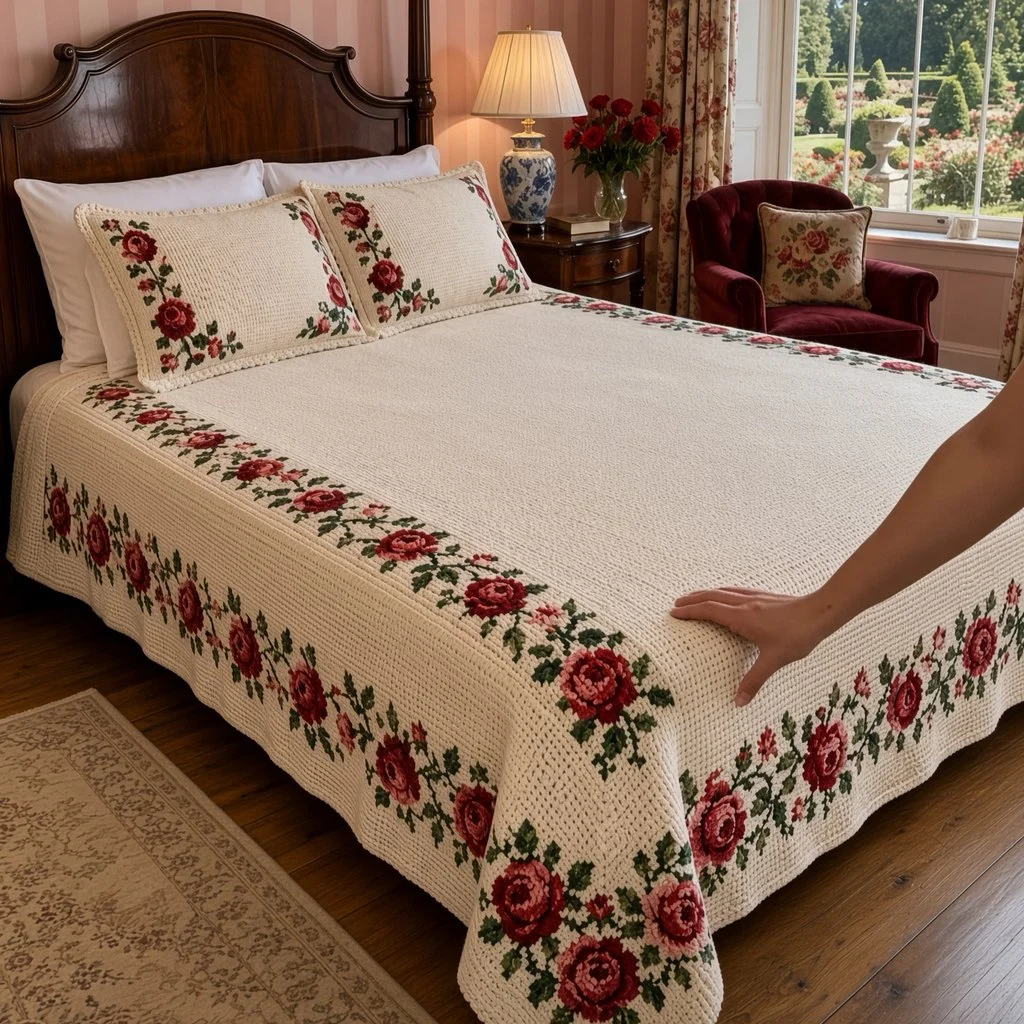
This crochet rose bedspread pattern combines a plain cream Tunisian crochet base with borders of cross-stitched roses, buds and green vines. The Tunisian simple stitch makes a firm grid of little squares, and each square takes one cross stitch, so the roses come out crisp and slightly pixelated, like an old embroidered sampler. Two matching pillow shams carry the same roses along their short ends.
The borders are placed so they frame the bed the way a fitted coverlet would. One band of roses runs just inside the edge of the mattress top, along both sides and the foot, and a second band runs near the hem of the drop. A full rose sits at each corner where the bands turn. The bedspread is made in three long Tunisian strips that are seamed together before any stitching, so you never have to fit the whole width on your hook.
This is a long project, around 200 to 240 hours for the bedspread and shams. The base is simple, repetitive work, and the cross stitching is relaxing once the base is done. It suits a crocheter who already knows Tunisian simple stitch or is happy to learn it, and who enjoys working from a chart.
Materials
- Bulky weight yarn, cream about 5,500 m (55 skeins of 100 g / 100 m), for the base, shams and edging
- Bulky weight yarn, red about 450 m, for cross stitch
- Bulky weight yarn, dark red about 200 m, for cross stitch
- Bulky weight yarn, rose pink about 150 m, for cross stitch
- Bulky weight yarn, leaf green about 250 m, for cross stitch
- 8 mm Tunisian crochet hook with a 100 cm cable
- 6.5 mm standard crochet hook for seaming and edging
- Large blunt tapestry needle with an eye big enough for bulky yarn
- Locking stitch markers about 30, for marking chart positions
- Two pillows 50 x 75 cm, for the shams
Abbreviations
chchainscsingle crochetsl stslip stitchTSSTunisian simple stitchXone cross stitch, worked over one TSSst(s)stitch(es)rndroundreprepeatRS / WSright side / wrong sideTunisian Simple Stitch Strips (make 3)
- With cream and the 8 mm Tunisian hook, ch 97.
- Row 1, forward pass: insert hook in 2nd ch from hook, yarn over and pull up a loop; pull up a loop in each ch across, keeping all loops on the hook. (97 loops)
- Row 1, return pass: yarn over, pull through 1 loop, *yarn over, pull through 2 loops; rep from * until 1 loop remains on hook.
- Row 2, forward pass: skip the first vertical bar, *insert hook under the next vertical bar, yarn over and pull up a loop; rep from * across to the last st, then insert hook under both strands of the last bar and pull up a loop. (97 loops)
- Row 2, return pass: work as Row 1 return pass.
- Rows 3-297: rep Row 2. (97 sts in every row)
- Bind off: sl st under each vertical bar across. Fasten off. (97 sts)
- Each strip measures about 81 x 270 cm. TSS curls while you work, so block each strip flat before seaming.
Joining the Strips
- Lay the three strips side by side, RS up, with all foundation edges at the same end. This end is the foot of the bedspread.
- Hold two strips RS together and, with cream and the 6.5 mm hook, sl st through both layers in each row end, matching row for row. (297 sl st)
- Join the third strip the same way. The bedspread is now 291 sts wide and 297 rows long.
- Grid for placing the roses: lay the bedspread RS up with the foot edge toward you. Number the columns 1-291 from left to right and the rows 1-297 from the foot edge. Columns 1-97 are the left strip, 98-194 the middle strip and 195-291 the right strip.
Rose Chart (Motif A, 13 x 13)
- Key:
Ddark red,Rred,Prose pink,.no stitch (cream shows). Each letter is one X. Read each row from left to right. - Row 1:
....RRRRR.... - Row 2:
..RRDDDDDRR.. - Row 3:
.RDDRRRRRDDR. - Row 4:
.RDRPPPPPRDR. - Row 5:
RDRPRRRRRPRDR - Row 6:
RDRPRDDDRPRDR - Row 7:
RDRPRDPDRPRDR - Row 8:
RDRPRRDRRPRDR - Row 9:
RDRPPRRRPPRDR - Row 10:
.RDRPPPPPRDR. - Row 11:
.RDDRRRRRDDR. - Row 12:
..RRDDDDDRR.. - Row 13:
....RRRRR.... - Each rose has 147 X: 86 red, 38 dark red and 23 pink.
Leaf and Bud Chart (Motif B, 13 x 13)
- Key:
Gleaf green,Rred,Prose pink,.no stitch. Row 7 is the vine, which lines up with Row 7 of the rose on either side. - Row 1:
......RR..... - Row 2:
.....RPPR.... - Row 3:
.....RPRR.... - Row 4:
......GG..... - Row 5:
..GG...G..GG. - Row 6:
.GGGG..G.GGGG - Row 7:
GGGGGGGGGGGGG - Row 8:
.GGGG.G..GGGG - Row 9:
..GG..G..GG.. - Row 10:
......G...... - Row 11:
.....GGG..... - Row 12:
....GG.GG.... - Row 13:
......G...... - A border is always worked as A, then B and A alternately, so every band begins and ends with a rose.
Cross-Stitch Technique
- Each TSS forms a small square between two vertical bars. One X covers one of these squares, from corner to corner.
- Thread the tapestry needle with an arm’s length of yarn. Start on the WS, leaving a 10 cm tail to weave in later.
- Work all the half stitches of one color along a chart row first (bottom left to top right), then come back along the same row and cross them (bottom right to top left). All top stitches must slant the same way.
- Keep the tension even and relaxed. Pulling tight puckers the Tunisian fabric.
- Don’t carry yarn across the back for more than 3 squares. For longer gaps, fasten off and start again.
- Work the dark red first, then red, then pink, then green. Starting with the darkest color keeps the light pink from getting dirty while you handle the fabric.
Placing the Border Bands
- Horizontal bands (at the foot): place the chart upright, so chart Row 1 is on the bedspread row nearest the head and chart Row 13 is on the row nearest the foot. The buds point toward the head of the bed.
- Vertical bands (along the sides): turn the chart on its side so chart Row 1 lies along the edge of the band nearest the center of the bedspread. The buds point toward the center and the vine runs along the length of the bed.
- Foot hem band: rows 10-22, columns 10-282. Work A (B A) 10 times. (11 roses, 10 leaf sprays) The roses at columns 10-22 and 270-282 are the corner roses.
- Side hem bands: columns 10-22 on the left and columns 270-282 on the right. Start just above the corner rose and work (B A) 10 times on each side, from row 23 to row 282. (10 roses and 10 leaf sprays on each side)
- Foot top band: rows 57-69, columns 62-230. Work A (B A) 6 times. (7 roses, 6 leaf sprays) This band sits just inside the foot edge of the mattress.
- Side top bands: columns 62-74 on the left and columns 218-230 on the right. Start just above the corner rose and work (B A) 7 times on each side, from row 70 to row 251. (7 roses and 7 leaf sprays on each side) The band ends under the pillows.
- Before stitching, mark the first and last square of each motif with locking markers and check them against the chart. Counting mistakes are much harder to fix once a rose is half stitched.
- In all: 52 roses and 50 leaf sprays on the bedspread.
Bedspread Edging
- Rnd 1: with cream and the 6.5 mm hook, RS facing, join in a foot corner. 3 sc in corner st, sc in next 289 sts, 3 sc in corner st; 295 sc evenly along the side row ends; 3 sc in corner st, sc in next 289 sts, 3 sc in corner st; 295 sc evenly along the other side. Join with sl st to first sc. (1,180 sts)
- Rnd 2: *sc in next 2 sts, ch 3, sl st in 3rd ch from hook; rep from * around. Join and fasten off. (590 picots)
Pillow Sham Fronts (make 2)
- With cream and the Tunisian hook, ch 90.
- Rows 1-55: work in TSS as for the bedspread strips. Bind off. (90 sts, about 75 x 50 cm)
- Number the columns 1-90 from left to right and the rows 1-55 from the bottom.
- Left band: columns 6-18. Right band: columns 73-85. Turn the chart on its side with chart Row 1 toward the center of the sham.
- In each band, work A in rows 9-21, B in rows 22-34 and A in rows 35-47. (2 roses and 1 leaf spray per band)
Pillow Sham Backs (make 2 sets)
- Upper back: with cream and the Tunisian hook, ch 90. Work Rows 1-34 in TSS. Bind off. (90 sts)
- Lower back: with cream, ch 90. Work Rows 1-30 in TSS. Bind off. (90 sts)
- The bind-off edges are the open edges of the envelope. Together the two pieces are 9 rows taller than the front, giving about 8 cm of overlap.
Sham Assembly
- Lay a sham front WS up. Place the lower back on top, RS up, with its foundation edge along the bottom. Place the upper back on top, RS up, with its foundation edge along the top, overlapping the lower back. Pin all edges.
- Rnd 1: turn so the front faces you. With cream and the 6.5 mm hook, join in a corner through all layers. 3 sc in corner st, sc in next 88 sts, 3 sc in corner st; 53 sc evenly along the side; 3 sc in corner st, sc in next 88 sts, 3 sc in corner st; 53 sc evenly along the other side. Join. (294 sts)
- Through the overlap, work through all three layers with even tension so the sides lie flat.
- Rnd 2: *sc in next 2 sts, ch 3, sl st in 3rd ch from hook; rep from * around. Join and fasten off. (147 picots)
- Rep with the second sham.
Finishing
Weave in all ends on the WS. For the cross stitches, run each tail under the backs of three or four stitches of the same color, so nothing shows through the cream. Weave the base yarn ends into the seams between strips.
Wet block the bedspread on a large flat surface, pulling the bands straight and pinning the edges square. Let it dry completely, which may take two days with this much bulky yarn. Block the shams the same way, then put the pillows in through the back opening. On the bed, line up the top bands with the edges of the mattress so the corner roses sit right on the corners.
Tips for Success
- Use a Tunisian hook one or two sizes larger than the yarn label suggests. TSS is dense and curls a lot with a small hook.
- Place a locking marker every 20 rows along the edge of each strip as you work. It makes counting to the chart positions much faster later.
- Stitch one complete rose before working the bands, on the swatch or a sham. You’ll see how your yarn covers the squares and can adjust your tension.
- Lay the bedspread on the bed before stitching and check where the mattress edges fall. If your mattress is a different size, move the top bands so they sit about 5 cm inside the edge.
- Stitch the bands with the bedspread lying flat on a table, rolling up the parts you aren’t working on. It keeps the weight off your lap and the stitches even.
Common Mistakes to Avoid
- Missing the last stitch of a TSS row. Always work under both strands of the last bar, or the strip will narrow and the rows won’t match at the seams.
- Cross stitches slanting different ways. Even one X with the top stitch reversed shows clearly. Always work all half stitches first, then cross them in the same direction.
- Bands that drift off line. This happens when you count from a different edge or skip a row. Recount from the foot edge and the left edge every time you start a new motif.
- Puckered roses. If the fabric pulls in around the motifs, the stitches are too tight. Loosen your tension, and steam block any puckered areas.
- Turning the side charts the wrong way. If the buds point toward the outside edge, the side bands won’t match the foot bands. Check that chart Row 1 is always toward the center.
Ways to Customize This Pattern
- Change the size: for a double bed, use three strips of 85 sts and 270 rows, then reduce the number of B and A repeats so each band still begins and ends with a rose.
- Change the roses to another color, such as coral and peach, yellow and gold, or two shades of blue with the same green leaves.
- Add a single rose in the center of the bed, or a diamond of four roses, for a more formal look.
- Make a matching throw or table runner: one strip of 97 sts with a rose band along both long edges.
- Use worsted weight yarn and a 6 mm Tunisian hook for a lighter, finer bedspread. You will need more strips, and the roses will come out smaller.
Frequently asked questions
Tunisian simple stitch makes an even grid of nearly square cells, which is perfect for cross stitch. Regular single crochet works too, but its stitches are not square, so the roses would come out stretched.
You need a hook with a cable long enough to hold 97 bulky loops, about 100 cm. The cable holds the loops while you work, so the hook itself can be a normal length.
Yes, as long as you count the columns across all three strips carefully. Stitching after joining is easier, though, because some roses cross the seams and the bands stay perfectly aligned.
Use a large front-loading machine on a gentle cold cycle, or hand wash in a bathtub. Squeeze out the water without wringing, and dry it flat. Hanging it wet will stretch the fabric and distort the borders.
The finished Rose Border Bedspread and Pillow Shams Crochet Pattern