Rose Garden Crochet Blanket Pattern
Beginner Friendly
Perfect for those just starting their crochet journey, with clear instructions and simple techniques
Single-Day Project
A satisfying project you can complete in a single afternoon or evening.
Handmade Gift
A beautiful keepsake — free forever. Read online or print at home.
About This Rose Garden Crochet Blanket Pattern
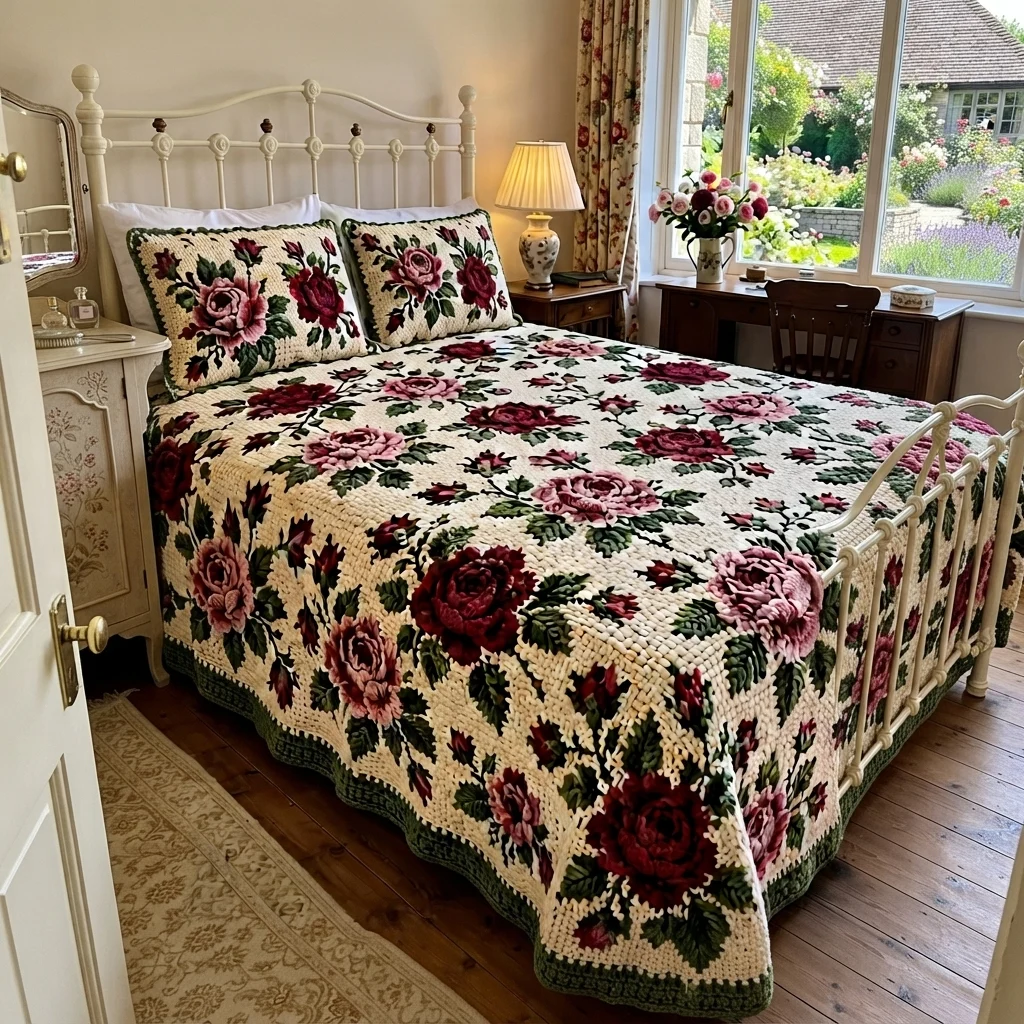
This rose crochet blanket pattern makes a soft cream throw scattered with sprays of deep burgundy and dusty pink roses, small buds and dark green leaves. A plain textured body keeps the flowers in the spotlight, and a dark green border frames the whole piece like the bedspread in the photo.
It is an advanced project because of the finishing. The body is simple half double crochet, but you will make eight large roses, eight small roses, sixteen buds, 64 leaves and 24 stems, then pin and sew every piece into its own spray. Plan on 45 to 55 hours in total, with about 20 of them spent on the flowers.
It suits crocheters who are comfortable with shaped ruffles and careful sewing, and who want a romantic, cottage-style throw for a bed with white linen. The finished blanket is about 152 x 192 cm, and it is easy to resize by changing the stitch count in steps of 2 and the rows in steps of 8.
Materials
- Chunky cotton-blend yarn, cream (C) about 3.2 kg, estimated
- Chunky cotton-blend yarn, dark green (G) about 900 g, estimated, border, leaves and stems
- Chunky cotton-blend yarn, burgundy (B) about 250 g, estimated
- Chunky cotton-blend yarn, dusty pink (P) about 200 g, estimated
- Crochet hook 6.5 mm
- Yarn needle
- Stitch markers and pins for placing the sprays
- Flat surface for blocking
Abbreviations
chchainscsingle crochethdchalf double crochetdcdouble crochetsl stslip stitchst(s)stitch(es)RSright sideFOfasten offCcream yarnGdark green yarnBburgundy yarnPdusty pink yarn( )xrepeat the stitches in brackets the number of times givenBody (flat, C)
- Foundation: with C, ch 142.
- Row 1: hdc in the 3rd ch from the hook (the skipped chains do not count as a stitch) and in each ch across (140). Ch 2 and turn.
- Rows 2-144: hdc in each st across (140). Ch 2 and turn at the end of every row except the last. The ch 2 does not count as a stitch.
- Place a stitch marker in the turning chain of every 20th row so you can check your length. Do not FO after row 144.
- Check your body: every row must have exactly 140 stitches, and the body should measure about 140 cm wide and 180 cm tall after blocking.
Green Border (G)
- Round 1: with the RS facing you and row 144 at the top, FO C and join G in the top right corner stitch. Ch 1 and work 3 sc in the corner st. Sc in each of the next 138 sts across the top. Work 3 sc in the top left corner st.
- Work 142 sc evenly down the left side, one in each row end between the corners. Work 3 sc in the bottom left corner, 138 sc along the foundation edge, 3 sc in the bottom right corner and 142 sc up the right side. Join with a sl st to the first sc (572).
- Rounds 2-6: ch 1, sc in each st around, working 3 sc in the middle st of each 3-sc corner group. Join with a sl st at the end of each round. Each round adds 8 stitches: round 2 has 580, round 3 has 588, round 4 has 596, round 5 has 604 and round 6 has 612.
- FO and weave in the end. For a scalloped look like the photo, add one optional round of crab stitch (reverse sc) in G.
- Check your border: round 6 has 148 stitches between the corner groups along the top and foot and 152 down each side, and the border should be about 6 cm wide.
Large Rose (make 8, B)
- Ch 37.
- Row 1: sc in the 2nd ch from the hook and in each ch across (36). Ch 1 and turn.
- Row 2 (petals): (sl st in the next st, 5 dc in the next st, sl st in the next st)x12 (12 petals, 36 sts used). FO leaving a tail of about 40 cm.
- Roll the strip from the first petal, with the petals on the outside, keeping the bottom edge level. Sew through the base every few stitches as you roll so the rose stays tight.
- Finish with a few stitches through the whole base, and secure the tail inside the rose. The rose should be about 9 cm across.
Small Rose (make 8, P)
- Ch 28.
- Row 1: sc in the 2nd ch from the hook and in each ch across (27). Ch 1 and turn.
- Row 2 (petals): (sl st in the next st, 5 dc in the next st, sl st in the next st)x9 (9 petals, 27 sts used). FO leaving a tail of about 35 cm.
- Roll and sew as for the large rose. The rose should be about 7 cm across.
Buds (make 16: 8 in B and 8 in P)
- Ch 19.
- Row 1: sc in the 2nd ch from the hook and in each ch across (18). Ch 1 and turn.
- Row 2: (sl st in the next st, 5 dc in the next st, sl st in the next st)x6 (6 petals, 18 sts used). FO leaving a tail of about 25 cm.
- Roll tightly and sew through the base. The bud should be about 5 cm across.
Leaves (make 64, G)
- Ch 10. Starting in the 2nd ch from the hook: sl st, sc, hdc, dc, dc, dc, hdc, sc, sl st (9 sts).
- FO leaving a tail of about 15 cm for sewing.
Stems (make 24, G)
- Ch 21. Starting in the 2nd ch from the hook, sl st in each ch across (20). FO leaving a tail of about 15 cm.
Spray Placement (8 sprays)
- Lay the blanket flat with the RS facing you and row 1 at the head. Number the stitches 1 to 140 from the right edge and the rows 1 to 144 from the head.
- Column A has sprays centered on stitch 35, on rows 16, 50, 84 and 118. Column B has sprays centered on stitch 105, on rows 33, 67, 101 and 135.
- Each spray has 1 large rose, 1 small rose, 2 buds (one in B and one in P), 3 stems and 8 leaves.
- Pin the large rose at the spray center. Pin the small rose about 14 stitches to the right and 8 rows up from it, and the two buds about 8 stitches to the left and 10 rows below it, and 12 stitches to the right and 10 rows below it.
- Pin a stem from the base of each flower toward the center of the spray, so the three stems meet under the large rose.
- Pin 8 leaves along the stems, 2 or 3 per stem, angled out at about 45 degrees. Step back and check that the sprays all look alike before you sew anything.
Sewing the Sprays
- Sew the stems first, with small stitches along both edges, tacking every 2 cm.
- Sew the leaves next, with the base end tucked under a stem and the last 1 cm of the tip free, so it lifts slightly.
- Sew the roses and buds last, over the ends of the stems, working small stitches around the whole base and through the body so each flower sits firmly.
- Weave all tails along the back of the blanket for at least 6 cm.
Finishing
Weave in all ends along the back, following the stitches for at least 8 cm. Block the blanket before you add the flowers if you can, by laying it flat on towels, pinning the corners and edges to about 152 x 192 cm, and misting it with water. Let it dry fully before moving it.
After sewing on the sprays, steam the blanket from a few centimeters above without pressing, so the petals keep their shape. Drape it over the bed with the head under the pillows and the green border showing at the sides and foot, and it will look like the photo.
Tips for Success
- Count the stitches after every 20 rows. There should always be 140, and a wrong count is easiest to fix straight away.
- Make the flowers in batches of eight, one type at a time, so every rose comes out the same size.
- Roll the rose strips tightly at the center and more loosely at the outside, for a rose that opens naturally.
- Use a thinner thread in the same color to sew the flowers on, so the stitches sink in and stay hidden.
- Pin every piece before you sew. Even spacing is the whole look of this blanket.
Common Mistakes to Avoid
- Counting the ch 2 as a stitch makes the body 141 stitches wide and the sides wavy. The turning chain never counts.
- Rolling the rose with the petals on the inside gives a flat, cupped flower. Keep the ruffled edge on the outside.
- Sewing the flowers on only at the center lets the petals flap. Stitch around the whole base.
- Working different corner counts in the border makes it ripple. Use exactly 3 sc in each corner stitch on every round.
- Sewing the leaves flat against the fabric hides their shape. Leave the tips free.
Ways to Customize This Pattern
- Swap the burgundy and pink for yellow and peach, or for a single color of rose, and keep the green leaves.
- Make a baby blanket by chaining 82 (80 hdc) and working 80 rows, with 4 sprays and 4 border rounds, about 90 x 105 cm.
- Make matching pillow covers by working 50 hdc for 50 rows, sewing one spray in the center, and adding a button closure on a plain back.
- Work the border in burgundy instead of green for a bolder frame.
- Add a few extra buds and leaves along the border for a garden-edge look.
Frequently asked questions
The amounts above are estimates. Weigh your swatch, scale it up by area for the body, then weigh one large rose, one small rose, one bud and one leaf and multiply by 8, 8, 16 and 64. Add about 10 percent for the border and sewing.
For width, add or remove 2 stitches at a time. For length, add or remove rows in any number. If you add a third column of sprays, space the centers about 35 stitches apart. Recalculate the border from the new counts: top and foot are the stitch count minus 2, and the sides are the row count minus 2.
Yes. Satin stitch and long and short stitch in the same colors gives a flat look much closer to the photo. Use a thick tapestry yarn and a blunt needle, and work the roses before you sew on any leaves.
With a washable cotton blend, wash it on a gentle cycle in cool water, press out the water without wringing, and lay it flat to dry. Dark burgundy and green can bleed, so wash it with a color catcher the first time and check that the flowers are sewn on securely before every wash.
The finished Rose Garden Crochet Blanket Pattern