Sunflower Table Runner Crochet Pattern
Beginner Friendly
Perfect for those just starting their crochet journey, with clear instructions and simple techniques
Single-Day Project
A satisfying project you can complete in a single afternoon or evening.
Handmade Gift
A beautiful keepsake — free forever. Read online or print at home.
About This Sunflower Table Runner Crochet Pattern
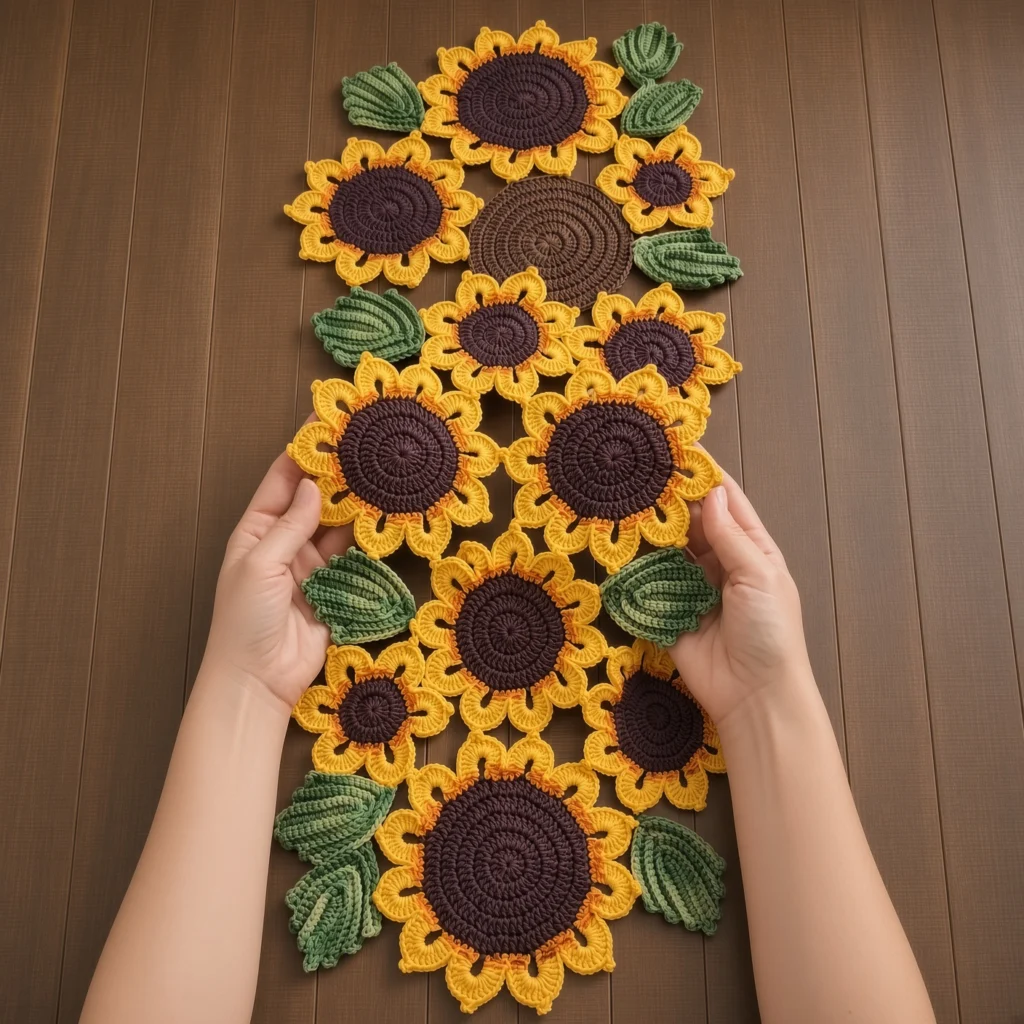
This sunflower table runner crochet pattern builds a long, freeform runner out of twelve individual sunflowers in three sizes, one bare seed-head disc and nine ridged leaves, all sewn together at the points where they touch. Each flower has a dense dark-brown centre worked in joined rounds, a thin orange halo, and a ring of scalloped yellow petals with a tiny open loop at the base of every petal that gives the edge its lacy, pierced look. The leaves are worked in short rows through the back loop so the ridges run lengthwise, exactly like the veining on a real sunflower leaf.
The individual motifs are not hard, but there are a lot of them, and the runner only looks right if the tension stays consistent across every flower and the layout is planned before anything is stitched down. Expect 14 to 18 hours of hooking plus an evening of blocking and sewing. It suits a confident crocheter who is comfortable with joined rounds, colour changes, working into chain loops and short-row shaping, and who wants a centrepiece that will hold its shape on the table for years.
Worked in worsted-weight cotton on a 4.0 mm hook, the finished runner measures roughly 38 cm wide by 95 cm long, which fits a six-seat dining table with room to spare. You can shorten or lengthen it by adding or removing a row of flowers without changing anything else in the pattern.
Materials
- Worsted-weight (4) cotton yarn, golden yellow approx. 200 g (petals)
- Worsted-weight (4) cotton yarn, dark brown approx. 150 g (flower centres)
- Worsted-weight (4) cotton yarn, leaf green approx. 120 g (leaves)
- Worsted-weight (4) cotton yarn, tan or mid brown approx. 30 g (seed head)
- Worsted-weight (4) cotton yarn, burnt orange approx. 30 g (halo rounds)
- 4.0 mm (G/6) crochet hook go down to 3.75 mm if your rounds cup
- Tapestry needle for joining and weaving ends
- Stitch markers one for each round start
- Blocking mat, rust-proof pins and spray starch starch is optional but recommended
- Scissors and measuring tape
Abbreviations
chchainsl stslip stitchscsingle crochethdchalf double crochetdcdouble crochettrtreble crochetrev screverse single crochet (crab stitch), worked left to rightinc2 sc in the same stitchMRmagic ringBLOthrough the back loop onlyskskipst(s)stitch(es)reprepeat[ ]work the instructions in brackets the number of times statedLarge Sunflower (make 4)
- With dark brown, MR, ch 1, 6 sc in ring, join with sl st to first sc. (6)
- Ch 1, inc in each st around, join. (12)
- Ch 1, [sc in next st, inc] 6 times, join. (18)
- Ch 1, [sc in next 2 sts, inc] 6 times, join. (24)
- Ch 1, [sc in next 3 sts, inc] 6 times, join. (30)
- Ch 1, [sc in next 4 sts, inc] 6 times, join. (36)
- Ch 1, [sc in next 5 sts, inc] 6 times, join. (42)
- Ch 1, [sc in next 6 sts, inc] 6 times, join, changing to burnt orange on the final pull-through of the join. Fasten off brown. (48)
- With orange: ch 1, sc in each st around, join, changing to golden yellow on the join. Fasten off orange. (48)
- With yellow: ch 1, sl st in first st, [ch 5, sk next 3 sts, sl st in next st] 12 times; the final sl st lands in the same st as the first sl st. (12 ch-5 loops)
- Sl st into the first ch-5 loop. In each ch-5 loop work (sc, hdc, 2 dc, tr, 2 dc, hdc, sc); join with sl st to the first sc. Fasten off, leaving a 40 cm tail for joining. (12 petals)
Medium Sunflower (make 4)
- With dark brown, MR, ch 1, 6 sc in ring, join. (6)
- Ch 1, inc in each st around, join. (12)
- Ch 1, [sc in next st, inc] 6 times, join. (18)
- Ch 1, [sc in next 2 sts, inc] 6 times, join. (24)
- Ch 1, [sc in next 3 sts, inc] 6 times, join. (30)
- Ch 1, [sc in next 4 sts, inc] 6 times, join, changing to burnt orange on the join. Fasten off brown. (36)
- With orange: ch 1, sc in each st around, join, changing to golden yellow on the join. Fasten off orange. (36)
- With yellow: ch 1, sl st in first st, [ch 4, sk next 3 sts, sl st in next st] 9 times; the final sl st lands in the same st as the first sl st. (9 ch-4 loops)
- Sl st into the first ch-4 loop. In each ch-4 loop work (sc, hdc, dc, tr, dc, hdc, sc); join with sl st to the first sc. Fasten off, leaving a 40 cm tail. (9 petals)
Small Sunflower (make 3)
- With dark brown, MR, ch 1, 6 sc in ring, join. (6)
- Ch 1, inc in each st around, join. (12)
- Ch 1, [sc in next st, inc] 6 times, join. (18)
- Ch 1, [sc in next 2 sts, inc] 6 times, join, changing to burnt orange on the join. Fasten off brown. (24)
- With orange: ch 1, sc in each st around, join, changing to golden yellow on the join. Fasten off orange. (24)
- With yellow: ch 1, sl st in first st, [ch 3, sk next 2 sts, sl st in next st] 8 times; the final sl st lands in the same st as the first sl st. (8 ch-3 loops)
- Sl st into the first ch-3 loop. In each ch-3 loop work (sc, hdc, dc, hdc, sc); join with sl st to the first sc. Fasten off, leaving a 30 cm tail. (8 petals)
Bare Seed Head (make 1)
- With tan, work Rounds 1–8 exactly as for the Large Sunflower centre, staying in tan throughout and not changing colour. (48)
- Ch 1, [sc in next 7 sts, inc] 6 times, join. (54)
- Ch 1, rev sc in each st around, working from left to right so the corded ridge sits on the outer edge; join with sl st to the first rev sc. Fasten off, leaving a 30 cm tail. (54)
Ridged Leaf (make 9)
- First half: with green, ch 12. Row 1: sc in 2nd ch from hook and in each ch across, ch 1, turn. The end with the yarn tail is the base; the end where you started stitching is the tip. (11 sc)
- Row 2: sl st BLO in first st, sc BLO in next 8 sts, leave the last 2 sts unworked, ch 1, turn. (9 sts worked)
- Row 3: sc BLO in first 8 sts, sl st BLO in the last st, ch 1, turn. (9)
- Row 4: sl st BLO in first st, sc BLO in next 6 sts, leave the last 2 sts unworked, ch 1, turn. (7)
- Row 5: sc BLO in first 6 sts, sl st BLO in the last st, ch 1, turn. (7)
- Row 6: sl st BLO in first st, sc BLO in next 4 sts, leave the last 2 sts unworked, ch 1, turn. (5)
- Row 7: sc BLO in first 4 sts, sl st BLO in the last st. Fasten off. (5)
- Second half: turn the piece so the unused loops of the foundation chain face up. Join green with a sl st in the free loop of the chain directly under the first sc of Row 1 (the tip end), ch 1, sc in the same loop and in each of the next 10 free loops toward the base, ch 1, turn. (11 sc)
- Repeat Rows 2–7 of the first half. Fasten off.
- Edging and stem: join green with a sl st at the base of the leaf, ch 1, sc evenly up the stepped edge of one half (1 sc in each row-end), work 3 sc into the tip, sc evenly down the other half to the base, ch 3, sl st in 2nd ch from hook and in the next ch (stem made), join with sl st to the first sc. Fasten off, leaving a 40 cm tail.
Finishing
Weave in every end except the long joining tails, then wet-block all 22 pieces before you assemble anything. Soak the flowers, squeeze out the water in a towel and pin each one out flat with the petals fanned evenly and a small open loop visible at the base of each petal. Pin the leaves so the ridges lie straight and the tips are pointed. A light mist of spray starch while they are still damp will help the petals keep their scalloped edge on the table. Let everything dry completely.
Lay the dry pieces on a long table or the floor and build the runner from the top down in an offset pattern, about 95 cm long by 38 cm wide: a large flower centred at the top, a medium flower and a small flower below it with the seed head between them, two medium flowers below that, two large flowers side by side, then a large flower with a small flower at each side, and a large flower centred at the bottom. Adjust so each flower touches its neighbours at two or three petal tips and no large gaps show through. Tuck the leaves behind the flowers along both outer edges and in the gaps, with three leaves at the top end, three at the bottom and the rest spread down the sides so the outline reads as a loose oval. Take a photo of the layout before you move anything.
Join with the tapestry needle and the yellow tails, whip-stitching each pair of touching petals together over three or four stitches on the wrong side. Attach each leaf with green yarn at the base and at one or two points along its edge where it sits behind a flower, stitching through the back of the petals only so no green shows on the front. Sew the seed head to the flowers around it in the same way. Weave in all tails, steam lightly from the back and let the runner rest flat overnight before using it.
Tips for Success
- Make all four large centres in one sitting, then all four medium, then all three small. Working same-size pieces back to back keeps the tension consistent, and mismatched centres are the first thing the eye notices in a finished runner.
- When you work the petal fan into each chain loop, push the stitches together as you go so the fan sits on top of the loop rather than spreading along it. That is what keeps the little hole at the base of each petal open.
- Change colour on the final pull-through of the joining sl st, not at the start of the next round. The orange halo will then form a clean, unbroken ring with no brown jog.
- Use cotton, not acrylic. Cotton holds the blocked petal shape and the leaf ridges; acrylic relaxes within a week and the runner turns into a soft, wavy sheet.
- Mark the base end of each leaf with a stitch marker before you start the second half. Once both halves are worked, the two ends look similar and it is easy to sew a leaf on upside down.
Common Mistakes to Avoid
- Centres that cup or ruffle. Cupping means you are too tight or your hook is too big for your yarn; ruffling means the opposite. Check the 4 cm gauge at Round 4 and swap hooks before you make twelve of them.
- Landing the last chain loop in the wrong stitch. Count carefully in the loop round: on the large flower it is exactly 12 repeats of ch 5, sk 3, and the final sl st must go into the first stitch. If you end up one stitch short or long, you will have an uneven petal, so pull back and recount rather than fudging it.
- Leaves that curl instead of lying flat. This happens when the sl st at the start of the short rows is worked too tight. Keep the sl st loose, and if the leaf still curls, block it hard with pins along both edges.
- Sewing petals together on the right side. Whip stitches on the front are visible against the yellow. Always stitch through the back loops of the petals from the wrong side and check the front every few stitches.
- Joining before blocking. Unblocked petals sit at slightly different angles, so you end up sewing gaps that would have closed on their own. Block first, every time.
Ways to Customize This Pattern
- Make a matching placemat from one large flower with two leaves tucked behind it, or a coaster from a single small flower. A set of six placemats uses roughly the same yarn as the runner.
- Turn it into a wreath by joining the flowers around a 30 cm ring instead of in a line, with the leaves pointing outward. Eight medium flowers and eight leaves fill a ring nicely.
- Swap the palette for a late-autumn version: rust and mustard petals with a near-black centre, and leaves in olive and ochre instead of bright green.
- Add a second, shorter petal round on the large flowers only: after Round 11, join yellow to the front loops of Round 9 and work another set of 12 loops and smaller (sc, hdc, dc, hdc, sc) fans. It gives the big flowers a full, double-layered look.
- Extend it to a tablecloth centre for a round table by working the layout as a circle: one seed head in the middle, large flowers around it, then medium and small flowers filling the outer ring.
Frequently asked questions
Only ever stitch through the petals where two of them physically overlap, and keep each join to three or four small whip stitches. Never pull a petal across a gap to reach a neighbour; move the flower instead. If the layout leaves a gap that nothing reaches, fill it with a leaf rather than stretching a petal.
You can, but you will get a visible jog at the colour change to orange and again at yellow, and the petals will start slightly off-centre. If you prefer spirals, work the brown centre as a spiral, then sl st into the next stitch, ch 1 and switch to joined rounds for the orange round and the petals so the halo stays even.
Yes, that is the intended shape. The rows shorten at the tip end so the point forms naturally, while the sl st at the base of each row pulls the base in just enough to round it. The stem chain in the edging round finishes the base. If your leaf looks too squared off at the base, work the base-end sl sts a little tighter.
Mercerised cotton barely moves, but unmercerised cotton like Sugar’n Cream can shrink up to 5% in a hot wash. Hand-wash cool, roll in a towel and re-pin to the original 38 x 95 cm layout to dry. The starch will wash out, so mist the petals again once they are dry.
The finished Sunflower Table Runner Crochet Pattern