Vintage Meadow Floral Crochet Lampshade Pattern
Advanced
For experienced crocheters who enjoy complex shaping, fine detail, and ambitious construction
Single-Day Project
A satisfying project you can complete in a single afternoon or evening.
Handmade Gift
A beautiful keepsake — free forever. Read online or print at home.
About This Vintage Meadow Floral Crochet Lampshade Pattern
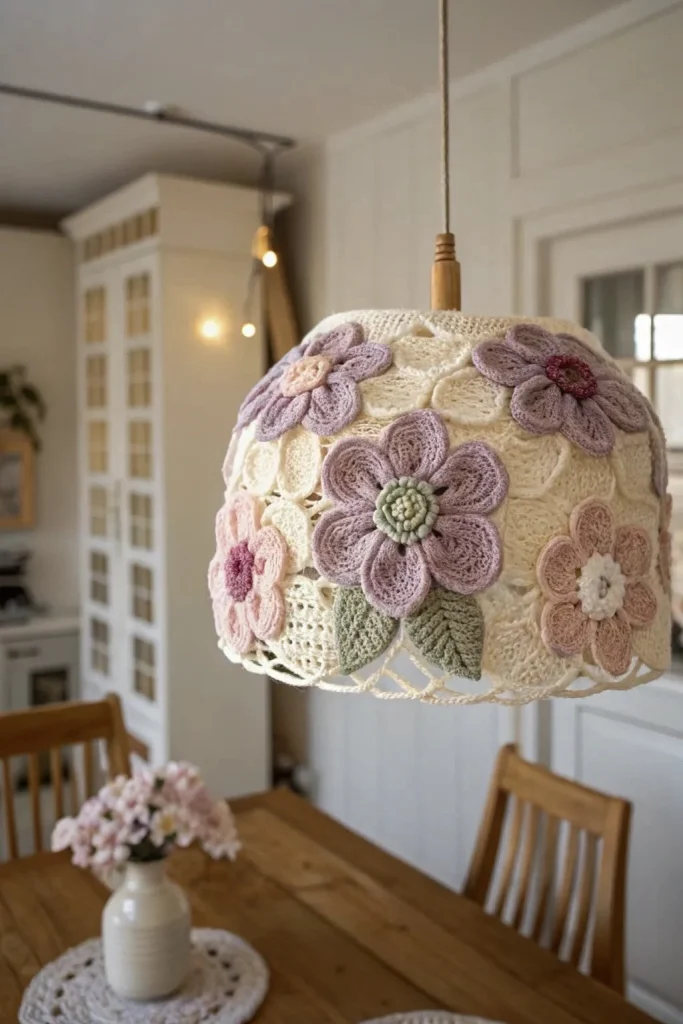
This floral crochet lampshade pattern combines an ivory lace cover with oversized dusty lilac flowers, smaller blush blooms and softly raised sage leaves. The flowers overlap the open background, while an ivory lattice finishes the lower edge. It is inspired by the rounded floral pendant shade in the reference photograph.
The cover is worked separately and fitted to a purpose-made lampshade frame. Individual oval petals, textured centers and veined leaves give the surface its depth. Allow approximately 25–35 hours for crocheting, blocking and hand sewing; this advanced project suits makers comfortable with shaped lace, working around foundation chains and fitting crochet to a rigid structure.
Materials
- Sport-weight matte cotton, approximately 160 m per 50 g Ivory 200 g; dusty lilac 100 g; blush pink 50 g; sage green 25 g; muted berry 15 g; pale cream 15 g. Quantities include a margin for swatches and sewing.
- Crochet hooks 3.0 mm for cover, petals and leaves; 2.5 mm for centers.
- Purpose-made tapered lampshade frame Approximately 25 cm top diameter, 33 cm bottom diameter and 25 cm vertical height, with rounded shoulders if available; sloping side approximately 25.3 cm.
- Compatible pendant fitting and cool-running LED bulb Use a frame and fitting rated for a textile shade; follow their clearance and wattage requirements.
- Ivory cotton twill tape Approximately 2 m, 6–10 mm wide, for wrapping the top and bottom rings.
- Strong ivory sewing thread, tapestry needle and sewing needle For frame attachment and discreet motif stitching.
- Stitch markers, tape measure, rustproof pins and blocking mat Use removable markers at the six shaping points.
- Scrap cotton ties For temporary fitting with the lamp disconnected.
Abbreviations
chchainsl stslip stitchscsingle crochethdchalf double crochetdcdouble crochettrtreble crochetinc2 sc in the same stitchMRmagic ringst / stsstitch / stitchesspspaceRSright sideWSwrong sideFLOfront loop onlyBLOback loop onlypcpopcorn: work 5 dc in one stitch, remove hook, insert through first dc, retrieve dropped loop and pull through; counts as 1 stitchUS crochet terminology is used. Instructions in parentheses followed by a number are repeated that many times. Joining slip stitches and lifting chains do not count unless explicitly stated.
Gauge, Dimensions and Construction
- Mesh gauge after washing and blocking: 7 mesh units and 9.5 rounds per 10 cm, using the 3.0 mm hook. One mesh unit is 1 dc plus its following ch-1 space. Measure across a relaxed swatch, without stretching the chains.
- Make a swatch: ch 31. Row 1: dc in fifth chain from hook, then (ch 1, skip 1 chain, dc in next chain) 13 times. The first four chains represent the first dc and ch-1 space; there are 15 dc and 14 spaces. Rows 2–12: ch 3, turn; (ch 1, dc in next dc) 14 times. Measure over the central spaces and rows.
- Petal gauge: approximately 22 sc and 24 rounds per 10 cm with the 3.0 mm hook. A large oval petal should block to approximately 6.5–7 cm long and 3.5–4 cm wide; a small petal approximately 5.5–6 cm long.
- The cover has 54 mesh units at the top and 72 at the bottom. At gauge, its relaxed circumferences are approximately 77 cm and 103 cm. These stretch slightly over frame circumferences of approximately 78.5 cm and 103.7 cm.
- Work the cover from top to bottom in joined rounds without turning. Six evenly distributed increases on each shaping round add six mesh units. The 24 mesh rounds measure approximately 25.3 cm along the slope; check the actual frame before adding the lower edging.
- Make 3 large lilac flowers, 2 small blush flowers, 1 small ivory flower, 6 sage leaves and 12 ivory background leaves. Position the most prominent lilac flower at the front, with two sage leaves beneath it.
Ivory Mesh Cover
- Foundation: with ivory and the 3.0 mm hook, loosely ch 108. Check for twists and join with sl st to the first chain. The foundation must stretch comfortably around the top ring.
- Round 1: ch 4, counting as the first dc and ch-1 space; skip the next foundation chain, then (dc in next chain, ch 1, skip next chain) 53 times. Join to the third chain of the starting ch 4. There are 54 dc and 54 ch-1 spaces: 54 mesh units.
- Round 2: ch 4; work (dc in next dc, ch 1) 53 times. Join to the third starting chain. 54 mesh units. All subsequent dc are worked into dc, skipping the intervening chain space.
- Round 3: repeat Round 2. 54 mesh units.
- Round 4, shaping: ch 3, counting as the first dc; work (ch 1, dc, ch 1) in the same first dc to make the first doubled mesh unit. Then work (dc in next dc, ch 1) 8 times. Repeat the following five times: (dc, ch 1, dc, ch 1) in next dc, then (dc in next dc, ch 1) 8 times. Join to the third starting chain. 60 dc and 60 spaces: 60 mesh units.
- Round 5: ch 4; (dc in next dc, ch 1) 59 times; join. 60 mesh units.
- Round 6: repeat Round 5. 60 mesh units.
- Round 7, shaping: ch 3; (ch 1, dc, ch 1) in the same first dc, then (dc in next dc, ch 1) 9 times. Repeat the following five times: (dc, ch 1, dc, ch 1) in next dc, then (dc in next dc, ch 1) 9 times. Join. 66 mesh units.
- Round 8: ch 4; (dc in next dc, ch 1) 65 times; join. 66 mesh units.
- Round 9: repeat Round 8. 66 mesh units.
- Round 10, shaping: ch 3; (ch 1, dc, ch 1) in the same first dc, then (dc in next dc, ch 1) 10 times. Repeat the following five times: (dc, ch 1, dc, ch 1) in next dc, then (dc in next dc, ch 1) 10 times. Join. 72 mesh units.
- Round 11: ch 4; (dc in next dc, ch 1) 71 times; join. 72 mesh units.
- Rounds 12–24: repeat Round 11 for each round. 72 mesh units per round. Fasten off after Round 24. The mesh contains 144 alternating dc and chain-space positions around its lower edge.
Upper Binding and Lower Lattice
- Upper binding, Round 1: with the cover upright, join ivory to the unused underside of any foundation chain. Ch 1; sc once into each of the 108 foundation chains. Join to first sc. 108 sc.
- Upper binding, Round 2: ch 1, sc in each stitch; join. 108 sc. Fasten off with a long sewing tail.
- Lower lattice, Round 1: join ivory to any dc of mesh Round 24. Ch 1, sc in the same dc; (ch 5, skip the next ch-1 space, next dc and next ch-1 space, sc in the following dc) 35 times. Ch 5 and join to first sc, skipping the final space, dc and space. 36 sc anchors and 36 ch-5 arches.
- Lower lattice, Round 2: sl st into the first three chains of the first arch to reach its midpoint. Ch 1, sc in that arch; (ch 5, sc in next arch) 35 times; ch 5 and join to first sc. 36 anchors and 36 arches.
- Lower lattice, Round 3: sl st into first arch; ch 1. Work 5 sc in each of the 36 arches, leaving the anchoring sc unworked. Join to first sc. 180 sc. Fasten off. This border hangs approximately 2 cm below the lower frame ring.
Large Lilac Petals — Make 18
- Use dusty lilac and the 3.0 mm hook. Work around both sides of the foundation chain in joined rounds. Ch 10.
- Round 1: sc in second chain from hook and in next 7 chains; 3 sc in last chain. Rotate the work; sc in the next 7 unused chain loops, then 2 sc in the same chain that holds the first sc. Join. 20 sc. Place a marker in the first stitch and keep the starting position unchanged.
- Round 2: ch 1; inc in first stitch, sc in next 7, inc in next 3, sc in next 7, inc in last 2. Join. 26 sc.
- Round 3: ch 1; (sc in next stitch, inc in next stitch), sc in next 7, (sc in next stitch, inc in next stitch) 3 times, sc in next 7, (sc in next stitch, inc in next stitch) 2 times. Join. 32 sc.
- Round 4: ch 1; working BLO, sc in each stitch. Join. 32 sc. Fasten off, leaving a 35 cm tail.
- With RS facing, fold the end nearest the beginning of the rounds into a shallow pleat. Sew together the first and last 3 edge stitches at that end. This forms a narrow petal base while leaving the opposite end rounded. Keep the pleat approximately 1 cm deep.
Small Petals — Make 18
- Make 12 in blush and 6 in ivory with the 3.0 mm hook. Ch 8.
- Round 1: sc in second chain from hook and in next 5 chains; 3 sc in last chain. Rotate; sc in next 5 unused chain loops, then 2 sc in the same chain that holds the first sc. Join. 16 sc.
- Round 2: ch 1; inc in first stitch, sc in next 5, inc in next 3, sc in next 5, inc in last 2. Join. 22 sc.
- Round 3: ch 1; (sc in next stitch, inc in next stitch), sc in next 5, (sc in next stitch, inc in next stitch) 3 times, sc in next 5, (sc in next stitch, inc in next stitch) 2 times. Join. 28 sc.
- Round 4: ch 1; working BLO, sc in each stitch. Join. 28 sc. Fasten off with a 30 cm tail. Pleat and sew the base as for a large petal.
Textured Flower Centers — Make 6
- Use the 2.5 mm hook. Make one sage, two berry and three pale cream centers. All centers are flat appliqués; do not stuff them.
- Round 1: 6 sc in MR. Tighten and join. 6 sc.
- Round 2: ch 1; inc in each stitch. Join. 12 sc.
- Round 3: ch 1; (sc in next stitch, inc in next stitch) 6 times. Join. 18 sc.
- Round 4: ch 1; working FLO, (pc in next stitch, sc in next 2 stitches) 6 times. Join. 18 stitches, including 6 popcorns. Push popcorns toward the RS.
- Round 5: ch 1; (sc in next 2 stitches, inc in next stitch) 6 times. Join. 24 sc.
- Round 6: ch 1; (pc in next stitch, sc in next 2 stitches) 8 times. Join. 24 stitches, including 8 popcorns. Fasten off with a 40 cm sewing tail.
- For the sage center only, use pale cream to embroider six small straight stitches radiating around the central ring. Keep the stitches short enough to sit between the raised popcorns. Centers should measure approximately 3.5–4 cm across after blocking.
Veined Leaves — Make 18
- Make 6 sage leaves and 12 ivory leaves with the 3.0 mm hook. Ch 13. Work around both sides of the chain.
- Round 1: sc in second chain from hook, hdc in next chain, dc in next 3 chains, tr in next 3 chains, dc in next 2 chains, hdc in next chain; work (sc, ch 2, sc) in last chain. Rotate; hdc in next unused chain loop, dc in next 2, tr in next 3, dc in next 3, hdc in next, sc in next. Join to first sc. 24 stitches and one ch-2 tip space.
- Round 2: ch 1; working BLO, sc in next 11 stitches, inc in next stitch; work (sc, ch 2, sc) in tip space; inc in next stitch, sc in remaining 11 stitches. Join. 28 sc and one ch-2 tip space.
- Round 3: ch 1; sc in each of the first 14 stitches, (sc, ch 2, sc) in tip space, sc in remaining 14 stitches. Join. 30 sc and one ch-2 tip space. Fasten off with a 40 cm tail.
- Surface vein: with RS facing and matching yarn, bring a loop through the foundation chain near the rounded base. Surface sl st along the 12-chain central spine toward the pointed tip. Fasten off on the WS without tightening the vein.
- Embroider four diagonal straight-stitch veins on each side of the central spine. Work each vein through the fabric only, stopping one stitch short of the edge. Leaves should measure approximately 7–8 cm long.
Flower Assembly and Motif Layout
- Block all petals and leaves flat before assembly. For each large flower, arrange six lilac petals radially, with pleated bases overlapping inside a circle approximately 3 cm across. Sew the overlapping bases together. Finished large flowers measure approximately 13–14 cm across.
- Make two blush flowers and one ivory flower in the same way, using six small petals per flower. Aim for approximately 11–12 cm across. Keep the petals slightly cupped rather than pressing them flat.
- Sew the sage center to one large lilac flower, a berry center to another large lilac flower and a pale cream center to the remaining large lilac flower. Give one blush flower a berry center and the other a pale cream center. Use the final pale cream center for the ivory flower. Sew around each center twice through the petal bases.
- Mark the cover seam as the back. Choose a front point halfway around the cover. Locate flowers by their center positions, measured down the sloping mesh from its upper edge.
- Place the sage-centered lilac flower at the front, approximately 13 cm down. Place the other two lilac flowers approximately 7 cm down and 14 cm to either side of the front center, measured around the cover.
- Place the blush flowers approximately 19 cm down and 20 cm to either side of the front center. Place the ivory flower at the back, approximately 12 cm down. Allow neighboring petals to overlap without pulling the mesh.
- Place two sage leaves beneath each large lilac flower, points directed downward and outward. Distribute the 12 ivory leaves between flowers, alternating their direction to create a soft, overlapping background.
- Temporarily tie the cover onto the frame, then baste the motifs in place. Remove the cover to sew. Attach ivory leaves first, followed by sage leaves and then flowers. Sew through mesh dc posts wherever possible. Catch each flower at its center, each petal base and one point near each petal tip; leave the rest of each edge free for relief.
Finishing
Wash and block the mesh cover to the frame’s measured circumferences and approximately 25.3 cm along its slope, excluding the hanging lattice. Let it dry completely. Wrap both frame rings with cotton twill tape, overlapping the tape ends by 2 cm and sewing them securely. Keep the fitting and its ventilation openings clear.
With the lamp disconnected, slide the cover over the frame. Align the upper binding with the top ring and mesh Round 24 with the bottom ring, leaving the lattice below it. Divide each edge into quarters and secure those points first. Sew the upper binding to the wrapped top ring through every second sc, giving 54 attachment points. Sew each of the 72 dc posts in mesh Round 24 to the wrapped lower ring. Keep the cover evenly tensioned and its seam at the back.
Weave in all yarn ends on the inside of the crochet, trim loose fibers and check that no strand extends toward the socket. The frame must support the shade through its own fitting; crochet must never carry the electrical fitting or suspend the frame. Have the finished shade installed according to the fitting manufacturer’s instructions, and check that all required bulb clearances remain open.
Tips for Success
- Mark all six increases on each shaping round. Each sector gains exactly one mesh unit, keeping the taper balanced.
- Block the mesh before permanently sewing on flowers. Dense appliqués can conceal a cover that is too short or too narrow.
- Stagger the petal tips when overlapping flowers so the ivory background remains visible between the lilac and blush blooms.
- Use a light touch on surface veins. A tight central vein folds the leaf and shortens it enough to change the layout.
- Fit the cover with temporary ties before final sewing; check both the front view and the back for sagging under the flowers.
Common Mistakes to Avoid
- Counting the starting ch 4 as two dc adds an extra mesh unit. It represents one dc and one chain space; join into its third chain.
- Increasing into chain spaces changes the shaping distribution. On shaping rounds, work both dc of each doubled unit into one existing dc.
- Skipping the extra stitches at the beginning end of an oval makes petals pointed at both ends. Mark the first stitch and follow the three increases around each rounded end.
- Sewing only the flower centers allows petals to droop. Add the specified discreet tip stitches while leaving most edges free.
- Forcing a mismatched cover onto the frame distorts the mesh. Correct the hook size after swatching or choose a frame matching the stated dimensions.
Ways to Customize This Pattern
- Use mushroom gray in place of lilac and soft oatmeal in place of blush for a quieter neutral shade.
- Make all three large flowers lilac with sage centers to repeat the prominent front flower around the shade.
- Replace the six sage leaves with ivory leaves for a cream-on-cream background while retaining the colored flowers.
- For a shorter hanging edge, omit lower lattice Round 2 and work the 180-sc finishing round directly into the first set of 36 arches.
- For a less dense arrangement, omit the back ivory flower and place its six petals as individual overlapping ivory accents between the remaining blooms.
Frequently asked questions
The written cover is tapered. For a drum frame approximately 33 cm across, begin with 144 chains and work 72 mesh units in every round, omitting all shaping increases. Swatch and measure the drum’s height before choosing the number of even rounds; the written tapered cover will not fit it correctly.
The metal frame holds the shape. The cotton cover is stretched lightly over it and sewn to both rings. Starch is unnecessary and does not replace the frame.
Attach flowers to several dc posts across their full width, including the petal-tip stitches. Secure both cover edges to the frame before judging the final drape. If a flower still pulls, add small matching stitches through adjacent mesh posts beneath its petals.
Disconnect the lamp and remove the frame from its fitting first. For washing, undo the attachment stitches and remove the textile cover from the frame. Hand-wash gently, reshape to the original measurements and dry completely before reattaching. Never immerse electrical components.
Cotton remains combustible. Use only a cool-running LED bulb compatible with the fitting and textile shade, observe the manufacturer’s clearances and wattage limits, and keep the upper opening unobstructed.
The finished Vintage Meadow Floral Crochet Lampshade Pattern